

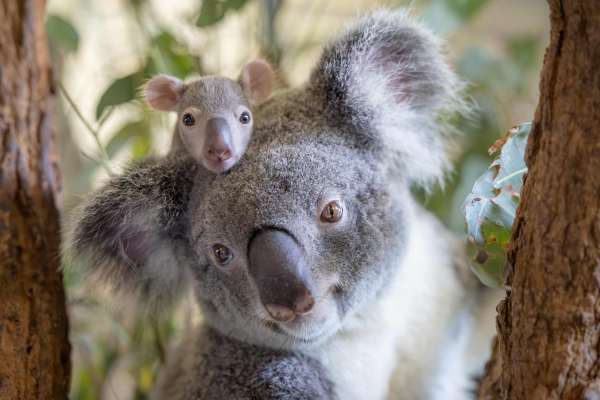
Australia Zoo is pleased to announce the first joey of the season has emerged from her mum’s pouch!
Queenie, an adult koala at Australia Zoo, is the proud mother of a female joey who is slowly settling into her new home with us.
Queenie’s joey is one of eight young koalas to recently join the Australia Zoo family, with the tiny joeys now beginning to peek out from their mothers’ pouches.
Koalas typically give birth to a single joey about the size of a jellybean, which grows inside its mother’s pouch for around six months before beginning to peek out. The joey then spends another four to six months as a “backrider,” clinging to its mum’s belly or back before becoming more independent.
Australia Zoo is proudly committed to a breeding program that helps create an insurance population for these iconic animals, which are sadly struggling in the wild.
Wildlife conservationist Terri Irwin said, “Koalas were classed as an endangered species in 2022, and face many threats in the wild, including habitat loss, vehicle collisions, domestic pet attacks, and disease. Our team’s efforts to build a healthy population of koalas at Australia Zoo are critical to ensuring this iconic species survives for generations to come.”
Additionally, the Australia Zoo Wildlife Hospital, a state-of-the-art rehabilitation facility and Wildlife Warriors’ flagship project, plays a vital role in treating sick, injured and orphaned wild koalas, giving them a second chance at life.
Koalas have a highly specialised diet, feeding on eucalyptus leaves, with individuals preferring different species. To support their needs, Australia Zoo maintains thriving eucalyptus plantations to sustainably supply fresh leaf to both its koalas and wild koalas recovering at the Australia Zoo Wildlife Hospital. More than 16,500 trees have recently been planted and are being carefully nurtured to ensure a long-term sustainable food supply.
“Conservation is at the heart of everything we do here at Australia Zoo. We are delighted to share these beautiful animals with our visitors and hope that they will be inspired to support our mission to protect them for future generations,” said Terri.











