

There comes a point in every industry, usually after a few shocks and a fair bit of denial, when the conversation changes.
Not the words, mind you. The words stay reassuringly familiar. Collaboration. Innovation. Transition. You’ll hear all of those again when SMM 2026 opens in Hamburg this September.
But listen a little more closely this year, and there’s something else underneath it all. A shift in tone. A quiet acknowledgement that the balance of influence in global shipping is moving and not by inches.
Asia isn’t knocking on the door anymore. It’s already inside, rearranging the furniture.
Claus Ulrich Selbach of Hamburg Messe und Congress said it with the sort of measured confidence you’d expect from a man who has watched this show evolve over decades.
“The SMM brings together the strengths of both regions: Asia as a dynamic driver of growth and Europe as a leader in innovation and technology, supported by clear regulatory frameworks for the maritime transition.”
It’s a tidy line. But behind it sits a rather untidy reality.
The industry has been forced to grow up
Shipping, for all its global reach, has always had a slightly old-fashioned rhythm. Deals done over long lunches. Change is introduced carefully, sometimes reluctantly. A preference for what worked yesterday over what might work tomorrow.
Then came the disruptions.
Supply chains faltered. Energy costs surged. Environmental targets stopped being optional. And suddenly, the industry that prided itself on stability found itself scrambling to keep up.
That tends to focus the mind.
What we’re seeing now and what SMM 2026 will quietly confirm is an industry learning to collaborate not because it sounds good, but because it has to.

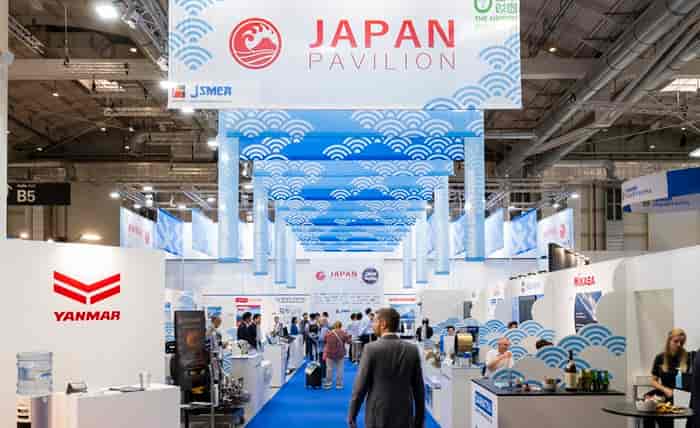
India’s maritime rise fuels global collaboration dialogue. – @ Hamburg Messe und Congress/ Rene Zieger
Asia’s rise feels different this time
Asia has been the engine room of maritime growth for years. That’s not new.
What is new is the confidence and the intent.
India’s decision to arrive with its first official national pavilion is telling. It’s not just about visibility; it’s about signalling that the country wants a seat at the grown-up table, not a spot on the sidelines.
Korea continues its steady expansion, increasing its presence by around 15 per cent. No fuss, no drama, just a consistent belief that showing up matters.
Japan, as ever, does things its own way. A 13 per cent increase in exhibition space might not sound dramatic, but coupled with a 22 per cent expansion of its national pavilion, it speaks volumes. Less talk, more substance.
And then there’s Southeast Asia, Indonesia, Malaysia, and Vietnam, edging into the conversation. Not yet dominant, but no longer invisible either.
If you’ve been around long enough, you’ll recognise the pattern. This is how influence builds quietly, then all at once.
Europe still sets the rules for now
For all the momentum shifting east, Europe remains the place where many of the rules are written.
Decarbonisation frameworks. Alternative fuel standards. Regulatory pathways that, like it or not, shape how the rest of the world operates.
It gives Europe a certain gravity.
And it’s precisely why SMM matters.
For Asia-Pacific companies, this isn’t just a trade show. It’s a proving ground. A place to test technology, read the regulatory mood, and, perhaps most importantly, build relationships that can withstand the inevitable bumps ahead.
Because in this industry, trust still counts for something.
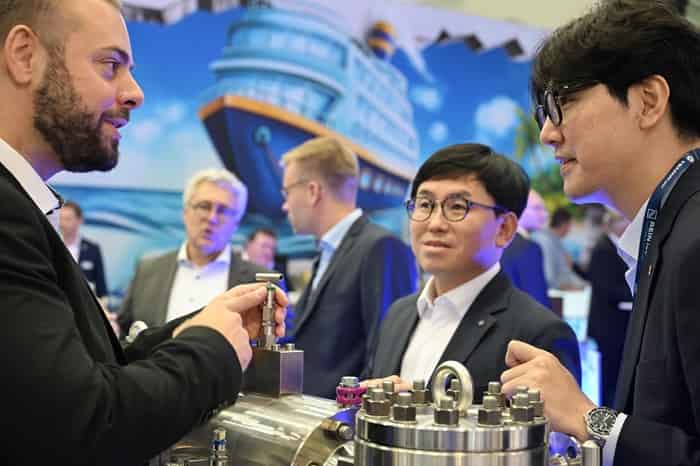
Deal-making and innovation drive Asia-Europe maritime partnerships. – @ Hamburg Messe und Congress / Rene Zieger
Hamburg: still the room where it happens
There’s a moment at SMM, usually somewhere between the formal sessions and the quieter conversations, when you realise how much is actually being decided.
More than 2,200 exhibitors. About 50,000 participants. A swirl of languages, agendas and ambitions.
And yet, for all the scale, it often comes down to something quite simple: who’s talking to whom, and what they’re willing to do next.
Deals aren’t always announced with fanfare. Sometimes they’re sketched out over coffee, refined over dinner, and signed months later.
But the direction is set here.
A convergence that can’t be ignored
What’s unfolding goes beyond geography.
Shipping is colliding with energy. Digital systems are weaving their way into operations. Infrastructure investment is accelerating, particularly across Asia, where governments and private players alike are betting heavily on the future.
Europe, in turn, is supplying the frameworks and technologies that make those investments viable over the long term.
It’s not always neat. It’s rarely straightforward. But it’s undeniably happening.
And SMM sits right in the middle of it.
So what does it all mean?
If you strip away the formalities, the speeches, the carefully crafted messaging, you’re left with something rather human.
An industry under pressure, adjusting in real time.
Old hierarchies are softening. New players stepping forward. Long-standing relationships are being tested and, in many cases, strengthened.
There’s a certain energy to that. Not the overused “buzz” of marketing brochures, but a quieter sense that things are shifting in ways that will matter.
SMM 2026 won’t solve everything. No trade show ever does.
But it will, as it has done for years, provide a snapshot of a moment where you can stand back and see where the industry is heading.
And this time, the view is unmistakable.
Asia isn’t just part of the story anymore.
It’s helping write the next chapter.
Further information: SMM Hamburg official website.
by Octavia Koo – (c) 2026.
Read Time: 5 minutes.
About the Author.
 Octavia Koo arrived in Australia in the early eighties with little fuss and a good eye. Sydney suited her. At UNSW, she studied Arts, then found her footing in graphic design before drifting, quite naturally, into the digital side of things, building websites and shaping words that made people want to stay.
Singapore followed, and with it, the fast pace of tourism platforms and ITB Asia. Long before SEO became a buzzword, Octavia understood how stories travelled online. That’s where she met Stephen, and the seed for something more was planted.
A few years later, she joined Global Travel Media.
Today, Octavia works with quiet assurance, blending art, instinct and experience to produce stories that don’t shout; they simply work and linger.
==============================











