

There’s a certain quiet confidence about Singapore Airlines. No chest-thumping, no grandstanding, just numbers laid out neatly on the table and the unmistakable sense that someone, somewhere, knows exactly what they’re doing.
The SIA Group’s latest full-year result is one of those moments.
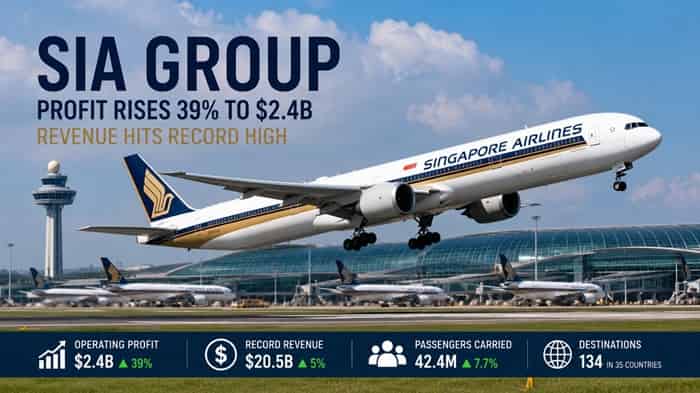
Operating profit climbed a handsome 39 per cent to $2.375 billion for the year ended 31 March 2026, riding on the back of record revenue of $20.5 billion. In an industry that still has a habit of lurching between feast and famine, that’s not just a good result, it’s a composed one.
And composition, in aviation, counts for a great deal.
Full planes, firmer yields and no apologies
Start with the obvious. People are flying again, not tentatively, but with intent.
SIA and its low-cost stablemate Scoot carried 42.4 million passengers across the year, up 7.7 per cent. More importantly, those passengers weren’t rattling around half-empty cabins. Load factors pushed up to 87.7 per cent, a figure that airline planners tend to regard with quiet satisfaction.
Traffic growth outpaced capacity, always a welcome imbalance and yields edged higher. Not dramatically, but enough to matter. Aviation margins are built on such increments, and SIA has long understood that the small levers are often the most powerful.
Cargo, meanwhile, did what cargo tends to do in these cycles, softened at the edges. Revenue slipped slightly on weaker yields, though volumes held up well enough to avoid anything more than a polite disappointment.
Fuel: the gift that keeps taking
Fuel, of course, remains the industry’s most unpredictable companion.
For the year just gone, SIA enjoyed a modest tailwind. Net fuel costs fell 6.7 per cent, helped by lower average prices and some tidy hedging outcomes. That provided a useful buffer against rising non-fuel costs inflation, capacity growth and the general expense of running a global airline in 2026.
But if that sounds like good news, it comes with an asterisk the size of a boarding pass.
Geopolitical tensions in the Middle East have already pushed fuel prices sharply higher, and as any seasoned airline executive will tell you, these things rarely resolve themselves quickly. The lag effect means much of that pain is yet to fully land. FY2026/27 may well be where the bill arrives.
Profit up, but context matters
On paper, net profit dropped by 57.4 per cent to $1.184 billion. That figure has already raised a few eyebrows in the more excitable corners of the market.
A calmer reading tells a different story.
Last year’s result included a one-off, non-cash accounting gain of $1.098 billion linked to the Air India–Vistara merger. Strip that out, and the comparison becomes far less dramatic. Add in SIA’s increased share of losses from Air India, now accounted for across a full year, and the decline starts to look less like deterioration and more like arithmetic.
In other words, the engine is still running smoothly.
A balance sheet with backbone
If there’s one area where SIA continues to separate itself from the pack, it’s the balance sheet.
Shareholders’ equity rose to $17.3 billion. Debt fell by $2.3 billion. The debt-equity ratio eased to 0.62. These are not the numbers of an airline scrambling to keep its footing; they’re the numbers of one preparing for its next move.
Cash reserves sit at $7.9 billion, even after significant spending on aircraft, dividends and debt repayment. There’s also $3.3 billion in undrawn credit lines, the sort of financial cushion that turns volatility from a threat into an opportunity.
Airlines don’t often get described as conservative. SIA, quietly, is.
Growth, but with purpose
Fleet and network expansion continue, though without the breathless urgency seen elsewhere.
The Group now operates 218 aircraft with an average age of just under eight years, a modern, efficient fleet by any measure. New deliveries during the year included Boeing 787s and 737-8s, while fresh orders for Airbus A320neo family aircraft signal a steady eye on future growth.
The network spans 134 destinations across 35 countries, with Scoot doing much of the exploratory work, adding secondary cities, testing demand, and opening new traffic flows.
SIA, by contrast, is sharpening its long-haul edge. More flights to London, increased services to Manchester, and the introduction of Madrid later this year all point to a deliberate strengthening of its European footprint.
And then there’s Australia, never far from SIA’s thinking. The decision to operate daily flights to Western Sydney International Airport from late 2026 suggests a clear view: the Australian market still matters, and will for some time yet.
Partnerships: the quiet multiplier
Behind the scenes, SIA continues to build its web of partnerships not loudly, but effectively.
Expanded codeshare arrangements with Air India now cover 82 destinations. Collaborations with Malaysia Airlines, Vietnam Airlines, and All Nippon Airways are deepening, while joint ventures edge closer to reality.
It’s a familiar strategy: extend reach without overextending capital. In a capital-intensive business, that’s not just prudent, it’s essential.
The product still matters
In financial engineering and network strategy, SIA hasn’t forgotten what built its reputation in the first place: the experience on board.
New long-haul cabin products are slated for late 2026, alongside upgrades to the KrisWorld system, enhanced dining, and refreshed amenity kits. Starlink connectivity, arriving from 2027, will bring high-speed Wi-Fi to selected aircraft, a sign that even the most traditional carriers understand the modern traveller’s expectations.
It’s not reinvention. It’s refinement. And SIA has long made a virtue of getting the details right.
Dividends a nod to patience
Shareholders, too, are being looked after.
The Group has proposed a total dividend of 37 cents per share for the year, combining ordinary and special payouts. It’s a reflection of strong cash flow and a balance sheet that can sustain it.
In an industry where profits can be fleeting, returning capital with this level of consistency is a statement in itself.
The view from 35,000 feet
The outlook, as ever, is mixed.
Fuel prices are rising. Geopolitical tensions remain unresolved. Supply chains are still not behaving entirely as they should. None of this is new, but none of it is trivial either.
And yet, SIA enters this next phase with a few advantages that matter: a diversified network, a dual-brand strategy, strong partnerships, and, perhaps most importantly, a culture that favours discipline over drama.
There’s an old aviation saying that the best airlines are the ones that make hard things look easy.
On this evidence, Singapore Airlines is doing exactly that.












