

There are moments in travel when the numbers tell a story, and then there are moments when they practically shout it across the room. Indonesia’s luxury hotel sector is firmly in the latter camp.
Fresh performance data confirms what many industry insiders have suspected for some time: Indonesia’s high-end hotels have not merely recovered from the pandemic, they’ve surged ahead, leaving other segments scrambling to catch up. And if there was any doubt, the conversation at the inaugural Indonesia Tourism Xchange 2026 made one thing abundantly clear: premium travel in Indonesia is not just back, it’s evolving.
Held at the polished surroundings of The Langham, Jakarta, the forum drew more than 400 heavyweights from across hospitality, investment, tourism and real estate. A fitting venue, really, if you’re going to discuss the future of luxury, you may as well do it somewhere that understands the assignment.
Luxury leads the charge comfortably
According to CoStar Group’s hotel analytics arm STR, luxury hotel occupancy across Indonesia has returned to pre-pandemic levels for the 12 months ending March 2026. That alone would be cause for optimism, but the real headline is this: every other hotel category is still trailing, sitting 5.5 percentage points below its former peak.
It’s a telling gap and one that says a great deal about where travellers are putting their money.
Rates, too, have followed suit. Indonesia’s hotel pricing has climbed more than 40% since 2019, driven by a combination of market maturity, rising demand, and a steady pipeline of high-end developments. Since 2023, luxury properties have led the charge in average daily rate growth, with Bali in particular enjoying strong momentum driven by international arrivals and an increasingly diverse set of source markets.
In plain English: travellers are spending again, and when they do, they’re spending well.

From left to right: David Johnson, CEO – Delivering Asia; Matt Gebbie, Director – Pacific Asia, Horwath HTL; Edward Kusma, Director – Harmoni Bali; Sherona Shng, Regional Vice President – Operations, Asia, Langham Hospitality Group; Bill Barnett, Managing Director, C9 Hotelworks; Jesper Palmqvist, Regional Vice President – Asia Pacific, STR
Not just luxury, meaningful luxury
But there’s a twist. Today’s luxury traveller isn’t chasing marble lobbies and identical suites from Singapore to San Francisco. They want something a little less… predictable.
Sherona Shng, Regional Vice President Operations, Asia at Langham Hospitality Group, put it succinctly: luxury guests in Indonesia are seeking “meaning, context, and a sense of place”.
It’s a sentiment that resonates in a destination as culturally layered as Indonesia. The winners, as Shng noted, will be those brands that resist the temptation to standardise and instead lean into the country’s complexity, crafting experiences that feel personal rather than manufactured.
It’s a subtle shift, but an important one. And it explains why some brands flourish here while others quietly fade into the background.
Bali’s branded residences quietly steal the spotlight
If luxury hotels are leading the recovery, branded residences are quietly building the next chapter.
Research from C9 Hotelworks reveals a booming pipeline across Asia, now valued at roughly USD40 billion. Indonesia’s slice of that pie stands at around USD 1.4 billion, hardly small change, and is growing.
Bali, unsurprisingly, sits at the centre of the action.

Indonesia’s luxury hotel occupancy returned to pre-pandemic levels for the 12 months ending March 2026, outpacing other hotel classes and underlining the resilience of high-end travel demand. Source: STR / CoStar
The island now accounts for a quarter of Indonesia’s branded residence market value, with more than 70 active hospitality-managed developments in play. Around 10% of that supply is already branded residences, a figure that continues to rise as developers chase the lucrative intersection of lifestyle and investment.
Canggu and Berawa lead the charge, followed by Uluwatu, Seseh, Pererenan and the ever-reliable Seminyak. Sanur, too, is edging back into the conversation, proof that even established markets can reinvent themselves when the timing is right.
Bill Barnett, Managing Director of C9 Hotelworks, was refreshingly direct: branded residences are no longer an add-on, they’re becoming a primary driver of luxury real estate demand.
And he’s not wrong. The appeal is obvious: brand trust, aspirational living, and a destination that sells itself. The challenge, as Barnett pointed out, lies in aligning those elements across a country as diverse and nuanced as Indonesia.
Growth, yes, but smarter this time
If there was a unifying theme at ITX 2026, it was this: growth alone is not enough.
Matt Gebbie, Director – Pacific Asia at Horwath HTL, framed it neatly, noting that Indonesia’s opportunity lies in “smart growth”. It’s a phrase that sounds deceptively simple but carries weight.
Investors today are no longer chasing volume for volume’s sake. They’re looking for clarity on destinations, on segments, on concepts that will actually perform. Luxury hotels, in particular, face heightened expectations around returns, differentiation and long-term viability.
That means sharper decision-making, deeper market understanding, and perhaps a little less blind optimism than in years gone by.
A sector finding its rhythm again
Sessions throughout the day, ranging from hotel performance trends to sustainability, design, and technology, painted a picture of an industry that is not just recovering, but recalibrating.
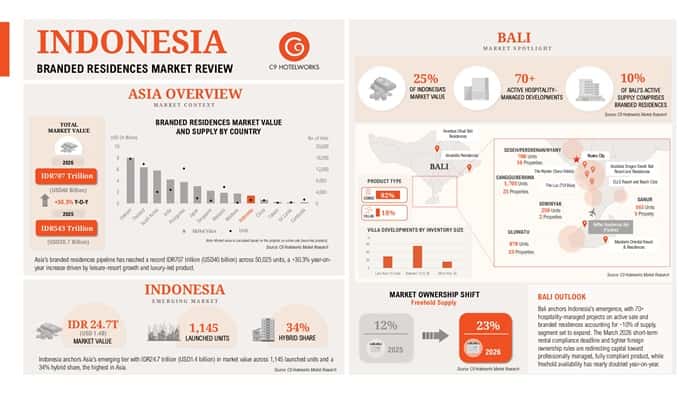
Branded residences have grown rapidly across Asia, with Bali now accounting for 25% of Indonesia’s branded residences market value. Source: C9 Hotelworks Market Research, 2026
Executives from across the sector, including leaders from Marriott International, ARTOTEL Group, and Banyan Group, explored how data, culture and innovation are shaping the next phase of Indonesia’s tourism story.
There was talk of technology, naturally. Of leadership, inevitably. And of sustainability, increasingly unavoidable. But beneath it all ran a quieter narrative: Indonesia is rediscovering its footing not by rushing forward, but by choosing its steps more carefully.
The bigger picture
For all the statistics and panel discussions, the takeaway is rather straightforward.
Indonesia’s luxury travel market is no longer playing catch-up. It’s setting the pace.
That’s good news for operators, investors and, ultimately, travellers who stand to benefit from a more thoughtful, more distinctive, and arguably more interesting version of luxury.
And if ITX 2026 is anything to go by, the industry is well aware of both the opportunity and the responsibility that comes with it.
After all, in a market as rich and varied as Indonesia, success has never been about doing more.
It’s about doing it better.
by Michelle Warner – (c) 2026.
Read Time: 6 minutes.
About the Author.
 Michelle Warner has always carried stories the way others carry passports lightly, faithfully, and with purpose. She learned her craft in newsrooms, shaping sentences with care, before swapping deadlines for departures as a flight attendant with some of the world’s great airlines. Years aloft sharpened her eye for character and deepened her fondness for the small, dignified rituals of travel, the quiet kindness of strangers, the poetry of arrival, the patience learned between time zones.
Now grounded by choice, Michelle has come home to writing with the same calm authority she once brought to turbulent cabins. Her prose blends an editor’s discipline with a traveller’s wonder, tinged with humour and reverence for the golden age of travel. Each piece feels like a handwritten boarding pass, gracious, observant, and unmistakably alive.











