

There is nothing like an oil-price spike to sharpen an airline executive’s pencil. For decades, aviation has lived by the barrel and, on bad days, looked as if it might die by it, too.
Fuel costs have shaped routes, fares, margins and, occasionally, corporate funerals. Now, as geopolitical shocks rattle global energy markets, sustainable aviation fuel, or SAF, is being recast as more than aviation’s green conscience. It is becoming a strategic insurance policy.
Fresh analysis from IDTechEx argues that SAF must now be viewed through the lens of energy security, not merely emissions reduction. The firm says rising oil prices show fossil fuels carry risks beyond climate damage, particularly for an industry so exposed to fuel volatility.
For airlines, that is a rather important distinction. Climate responsibility may win applause. Supply certainty keeps aircraft flying.
SAF has long been considered the most practical near-term pathway to decarbonising aviation because it can be used in existing aircraft and airport fuel systems. That matters in a sector where replacing fleets is not quite as simple as trading in the family Holden.
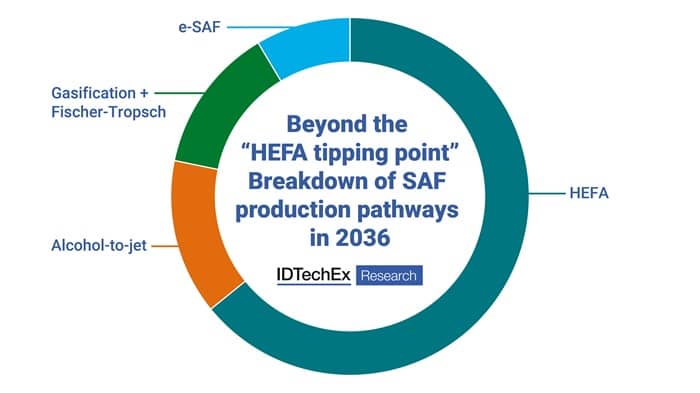
The leading SAF pathway today is HEFA, short for Hydroprocessed Esters and Fatty Acids. It turns waste oils and fats, including used cooking oil, into lower-carbon aviation fuel. IDTechEx identifies HEFA as a major contributor to early SAF growth, partly because it is currently among the lowest-cost SAF production routes.
But HEFA has limits. Used cooking oil does not flow like crude from a supergiant oilfield. Feedstock supply is finite, and some regions remain dependent on imports. That creates an awkward truth: a fuel designed to reduce dependency can still find itself tied to global trade flows.
For now, HEFA will do much of the heavy lifting. But aviation cannot afford to put all its fuel in one tank.
That is why attention is turning to other pathways, including alcohol-to-jet, which converts bioethanol into aviation fuel, and gasification combined with Fischer-Tropsch synthesis, which can turn waste streams into usable fuel. These technologies remain costly, but they offer a broader feedstock base and, crucially, more resilience.
IDTechEx expects the sustainable fuel landscape to become far more diverse by 2036, with aviation moving beyond what the industry calls the “HEFA tipping point”.
Then there is e-SAF, the polished but expensive child of the family. Made from captured carbon dioxide and green hydrogen, it could one day offer vast scalability without the same biological feedstock constraints. The catch, as ever, is price. An independent analysis cited by Energy Intelligence has placed e-SAF production costs well above those of the HEFA and Fischer-Tropsch routes.
Still, history has a habit of making yesterday’s luxury tomorrow’s necessity. Europe’s SAF mandates and incentives are already helping create demand, with IDTechEx noting that UK and EU rules have introduced binding blending targets.
The lesson for aviation is plain enough. Volatility is expensive. Dependence is risky. And resilience, like a good aircraft maintenance schedule, is best arranged before something goes wrong.
SAF will not solve aviation’s fuel problem overnight. It remains costly, constrained and unevenly supplied. But the current oil shock has changed the argument. SAF is no longer simply the industry’s environmental homework.
It is fast becoming aviation’s bid for control.
by My Thanh Pham – (c) 2026.
Read Time: 3 minutes.
About the Author.
 My Thanh Pham has lived more of a life of travel than most people ever do. After studying tourism, she went straight into the work of building journeys across South-East Asia, temples, beaches, night trains, and all, quietly fixing the messy bits so others could enjoy the ride.
She was never meant to stay behind a desk. Airline life followed, dividing her days between reservations and the airport floor, right where travel shows its true colours. Missed flights, tight hugs, frayed tempers, sudden joy, she saw it all, close up.
Now at Global Travel Media, My Thanh has traded ticket stubs for a keyboard. She writes the way she once worked: steady, clear-eyed and respectful of the road’s unpredictable rhythm, guiding readers through a world she knows from the inside.











