

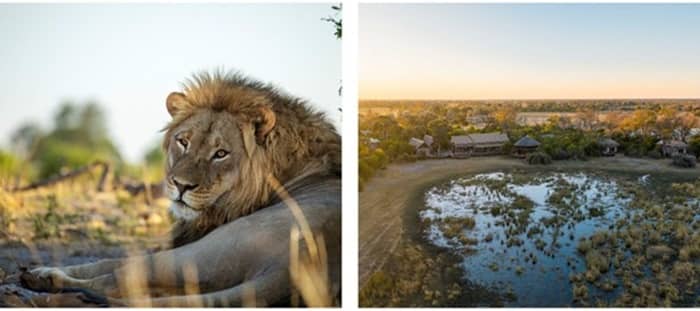
Anniversaries in the travel game can be a bit like hotel refurbishments, polished, well-lit, and occasionally missing the point. But every now and then, one comes along that deserves a closer look.
African Bush Camps’ 20th birthday is one of them.
Founded in 2006 by Zimbabwean guide Beks Ndlovu, the company didn’t set out to become a heavyweight in the safari world. It set out to do something far simpler and far more difficult. To build a business that respected the land, backed its people, and still delivered a safari worth travelling halfway across the globe for.
Two decades on, that original brief hasn’t been quietly shelved in favour of growth charts and expansion decks. If anything, it has become the business.
And that, in today’s tourism climate, is no small feat.
From Hwange Dust to Regional Muscle
The story starts, as these things often do, with one camp and a fair bit of belief.
Somalisa Camp, tucked into Hwange National Park, was the first stake in the ground. No grand rollout, no sprawling portfolio, just a carefully considered lodge in one of Africa’s great wildlife areas.
From there, African Bush Camps has expanded with a steady hand rather than a heavy footprint. Today, it operates across Botswana, Zambia and Zimbabwe, with properties set in places that do most of the talking themselves, the Okavango Delta, the Lower Zambezi, and the elephant-rich plains of Hwange.
What’s notable is not just where they’ve gone, but how they’ve gone about it. Growth has been deliberate, almost old-school in its restraint. No rush to plant flags everywhere. No temptation to overextend.
Instead, the company has built a network that feels joined up, helped along by The Collective, a curated group of partner lodges that allow guests to move across the region without the experience dropping off a cliff halfway through.
It’s a smart piece of thinking. More importantly, it respects the traveller’s time and their expectations.
Luxury, Stripped Back to Its Meaning
There’s a tendency in this industry to confuse luxury with excess. Bigger suites, longer wine lists, more adjectives.
Ndlovu sees it differently.
“For us, luxury is about authentic connection with the wild, experienced as it was meant to be.”
It’s the sort of line that could sound rehearsed in lesser hands. Here, it lands because it’s backed by experience. Ndlovu grew up in the bush, learning to track wildlife and read the land long before he ran a business.
That grounding shows.
“We are not simply running safari lodges,” he says. “We are custodians of wildlife areas and partners to local communities.”
There’s a quiet confidence in that statement. No theatrics. Just a clear understanding of the role tourism can and should play in places like this.
The People Who Carry the Story
If you strip a safari back to its essentials, it comes down to one thing: the guide.
African Bush Camps has built its reputation on getting this right.
Its guides are not imported talent or polished presenters flown in for the season. They are local, deeply rooted in the landscapes they work in, and, crucially, invested in them.
They don’t just point out wildlife. They interpret it. They explain it. They bring context to what might otherwise be just another sighting on a checklist.
The company’s decision to shut down operations for ten days each year to train its entire guiding team speaks volumes. It’s not convenient. It’s not cheap. But it reinforces a simple truth: quality doesn’t maintain itself.
And in a market where travellers are increasingly savvy, that kind of investment shows.
Where Tourism Meets Responsibility
Plenty of operators talk a good game on sustainability. Fewer build it into the bones of the business.
The African Bush Camps Foundation is where the company’s intent becomes tangible. Supporting 39 projects across Botswana, Zambia and Zimbabwe, it focuses on education, healthcare and conservation without overcomplicating the model.
Every guest contributes. Every stay has a knock-on effect.
In 2026, that translates into real outcomes: the rehabilitation of the Ditshiping Clinic in Botswana, a new computer lab at Khwai Primary School, and a library already shaping learning in a remote community.
It’s not flashy work. It doesn’t need to be.
What matters is that it’s consistent and that it’s still there long after the guests have flown home.
A Taste of the Bush, Bottled
Anniversaries tend to invite a bit of experimentation, and African Bush Camps hasn’t resisted the urge entirely.
Enter TALA Gin, developed in partnership with Cape Craft Lab. Distilled using botanicals drawn from the very landscapes the company operates in, wild sage, baobab, and African juniper, it’s positioned as a sensory extension of the safari experience.
“The land tells its own story to those willing to listen, walk, taste and smell,” says Matthew Breech of Cape Craft Lab. “With TALA Gin, we have distilled a transportable memory of Southern Africa.”
It’s a clever idea, and one that fits neatly within the brand’s broader narrative. Not a gimmick, more a quiet nod to place.
Eyes on the Horizon
Looking ahead, the pipeline is measured rather than ambitious for ambition’s sake.
Linyanti Legodimo, set to open in 2027 in Botswana’s Linyanti Reserve, is being positioned as a flagship experience, high-end, tightly curated, and centred on access to one of the region’s most compelling wildlife areas.
Alongside it comes a deeper push into wellness. Not the spa-heavy, cucumber-water variety, but something more grounded in time, space, and a landscape that does most of the heavy lifting.
At Bumi Hills Safari Lodge and Thorntree River Lodge, guests will be encouraged to slow down. A simple idea, but increasingly rare.
Twenty Years, and a Clear Direction
What African Bush Camps has managed, perhaps more than anything, is to avoid the trap that catches many growing travel brands: the slow drift away from what made them relevant in the first place.
It hasn’t tried to be everything to everyone. It hasn’t chased every trend.
Instead, it has stuck, rather stubbornly, to its founding principle: that tourism should leave something behind that matters.
“Over twenty years, we have seen what is possible when conservation, wellbeing, and opportunity align,” Ndlovu says.
It’s not a line built for headlines. But it is one built for longevity.
And in this business, that’s what counts.
Discover authentic, conservation-led safaris at: https://africanbushcamps.com.
by May Marclay – (c) 2026.
Read Time: 6 minutes.
About the Author.
 May Marclay’s career hasn’t followed a straight line, and she’s better for it. She began in real estate, then moved into hospitality, finding her rhythm with Centara in the Maldives. There, she worked the Asian markets the old-fashioned way: building trust, closing deals, and turning conversations into lasting business.
The UAE sharpened its focus. At IHG, supporting an Area General Manager, she saw the machinery of a major travel hub from the inside, no gloss, just how things actually get done.
Now, with her sights set on healthcare, May brings a broader lens than most. She speaks three languages, reads widely, travels with intent, and writes with the calm assurance of someone who understands both the detail and the bigger picture without needing to say so too loudly.











