

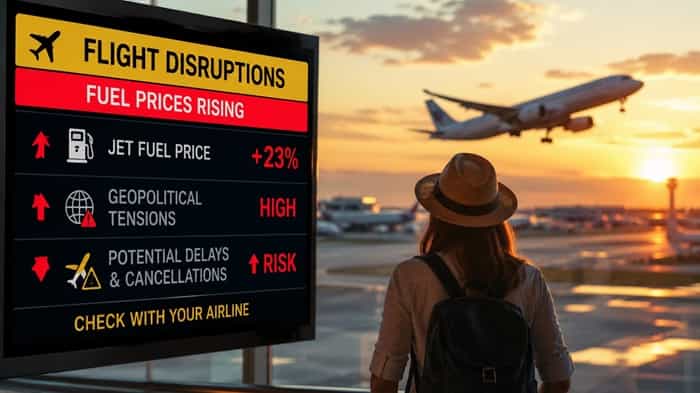
If the past few summers have taught travellers anything, it’s this: pack patience alongside your passport. And now, with aviation fuel prices climbing and geopolitical tensions simmering just enough to keep airline planners awake at night, a familiar unease is creeping back into the departure lounge.
The question, doing the rounds quietly at first, now with growing insistence, is whether flights themselves are at risk.
According to insights from travel eSIM provider Saily, online searches for flight cancellations, airline safety, and travel disruptions have ticked up notably in recent weeks. It’s not quite panic stations, but it’s certainly not the carefree optimism the industry would prefer heading into peak travel season.
At the centre of this conversation is Vykintas Maknickas, who offers a dose of calm, albeit with a realistic edge.
“People often assume that rising fuel prices immediately mean flights will stop operating, but that’s usually not how airlines react,” he says. “In most cases, airlines adjust through higher ticket prices, route changes, longer flight paths, or reduced frequencies rather than canceling entire operations. But for travelers, even small disruptions can create a lot of stress.”
It’s a point worth dwelling on. Airlines, after all, are remarkably adept at absorbing shocks up to a point. They hedge fuel, tweak schedules, and shuffle aircraft around like seasoned chess players. But those adjustments rarely happen invisibly. They ripple outward, and it’s the passenger who feels the tremor.
A More Cautious Traveller Emerges
What’s changing perhaps more fundamentally is traveller behaviour.
The modern holidaymaker is no longer simply hunting for the cheapest fare. Instead, there’s a quiet recalibration underway. Direct flights are back in favour. Short layovers, once the darling of bargain hunters, are being treated with suspicion. Travel insurance, that often-neglected afterthought, is suddenly enjoying renewed attention.
It’s less about fear and more about control.
After several bruising years marked by strikes, staffing shortages, and weather-related chaos, travellers have learned sometimes the hard way that the system doesn’t always bend in their favour. The result is a more measured, pragmatic approach to planning.
What Could Change This Summer?
If fuel prices remain stubbornly high and there’s little to suggest they won’t, passengers can expect a handful of familiar pressures to resurface:
- Higher ticket prices, particularly for last-minute bookings
- Reduced flight frequencies on marginal routes
- Longer travel times as airlines reroute around restricted airspace
- Congestion at major international hubs
- More frequent schedule adjustments during peak periods
None of this amounts to a collapse of the system. But it does mean the journey may feel a touch less seamless than the glossy brochures promise.
Maknickas puts it plainly: “Even when flights continue operating normally, uncertainty changes how people prepare for trips.”
And that preparation is becoming increasingly deliberate.
The New Rules of Travel
The seasoned traveller of 2026 looks a little different from their pre-pandemic counterpart. There’s less blind faith, more quiet contingency planning.
Among the practical steps gaining traction:
- Boarding passes and hotel confirmations saved offline
- Avoidance of tight connections, especially in busy hubs
- Regular monitoring of airline updates before departure
- Backup payment methods are tucked safely away
- Key travel documents stored digitally and securely
- Extra buffer time is built into every stage of the journey
It’s hardly glamorous, but it is effective. And in an environment where even minor disruptions can cascade into larger inconveniences, that margin for error can make all the difference.
A Season of Adjustment, Not Alarm
For all the noise, it’s worth keeping perspective. There is no credible suggestion that international air travel is on the brink of widespread shutdown. Airlines remain resilient, demand remains strong, and the global appetite for travel shows no sign of fading.
What is changing is the texture of the experience.
Rising costs and geopolitical complexity are quietly reshaping how airlines operate and how passengers respond. The result is a travel landscape that demands a little more foresight, a little more flexibility, and, perhaps, a little less romance.
Still, the planes will fly. They always do.
The difference this summer is that travellers will board them with eyes wide open, wiser, warier, and, in their own understated way, better prepared for whatever the skies may bring.
by Maysa Punchanit – (c) 2026.
Read Time: 3 minutes.
About the Author.
 Maysa Punchanit has never waited for life to become easy. She’s far too practical for that. Instead, she’s built her path the way many strong women do, step by step, job by job, learning something useful everywhere she’s been.
Her working life has taken her through hospitality, sales, beauty therapy and the fast-moving world of social media, where she partnered with some of Thailand’s best-known companies. Along the way, she discovered a steady voice for blogging, warm, direct and grounded in real experience rather than marketing spin.
Being a single mother sharpened her resolve rather than slowing her stride. If anything, it gave her purpose.
Now with Destination Thailand News and Global Travel Media, Maysa arrives not as a newcomer, but as someone quietly battle-tested, resilient, capable and ready for the next chapter.
=================================











