

There’s a certain irony in the fact that South Australia, arguably the nation’s most quietly confident food state, has had to wait this long for the world’s most famous restaurant guide to knock on the door.
Still, better late than never.
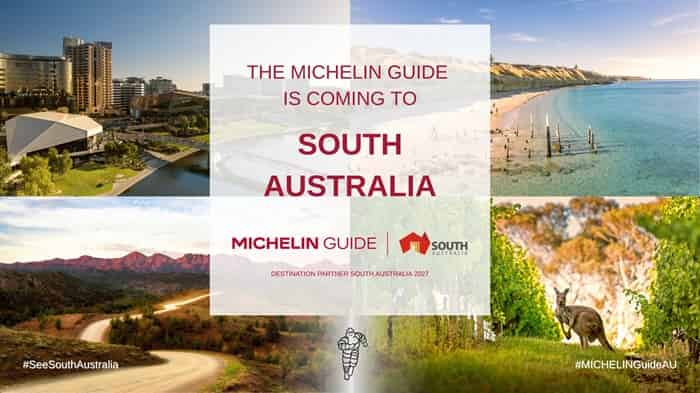
The arrival of the Michelin Guide in South Australia, with its inaugural 2027 selection due to be unveiled in October next year, is less a bolt from the blue and more a case of the global dining establishment finally catching up.
Because anyone who has spent a serious weekend eating and drinking their way from Adelaide through the Barossa, McLaren Vale or the Hills already knows the truth: this place has been ready for Michelin for years.
Not manufactured ready. Not “polished for inspection” ready. Properly ready.
The kind of readiness that comes from generations of growers who understand their soil better than most people understand their own postcode. From chefs who don’t need to shout because the produce does the talking. From a dining culture that has never confused formality with quality.
Gwendal Poullennec, the Michelin Guide’s International Director, put it in more diplomatic terms, noting the state’s “impressive diversity of culinary expressions.” Fair enough. But what he’s really getting at is something simpler: South Australia cooks with confidence.
And confidence, in this game, is everything.

Michelin’s inspectors, famously anonymous and rarely sentimental, were reportedly struck by the region’s authenticity and personality. That’s the sort of language that carries weight. These are not people prone to being swept away by a good view and a clever wine list.
They’re looking for substance. And they found it.
What they would have seen is a food culture that doesn’t sit neatly in a single box. European technique runs deep, thanks to waves of migration that brought Italian, German, and Greek traditions, but it’s been softened, brightened, and occasionally spiced up by Asian influences and a distinctly Australian sense of ease.
Menus here don’t posture. They evolve.
One night, it’s handmade pasta with something pulled straight from the garden. The next, it’s seafood treated with the kind of restraint that only comes when you trust the ingredient completely. And always, somewhere nearby, there’s a glass of wine that makes perfect sense of it all.
That proximity between vineyard, producer and plate is South Australia’s quiet superpower. You don’t need to drive for hours or cross regions to understand the connection. It’s right there, often within the same afternoon.
For travellers, that translates into something increasingly rare: authenticity without inconvenience.
For the state, it’s a golden ticket.
The Michelin Guide doesn’t just hand out stars; it moves markets. Destinations that make the cut see a lift in international attention, higher-spending visitors, and a level of prestige that marketing budgets alone can’t buy.
Tourism Minister Emily Bourke was understandably upbeat, calling the announcement recognition of what locals already know—that South Australia belongs at the top of any serious foodie itinerary.
She’s not wrong. But with recognition comes expectation.
The Michelin effect can be a double-edged sword. It rewards excellence, certainly, but it can also tempt kitchens to chase stars rather than stay true to themselves. The real trick for South Australia will be holding onto its identity, the relaxed confidence, the lack of pretension, while the spotlight intensifies.
If it can manage that, it won’t just impress Michelin. It will outlast it.
Because what makes this place special isn’t something that can be awarded in a ceremony or summed up in a guidebook. It’s the feeling you get sitting at a table where everything, food, wine, and conversation, just fits.
That’s harder to measure. And far more valuable.
Come October 2026, there will be headlines, lists, winners and, inevitably, a few bruised egos. That’s the nature of the beast.
But the bigger story is already written.
South Australia isn’t being discovered.
It’s being recognised.
For operators: now is the time to sharpen your edge, not change your soul.
For travellers: book early, stay longer, and don’t just eat, explore.
by Maysa Punchanit – (c) 2026.
Read Time: 4 minutes.
About the Author.
 Maysa Punchanit has never waited for life to become easy. She’s far too practical for that. Instead, she’s built her path the way many strong women do, step by step, job by job, learning something useful everywhere she’s been.
Her working life has taken her through hospitality, sales, beauty therapy and the fast-moving world of social media, where she partnered with some of Thailand’s best-known companies. Along the way, she discovered a steady voice for blogging, warm, direct and grounded in real experience rather than marketing spin.
Being a single mother sharpened her resolve rather than slowing her stride. If anything, it gave her purpose.
Now with Destination Thailand News and Global Travel Media, Maysa arrives not as a newcomer, but as someone quietly battle-tested, resilient, capable and ready for the next chapter.











