

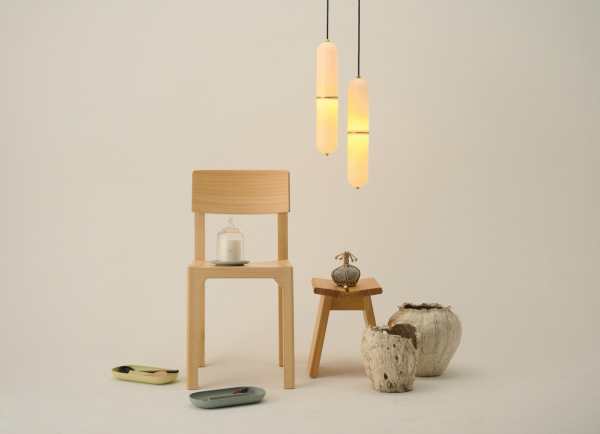
A collaboration between Danish-born writer and producer Jens H. Jensen, who has lived in Japan for over twenty years, and OEO Studio, who are responsible for creating and curating the exhibition, Japanmade presents a carefully chosen selection of Japanese brands that continue to produce locally. These brands support the country’s network of specialised small to medium-sized producers and maintain close relationships between designers and craftsmen.
Jens H. Jensen notes how: “Japan has an extraordinary wealth of both design and production capabilities that resonates well with the Nordic and European markets. My idea in launching Japanmade was to create a platform during 3daysofdesign to bring like-minded Japanese brands together and create a destination for anyone excited about Japanese contemporary design.”
OEO Studio has transformed the 75 m² exhibition space into an immersive spatial narrative that reflects the studio’s signature refinement, material sensitivity and cross-cultural fluency. Deeply rooted in two decades of collaboration with Japanese artisans and manufacturers, the exhibition exemplifies OEO Studio’s unique blend of Japanese minimalism and Danish functionality.
Brands participating include New Light Pottery, a lighting studio based in Nara, the ancient former capital of Japan, founded in 2015 by designers Hiroyuki Nagatomi and Chizu. Renowned for sculptural lighting that blends traditional techniques with contemporary form, the studio emphasises minimal design that highlights the natural texture and beauty of its materials. Visitors can explore New Light Pottery’s lamps crafted from Japanese washi paper, glass, ceramics, lacquer-finished brass and marble.
Conversely, MAS showcases furniture rooted in Japanese woodworking expertise and a deep understanding of timber. Launched in 2021 under the design direction of Wataru Kumano, MAS explores new methods and material expressions, exemplified by its debut collection made entirely from Hinoki – Japanese cypress – a softwood rarely used in furniture. MAS is a sub-brand of Karimoku Furniture, one of Japan’s leading furniture manufacturers, with a rich heritage in fine woodworking. Founded in 1940 in Kariya, Aichi, Karimoku Furniture has been committed to high-quality production, with MAS offering manufacturing that draw out the unique charm of diverse wood species through this accumulated expertise.
Naowashi by Gen Taniguchi, a handmade paper workshop in Nao, Saga Prefecture, will showcase its paper products. Naowashi’s products are made entirely from Paper Mulberry – Kajinoki – grown locally in Nao, instead of the typical Paper Mulberry – Kozo – used as the raw material for washi. Kajinoki is longer than Kozo and intertwines easily, producing a paper that is both thin and strong. Taniguchi manages the 300-year-old Naowashi workshop. As the last remaining Japanese paper workshop, Naowashi continues to pass on this traditional craft to future generations.
Sekisaka, a Japanese manufacturer with over 300 years of rich craftsmanship in the Kawada district of Sabae City, Fukui Prefecture, will present refined objects that reinterpret traditional craftsmanship using modern materials. Fukui Prefecture is renowned for its Echizen Urushi lacquerware. During a period of significant economic growth, the lacquerware industry shifted from traditional handcrafted wooden Urushi lacquerware to mass-produced commercial lacquerware. Drawing on centuries-old lacquerware techniques, Sekisaka creates timeless pieces that honour the past while meeting contemporary lifestyle needs.
Sheep will display its artisanal soybean candles, crafted with carefully selected natural ingredients, which contain virtually no harmful substances. Its main materials are high-quality soy wax, pure essential oils, and cotton wicks. Soy candles produce less soot and fewer harmful substances, making them suitable for use in your room, even during meals. Each candle is made by hand, and the fragrance blending, labelling, and packaging all take place in its own workshop in Nagoya City, Aichi Prefecture.
Material intelligence is a unifying thread that runs throughout the exhibition. From solid brass, ceramics, washi paper, and glass that develop character over time to the innovative use of Japanese cypress by MAS – the pieces on show demonstrate a commitment to longevity, tactility, and technical mastery.
With a professional relationship with Japan spanning over twenty years, OEO Studio’s involvement extends beyond exhibition design. Japanmade is a natural continuation of a longstanding cultural exchange that has influenced the Copenhagen-based practice since its earliest days, allowing the studio to bring its dialogue with Japan home to its city.
Thomas Lykke, Head of Design and Co-Founder of OEO Studio, reflects: “The essence of Japan is deeply embedded in our studio and philosophy, holding equal significance to our Scandinavian origins. Our professional connection with Japan began 20 years ago, and from the very beginning, we felt a strong bond that has developed into wonderful new ventures, such as the Japanmade initiative with our long-standing friend Jens H. Jensen, whom we first met during our inaugural visit to Japan.”
Anne-Marie Buemann, Managing Partner and Co-Founder of OEO Studio, adds: “Our shared passion for design, craftsmanship and Japanese culture drives this initiative. We pursue it with enthusiasm and curiosity, aiming to promote a love for Japan through a fresh perspective – one that honours its traditions while being curated with the discerning eye and narrative of an editor.”
As Copenhagen becomes the epicentre of the international design scene each June, Japanmade positions OEO Studio and Jens H. Jensen at the forefront of a meaningful cultural exchange. Anchored by a carefully curated roster of Japanese brands – including New Light Pottery, MAS, Naowashi, Sekisaka and Sheep – the exhibition brings together diverse yet interconnected approaches to materiality, craft and contemporary production. Combining Jensen’s two decades of experience in Japan with OEO Studio’s longstanding cross-cultural practice, Japanmade fosters a thoughtful dialogue between two design nations linked by restraint, precision and material integrity, viewed through a distinctly Danish perspective.











