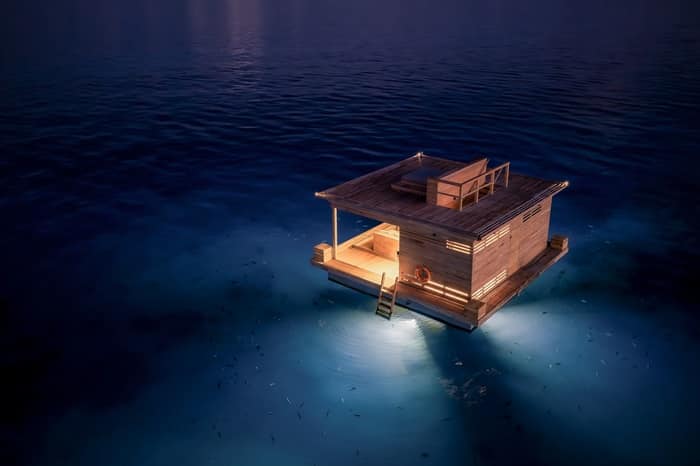
There are luxury hotels, there are bucket-list hotels, and then there are hotels that calmly sink beneath the Indian Ocean and decide conventional tourism is simply too shallow.
Welcome back to The Manta Resort on Tanzania’s spectacular Pemba Island, where the next chapter of underwater tourism has officially surfaced or more accurately, submerged.
The resort this week unveiled its newly reimagined Underwater Room, a bold third-generation evolution of one of the world’s earliest underwater accommodation concepts. Perched in the crystalline waters of the Pemba Channel, the new structure offers guests front-row seats to one of East Africa’s richest marine ecosystems without needing to wrestle into a wetsuit or argue with a stubborn snorkel.
And unlike many tourism gimmicks that arrive with more hype than substance, this one carries a serious conservation heartbeat beneath its steel frame.
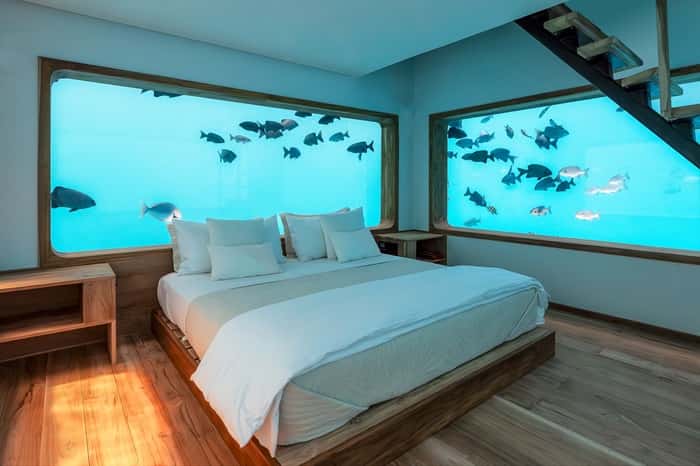
The submerged bedroom of the Underwater Room at The Manta Resort features floor-to-ceiling ocean windows on three sides, offering unobstructed views of the surrounding coral reef and marine life.
The original Manta Underwater Room, launched in 2013 and widely celebrated as one of the world’s most unique hotel experiences, has now been fully submerged into the nearby reef system. Rather than being dismantled or discarded, the retired structure has been thoughtfully integrated into the marine environment within the resort’s protected replenishment area, where it will continue to serve as an artificial reef, supporting ocean biodiversity.
That, in many ways, says everything about the philosophy behind this project.
The newly launched underwater suite has been developed by Genberg Underwater Hotels, drawing on more than a decade of operational experience gained from the original concept. Improvements include upgraded marine-grade steel construction, advanced corrosion protection suited to tropical conditions, enhanced panoramic underwater viewing panels, and refined climate-control systems designed to deliver both comfort and long-term durability in a demanding marine environment.
In short, this is less “novelty fish tank with a bed” and more sophisticated ocean engineering with room service.
The floating multi-level accommodation includes an underwater bedroom beneath the surface and an above-water lounging and viewing deck where guests can watch the sun melt into the Indian Ocean while reef fish continue their nightly business downstairs.
Importantly, the project’s ambitions stretch well beyond tourism brochures and Instagram envy.
Through collaboration with the tourism division of Blue Alliance, all proceeds generated by the Underwater Room are directly channelled into coral reef restoration, environmental monitoring, sustainable fishing initiatives and community livelihood programs across the region.
In an era where “eco-tourism” is too often slapped onto projects with the environmental credibility of a plastic straw, The Manta Resort appears determined to prove that tourism can still be both commercially successful and environmentally responsible.
“The underwater room has shown that a very small footprint can still create meaningful impact,” said Matt Saus, CEO and co-founder of The Manta Resort.
“This project has always been about more than just creating a unique place to stay. It shows how tourism and innovation, when carefully managed, can contribute to protecting marine ecosystems and supporting coastal communities.”
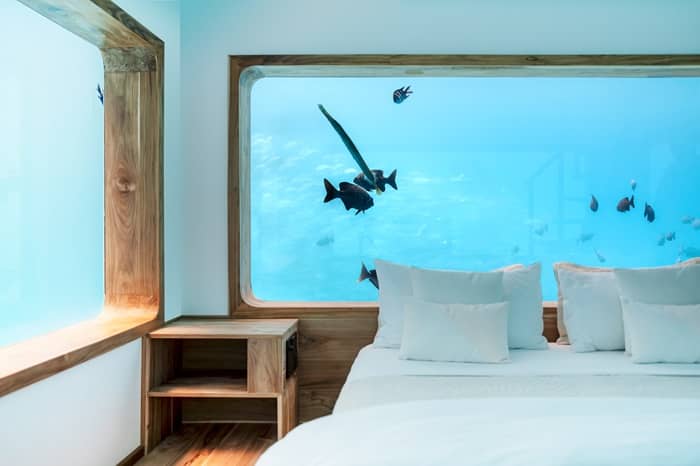
Tropical fish swim past the bedroom window of the Underwater Room at The Manta Resort, where guests sleep three metres below the surface of the Indian Ocean.
That message matters.
The Pemba Channel, located in the western Indian Ocean between mainland Tanzania and Pemba Island, is regarded as one of East Africa’s most ecologically significant marine corridors. The surrounding reefs support extraordinary biodiversity, migratory species and local fishing communities whose livelihoods have depended on these waters for generations.
For travellers increasingly seeking meaningful experiences rather than simply ticking destinations off a list, the Underwater Room taps directly into the growing appetite for immersive, conservation-conscious tourism.
It also arrives at a fascinating moment for global hospitality. Luxury travellers are no longer satisfied with thread counts and rooftop cocktails alone. They want stories. They want purpose. They want something their neighbour’s Maldives villa cannot casually outdo over Sunday lunch.
Sleeping beneath the sea while contributing to reef restoration rather neatly solves that equation.
And perhaps that is the real genius of The Manta Resort’s underwater vision. It understands that modern tourism cannot merely consume paradise; it must help protect it.
That is a lesson much of the global tourism industry is still struggling to learn.
For now, however, guests visiting Pemba Island can simply enjoy one of the world’s most remarkable hotel experiences: drifting gently above the Indian Ocean while tropical marine life glides silently past the bedroom window.
Frankly, it beats arguing over buffet breakfast times.
For more information, visit The Manta Resort Official Website.