

It is possible to have a fulfilling visit to Rome without going anywhere near the Colosseum, Palatine Hill, the Pantheon, or the Trevi Fountain. Rome is full of hidden gems that would be stars of an itinerary in most other places, but are often overlooked in favour of the more famous attractions here. While the majority of tourists head into central Rome to see the admittedly wonderful sights in that part of the city, savvy visitors head farther from the centre toward the Galleria Borghese, a stately palace now a private art gallery. Entrance here is limited to a small number of people at any one time, making it a place where civility reigns and one of the most pleasant museum experiences in Rome. Galleria Borghese is set on expansive grounds that were once the private domain of the villa, but are now a public park known as Villa Borghese.
-

- Piazza Mincio in Rome’s Quartiere Coppedè
-

- Inside the Keats-Shelley Memorial House
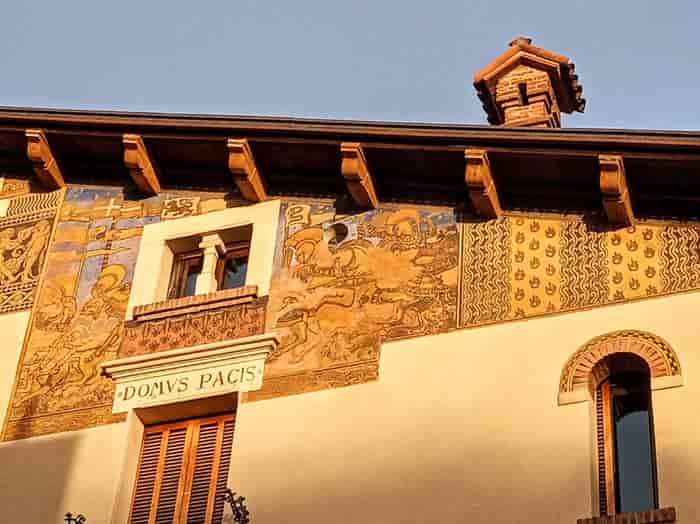
Close to the Galleria Borghese is the interesting Quartiere Coppedè. A tranquil neighbourhood devoid of tourists, the Coppedè district is home to a series of eclectic architectural marvels, constructed in a variety of styles to create what was, at the time (1910s), an avant-garde residential area. It remains unique to this day. A pair of palaces joined by a stone bridge announce the start of a district where individual villas of artistic merit are meant to be appreciated by the discerning eye, most notably along Via Tagliamento, Via Brenta, and other streets radiating from the elaborate fountain centrepiece of picturesque Piazza Mincio.
Completely unnoticed by the selfie-takers on the Spanish Steps is the Keats-Shelley Memorial House at their base. A lovely townhouse honouring Romantic poets John Keats and compatriot Percy Shelley, two giants of literature among the many British writers who traded the UK for Italy in search of inspiration. The Keats-Shelley House is now a small museum evoking a more genteel era when poetry was rather more appreciated than it is today. Straight ahead from the Keats-Shelley House is the glamorous Via dei Condotti, one of Rome’s most fashionable shopping streets, showcasing the best of Italian fashion and design.
-
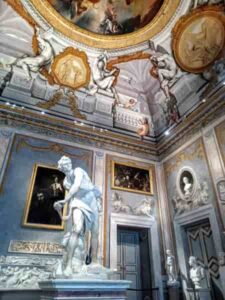
- Inside the Galleria Borghese
-

- Inside the Hendrik Christian Andersen Museum
Close to the popular Piazza del Popolo is the Hendrik Christian Andersen Museum, virtually unknown even among Romans, but it is well worth a visit to the splendid atelier of this Norwegian sculptor, who, like so many other creatives, found Rome an alluring place to pursue his work. Farther north of Rome’s city centre lies the Foro Italico, site of this week’s Italian Open tennis tournament—a must-attend event for Italy’s glitterati and assorted other European personalities. The tennis is the ostensible draw, but the unique Pietrangeli Court, surrounded as it is by monumental statuary of brawny athletes in various poses, brings up a match point in favour of visitors who appreciate aesthetics with their athletics. The statues at the Foro Italico are different in style from the allegorical pieces in Andersen’s atelier; although also monumentally imposing, the sculptures here seem as if they will come to life at any moment. The Foro Italico complex, which also includes the larger Stadio Centrale tennis stadium, the Stadio Olimpico soccer stadium, and the superb Stadio dei Marmi track with even more statues along its perimeter than the Pietrangeli arena, was built for Rome’s (ultimately unsuccessful) bid to host the 1940 Summer Olympics, an event that did not take place due to World War II. Today, the austere style of that era is personified in these works of art, which constitute an outdoor museum of sculpture. The Foro Italico is, of course, quite busy during the tournament, but the rest of the year it is open to the public.

The Pietrangeli tennis court at Foro Italico, credit Robert La Bua
Whether coming for a whirlwind of cultural stimulation or simply to devour the pastries and ice cream at Gelateria Della Palma, it is best to take Rome’s tempo in stride and adjust to the rhythm of daily life, where the paradox of restaurants closing for lunch leaves the local populace untroubled. As the saying goes, when in Rome, do as the Romans do and enjoy all the eternally attractive city has to offer.
by Robert La Bua – Global Travel Connoisseur – (c) 2026.
Read Time: 4 minutes.
About the Author.
 Robert La Bua is a luxury travel columnist, writer, and television guest renowned for his discerning eye and polished perspective on the finer things in life. For over 14 years, he has contributed to Destinations of the World News, the United Arab Emirates’ leading luxury travel magazine, where his byline is synonymous with elegance, insight, and excellence.
As the writer of the Global Travel Connoisseur column, Robert reports on exceptional destinations, premium flights, five-star hotels, and extraordinary experiences tailored for the most affluent of travellers. With an unerring taste for quality and a truly global perspective, his work continues to inspire those who believe travel should always be an occasion.
==================================











