

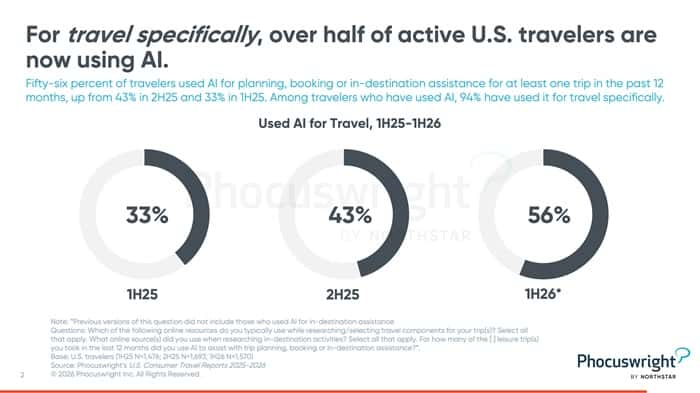
The travel industry has spent decades chasing the elusive “high-value traveller”, that mythical creature who travels often, spends freely and rarely complains about airline seat pitch. Now, according to fresh research from Phocuswright, the industry may finally have found them.
And surprise, surprise, they are powered by artificial intelligence.
The latest Phocuswright report, The AI Surge: Travel’s Fastest Behavioural Shift in a Decade, reveals that travellers using AI for trip planning and destination support are emerging as tourism’s most lucrative customer segment. They travel more frequently, spend substantially more money and engage more deeply with digital travel tools than travellers who still prefer the old-fashioned method of asking their cousin Barry for hotel advice.
The findings paint a striking picture of a rapidly evolving travel marketplace where AI is no longer a novelty but an increasingly influential travel companion.
According to the report, AI-enabled travellers boast a median household income of US$129,200, comfortably ahead of the US$104,000 median for nonusers. More importantly for the tourism sector, they are packing their bags far more often.
AI users average 3.8 leisure trips annually compared with 2.9 trips among nonusers. Their wallets are travelling further too, with annual leisure travel spending hitting US$4,500 versus US$3,000 for travellers who have not embraced AI tools.
In tourism language, that is not a trend. That is a revenue stream wearing sunglasses and boarding priority.
Mike Coletta, Senior Manager of Research and Innovation at Phocuswright, said the pace of adoption had surprised even seasoned industry observers.
“AI in travel has crossed a critical threshold, moving from experimentation to expectation,” Coletta said.
“What’s striking is not just the scale, but the speed. In a matter of months, usage has surged across every generation, every touchpoint, and every stage of the journey.”
Importantly, Coletta stressed this is not a case of AI bulldozing traditional travel channels into oblivion.
“Yet this is not a story of disruption replacing the old guard,” he said. “It is a story of augmentation, where AI is rapidly reshaping how travelers discover, plan and book, while traditional channels still hold meaningful ground.”
That distinction matters.
For all the hype surrounding generative AI, travel remains deeply human. Travellers still seek reassurance, inspiration and expertise, preferably from someone who knows the difference between a boutique hotel and a backpacker hostel with scented candles.
However, the front door to travel is changing rapidly.
The research found AI travellers use an average of four digital resources when researching and booking trips, compared with just 2.2 tools among non-users. They are also notably younger, averaging 41 years of age compared with 52 among traditional travellers, and they display a far stronger appetite for experimenting with emerging travel technology.
In short, these are digitally confident consumers who expect speed, personalisation and convenience preferably before the coffee arrives.
Eugene Ko, Director of Marketing and Communications at Phocuswright, believes the competitive implications for travel brands are already becoming impossible to ignore.
“AI is already changing where and how travel brands compete, and the impact is measurable,” Ko said.
“We’re seeing it show up in how travelers discover brands, where they engage, and how decisions are ultimately made.”
That shift is creating significant pressure on airlines, hotels, online travel agencies and tourism operators to rethink how they attract and retain customers in an AI-influenced booking journey.
The report also highlights a growing willingness among AI travellers to share personal data in exchange for better recommendations and tailored experiences. They are more open to booking through AI platforms in the future and significantly more likely to pay for premium AI services.
Nearly 40 per cent of AI travellers already subscribe to a monthly AI service, double the broader US adult average of 20 per cent.
For travel marketers, that statistic alone is enough to trigger both excitement and mild panic.
The release of the research comes ahead of Phocuswright Europe 2026 this June, where global leaders from travel, technology and investment sectors will gather to examine how artificial intelligence is reshaping traveller expectations and rewriting competitive strategy.
Coletta believes the implications extend well beyond simple booking behaviour.
“AI’s impact has moved beyond being just behavioral to being economic,” he said.
“At Phocuswright Europe, we will explore how this high value segment is redefining what travelers expect from digital experiences and how the industry can respond.”
One thing already appears certain. The traveller of the future may still want a beach, a boarding pass and a decent breakfast buffet.
But increasingly, they also want an AI assistant helping them choose it all.
by Soo James – (c) 2026.
Read Time: 3 minutes.
About the Author.
 There’s nothing rehearsed about Soo James, and that’s precisely the point. Malaysian by heritage, Sydney by schooling, she arrived at UNSW to study Arts, then took a left turn into IT, not out of ambition, but curiosity. Somewhere among systems and schedules, she worked out what really held her attention: people, language, and the quiet spaces between them.
Writing followed naturally. Travel and lifestyle gave her room to observe, to listen, to notice the details others rush past. Soo writes the way good travellers move, watching the room before admiring the view, catching the gesture before chasing the headline.
At Global Travel Media, her stories don’t shout or sell. They linger. They slow you down, open a door, and gently suggest there’s more to see if you’re willing to look.
===============================











