

For years, corporate travel was viewed as little more than an unavoidable line item on the monthly ledger. Flights booked, hotels charged, receipts filed away somewhere between “important” and “good luck finding that later.”
Not anymore.
In 2026, finance teams are scrutinising every dollar with the enthusiasm of an airport customs officer spotting an undeclared bottle of duty-free whisky. Inflation is biting, geopolitical tensions are rattling airline networks, and fuel surcharges now seem to rise faster than boarding groups on a delayed Friday afternoon flight.
Yet amid the noise of rising fares and unpredictable travel disruptions, another cost has quietly ballooned behind the scenes: fragmented travel payments.
And according to Corporate Traveller, the hidden administrative burden is costing Australian businesses far more than many realise.
The issue has become impossible to ignore. Recent industry data shows “Travel and Expense Management” is now the number one concern for 76 per cent of corporate travel buyers globally, with Australia and New Zealand topping the chart at 78 per cent. Nearly half of those surveyed believe automated expense tracking and reporting will fundamentally reshape travel programs over the next five years.
That shift reflects a broader reality confronting finance leaders across Australia’s SME sector.
Travel spending is no longer simply about finding the cheapest airfare from Brisbane to Melbourne and hoping nobody books business class “by accident.” Finance departments now want tighter controls, cleaner reporting, stronger visibility, and fewer late-night reconciliation headaches.

Tom Walley, Australia-based Global Managing Director – Corporate Traveller
Tom Walley, Global Managing Director of Corporate Traveller, said the expectations of finance teams have changed dramatically.
“There has been a fundamental shift in what finance leaders are asking for,” said Walley.
“It’s not just about getting the best airfare anymore. They want control over spending, visibility into where money is going, and systems that don’t create more work for their teams.”
That operational pain is especially acute for small and medium-sized businesses, where finance departments are often lean and already stretched thin. In many organisations, travel costs spill across personal credit cards, corporate cards, reimbursements and direct billing arrangements like coffee stains across an airport lounge carpet.
Every transaction creates another reconciliation workflow. Every trip generates another collection of receipts, approvals and manual data entry. And every month, finance teams lose hours untangling the mess.
The irony, of course, is that many businesses still think the problem is simply “travel spend” itself, when the real damage often comes from managing the payments behind it.
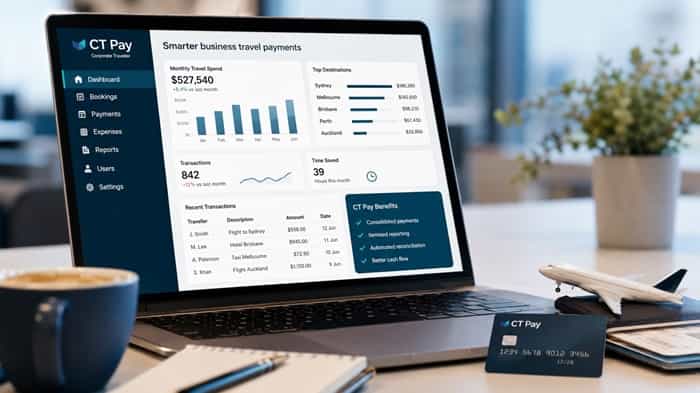
That is precisely the gap Corporate Traveller is now targeting with the launch of CT Pay, a dedicated payment and expense solution designed specifically for business travel.
Rather than scattering costs across multiple payment methods, CT Pay consolidates travel spending into a single dedicated credit account. The platform captures spending at the point of booking and generates itemised monthly statements, complete with traveller details, cost centres, and booking data, ready for direct integration into accounting systems.
In practical terms, it removes one of the great administrative rituals of modern business life: chasing employees for missing receipts after they’ve already forgotten which hotel minibar damage was “client-related.”
It also eliminates reimbursement cycles and removes out-of-pocket travel expenses for employees.
Walley said the company had already seen strong success internally before formally rolling out the solution to the broader market.
“We’ve been running this model successfully for years with a 90 per cent adoption rate in Australia, but now we’re productising it because the market is ready for a dedicated travel payment and expense solution that finance teams actually control,” he said.
“CT Pay solves a problem our customers have been telling us about for years. The last thing they need is to waste hours every month chasing receipts, hotel portfolios, and reconciling credit card statements. It also streamlines the approval process to include both travel and spend.”
There is also a broader financial advantage beyond administrative simplicity.
Businesses can book travel immediately while paying on fixed terms, easing cash flow pressure and reducing the need to tie up working capital simply to keep executives moving between airports.
For finance leaders already juggling rising operational costs, that flexibility may prove just as valuable as the automation itself.
Corporate Traveller’s own customer survey appears to reinforce the appetite for change.
Nearly 7 in 10 finance professionals said CT Pay reduced the number of travel transactions requiring monthly reconciliation. More than 71 per cent reported saving time during monthly reconciliation, while 39 per cent said the platform saved them 5 hours or more every month.
At that point, time-saving becomes particularly significant for companies operating across multiple entities or offices.
Insurance and financial services group Envest discovered exactly how costly fragmented systems had become before adopting CT Pay.
Prior to implementation, the business relied heavily on personal credit cards and multiple disconnected payment systems, creating what the company described as “leakage” and mounting administrative inefficiencies.
Today, Envest has consolidated 29 business entities into a single CT Pay account, processing more than $500,000 in monthly travel spend.
Chris Wright, Head of Procurement at Envest, said the operational difference had been substantial.
“People were buying travel on their personal credit cards and submitting expense claims. There’s a huge admin burden on that,” Wright said.
“We’ve completely turned that around. We now have a single account covering 29 companies. That’s probably 800 to 1,000 transactions a month, and the team is more effective because they’re not stuck doing admin for travel and cost recovery.”
The timing of the launch is hardly accidental.
As corporate travel rebounds across Australia and New Zealand, finance departments are demanding smarter systems rather than simply bigger budgets. The days of accepting fragmented expense management as “just the way travel works” are fading rapidly.
And frankly, few finance managers will mourn the passing of the shoebox full of receipts.
Corporate Traveller says it is now the first Australian travel management company to launch a dedicated payment and expense platform of this kind, with CT Pay available immediately to clients across Australia and New Zealand.
For many businesses, the biggest travel cost may no longer be the airfare itself.
It may be everything happening quietly after the plane lands.
by May Marclay – (c) 2026.
Read Time: 4 minutes.
About the Author.
 May Marclay’s career hasn’t followed a straight line, and she’s better for it. She began in real estate, then moved into hospitality, finding her rhythm with Centara in the Maldives. There, she worked the Asian markets the old-fashioned way: building trust, closing deals, and turning conversations into lasting business.
The UAE sharpened its focus. At IHG, supporting an Area General Manager, she saw the machinery of a major travel hub from the inside, no gloss, just how things actually get done.
Now, with her sights set on healthcare, May brings a broader lens than most. She speaks three languages, reads widely, travels with intent, and writes with the calm assurance of someone who understands both the detail and the bigger picture without needing to say so too loudly.











