

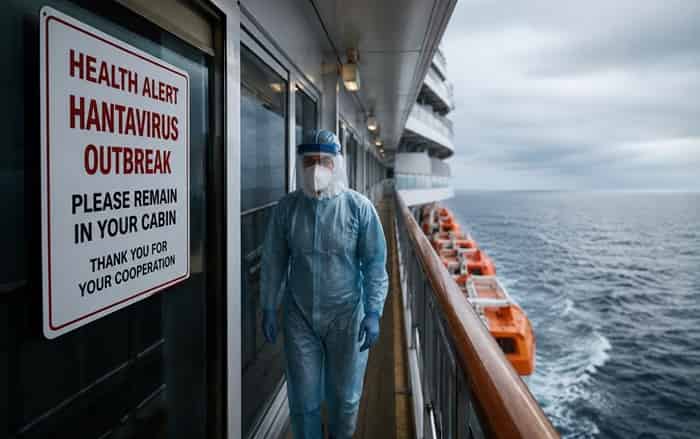
There are a few phrases guaranteed to empty a buffet line faster than “virus outbreak at sea”.
Unfortunately for the 147 passengers and crew currently aboard an expedition cruise ship drifting near Cabo Verde in the Atlantic Ocean, those words are now a grim reality rather than Hollywood fiction.
The World Health Organisation (WHO) confirmed this week that a deadly hantavirus outbreak onboard the vessel has already claimed three lives, with several more passengers falling ill in what is rapidly becoming one of the most closely watched maritime health scares in recent years.
And while authorities believe the initial infections likely occurred before passengers boarded the ship in Argentina, WHO officials have not ruled out the possibility of rare human-to-human transmission onboard.
That single sentence alone would have sent a collective shiver through the global cruise industry.
Because while cruise holidays are traditionally sold on sunshine, cocktails and carefree escapism, infectious disease outbreaks remain the industry’s recurring nightmare, the unwanted stowaway no operator ever wants on the manifest.
Speaking in Geneva, WHO’s chief of Epidemic and Pandemic Preparedness and Prevention, Maria Van Kerkhove, confirmed that seven people have become ill during the voyage.
“One patient is in intensive care in South Africa, although we understand that this patient is improving,” she said.
Two additional patients remain onboard the ship and are now being prepared for medical evacuation to the Netherlands for urgent treatment.
For those still on board, life has become considerably less glamorous than the brochure promised.
Passengers have reportedly been confined to their cabins while disinfection operations and emergency public health measures continue throughout the vessel. Medical teams from Cabo Verde are assisting onboard as authorities race to contain the situation.
Dr Van Kerkhove made it clear the priority is now straightforward and urgent.
“The plan is, and our highest priority is, to medically evacuate these two individuals” to ensure they receive appropriate care, she said.
Thankfully, WHO says there are currently no additional symptomatic cases onboard, although one passenger who earlier developed a mild fever continues to be monitored.
Still, the situation remains deeply unsettling.
Particularly because hantavirus is not your everyday travel bug picked up from questionable airport sushi or one too many ice cubes in tropical cocktails.
Hantaviruses are carried primarily by rodents and can trigger severe respiratory disease in humans. Infection generally occurs through exposure to infected rodents, their saliva, urine or droppings.
In severe cases, patients can deteriorate frighteningly quickly.
“There are no specific treatments for hantavirus other than supportive care,” Dr Van Kerkhove explained.
“Typically, people will develop respiratory symptoms, so respiratory support is really important.”
In some cases, patients require mechanical ventilation and intensive care support, a sobering reminder that even in an era of extraordinary medical advances, nature still occasionally plays by its own brutal rules.
WHO believes the initial infected passengers, a husband and wife who boarded in Argentina, were likely exposed before joining the voyage.
“With the timing of the incubation period of hantavirus, which can be anywhere from one to six weeks, our assumption is that they were infected off the ship,” Dr Van Kerkhove said.
But the plot, unfortunately, thickens.
The expedition cruise reportedly included extensive wildlife observation and birdwatching excursions, including stops at several islands off the African coast known for their significant rodent populations.
“This was an expedition boat,” she explained. “Many of the people on board were doing bird watching and seeing a lot of different wildlife.”
“There could be some source of infection on the islands as well for some of the other suspect cases.”
Then came the sentence no cruise executive ever wants to hear attached to their vessel.
“However, we do believe that there may be some human-to-human transmission that’s happening among the really close contacts.”
To be clear, human transmission of hantavirus is considered rare. Previous outbreaks involving the Andes virus strain, part of the hantavirus family, have shown only limited spread between close contacts.
Even so, “rare” offers little emotional comfort when you happen to be sharing confined quarters in the middle of the Atlantic Ocean.
The ship is now expected to continue towards the Canary Islands, where Spanish authorities are preparing a full epidemiological investigation and complete disinfection process once the vessel docks.
According to WHO, Spain has agreed to receive the ship and assist with passenger risk assessments and ongoing containment measures.
For the global cruise sector, which has spent years rebuilding traveller confidence following the pandemic era, the optics are undeniably uncomfortable.
Cruising has rebounded strongly across international markets, with expedition voyages particularly booming as affluent travellers chase remote destinations and once-in-a-lifetime wildlife encounters.
But this incident serves as a blunt reminder that adventure travel occasionally comes bundled with genuine risk, not just turbulent seas and delayed luggage.
And amid all the clinical briefings, investigations and evacuation planning, perhaps the most human moment came directly from Dr Van Kerkhove herself.
Addressing frightened passengers onboard, she offered reassurance that cut through the medical jargon with rare sincerity.
“We hear you. We know that you are scared,” she said.
“We’re trying to make sure that the ship has as much information as they can…that you’re cared for and of course, that you get home safely.”
At sea tonight, those words probably matter more than any itinerary ever printed.
For further information, visit: https://www.who.int/en or https://news.un.org/en.
by Christine Nguyen – (c) 2026.
Read Time: 4 minutes.
About the Author.
 Christine’s story is one of quiet courage, told without fuss and lived with remarkable grace. She arrived in Australia as a young refugee from Vietnam, carrying little more than hope, family, and a curiosity that refused to be extinguished. Sydney became home, built patiently, brick by careful brick.
She studied Tourism at TAFE and soon found her place in inbound travel, working with one of the city’s leading destination companies. Christine loved showing visitors the Australia that lives beyond postcards, warmer, truer, and far more interesting.
When the sea began to whisper, and life asked for a gentler rhythm, she listened. Designing brochures, writing blogs, she discovered storytelling waiting quietly inside her.
Today, at Global Travel Media, Christine writes with warmth and wisdom, softly and persuasively reminding us why travel still matters.











