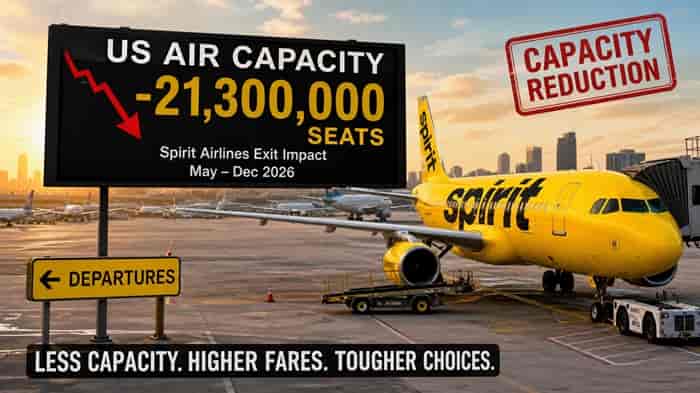
There are moments in aviation when a single announcement doesn’t just ripple, it reshapes the entire map. Spirit Airlines’ decision to cease operations on 2 May 2026 is precisely that sort of moment. Quietly, almost clinically, it removes 21.3 million seats from the United States’ aviation network. In reality, it detonates a sizeable hole in the country’s low-cost travel ecosystem.
Analysis from The Data Appeal Company and Mabrian (part of the Almawave-Almaviva Group) confirms what many in the industry had feared: this is not a minor adjustment. It is a structural surgery without anaesthesia.
Between May and December 2026, Spirit’s disappearance strips out 4.5 per cent of total domestic low-cost capacity in the US. That may sound modest on paper. In practice, it is the difference between a market that hums with competition and one that begins to tighten, sharpen, and inevitably charge more.
A Market Already Running Hot
To understand the significance, context matters. The US aviation sector has spent the better part of the past decade balancing demand surges with operational realities, fuel costs, labour constraints, and infrastructure bottlenecks. Spirit sat squarely in the middle of that equation, acting as both disruptor and pressure valve.
Ranked ninth in total seat capacity for 2026, the airline accounted for 1.4 per cent of overall US connectivity. Again, a seemingly small slice until you consider its role. Spirit wasn’t just another carrier; it was the price anchor. The airline that forced competitors to sharpen their pencils and trim their margins.
With 19.46 million domestic seats scheduled in that May–December window alone, its absence will be felt most keenly where it mattered most: affordability.
As Maria Pradissitto, Market Manager at Data Appeal North America, observed, the low-cost network is set to be “substantially affected.” It is a polite way of saying travellers accustomed to bargain fares may soon find those bargains harder to come by.
Where the Pain Will Be Felt
The impact is not evenly distributed. Far from it.
More than 81 per cent of the lost capacity is concentrated across just 15 major airports. Think of the usual suspects: Florida’s leisure gateways, Fort Lauderdale, Orlando and Miami, alongside the heavy hitters of Newark, LaGuardia, Atlanta and Chicago O’Hare. Add Las Vegas, Dallas-Fort Worth, Houston and Los Angeles to the mix, and the pattern becomes clear.
These are not fringe routes. They are the arteries of American travel.
For destinations such as Myrtle Beach or Charlotte, where low-cost access underpins tourism flows, the consequences could be immediate. Fewer seats mean fewer visitors, and fewer visitors tend to translate into softer local economies, at least in the short term.
The Price of Less Competition
There’s an old truth in aviation: remove capacity and prices rarely fall.
A Data Appeal analyst put it plainly, noting the withdrawal represents “a significant disruption in an already strained connectivity market, driven by rising operational costs, particularly fuel and occurring just as the summer travel season begins.”
Timing in this business is everything, and it’s unforgiving.
The expectation is that other carriers will step in to absorb some of the displaced demand. They always do. But absorption is not the same as replacement. Legacy airlines and even rival low-cost operators do not necessarily replicate Spirit’s pricing model. Nor are they obliged to.
As Pradissitto rightly points out, “affordability and accessibility will be impacted in the short to medium term, particularly for price-sensitive travellers.” Translation: the cheapest seat in the market just became more expensive.
A Familiar Cycle, Repeating
For seasoned observers, there is a sense of déjà vu. Aviation has long moved in cycles of expansion, consolidation, and correction. The disappearance of a low-cost player often signals the end of one chapter and the cautious beginning of another.
What follows is typically a recalibration. Routes are reallocated. Competitors test pricing elasticity. Airports renegotiate realities. And travellers are always adaptable, adjusting their expectations.
Yet something feels different this time. The scale, for one. Twenty-one million seats is not a rounding error. It is a recalibration of national proportions.
What Comes Next
In the near term, expect a tightening of supply on key domestic corridors, particularly leisure-heavy routes. Expect fares to edge upwards, quietly at first, then with more confidence as the market settles.
In the longer term, opportunity emerges. Gaps invite entrants. Whether existing carriers expand aggressively or new players step into the void remains to be seen. History suggests both.
For now, though, the scoreboard is clear: fewer seats, less competition, and a marketplace recalibrating in real time.
And as any seasoned traveller or airline executive will tell you, when the balance shifts this decisively, the effects tend to linger long after the headlines fade.