

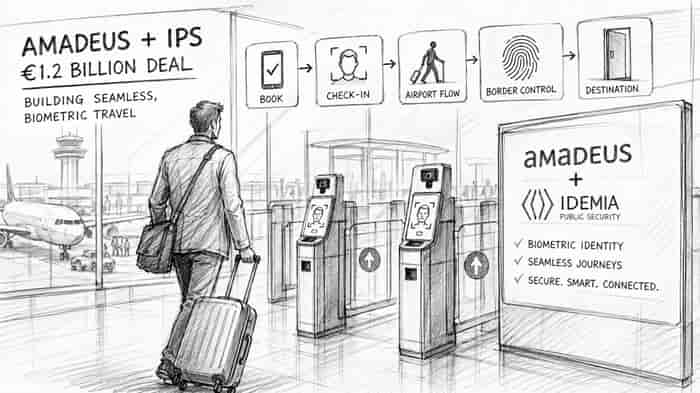
Every so often, a deal lands that doesn’t just shuffle the deck; it quietly changes the rules of the game. This is one of those.
Amadeus IT Group has put €1.2 billion on the table to acquire Idemia Public Security (IPS), and while the headline number will grab attention, it’s the intent underneath that matters more.
Because this isn’t about selling more airline seats or hotel rooms. Amadeus already does that in its sleep. This is about owning the journey itself, every step of it, from the first click to the final border gate nod.
And perhaps, if they get it right, removing the need for most of those steps altogether.
The End of the Airport Shuffle?
Anyone who has shuffled through an airport at peak hour knows the routine. Passport out. Boarding pass ready. Shoes off. Laptop out. Then, just when you think you’re done, another checkpoint, another queue, another polite but weary official asking who you are.
It works. But let’s not pretend it’s elegant.
Biometrics, for all the buzzwords attached to it, offers something refreshingly simple: recognition without repetition.
IPS, no small player, with 3,300 staff and more than 600 clients globally, has spent years refining that capability. From border control systems to secure identity platforms, its technology already sits quietly behind many of the processes travellers barely notice.
Bring that into Amadeus’ ecosystem, and suddenly the dots start to join.
A Strategy Years in the Making
If this feels like a sudden leap, it isn’t.
Amadeus has been circling this territory for some time. The 2024 acquisition of Vision-Box was the first clear signal. This latest move simply doubles down with conviction.
Luis Maroto, President and CEO, laid it out plainly enough:
“This demonstrates further our long-term commitment to biometrics as part of our broader platform strategy. Alongside AI, biometrics is one of the most transformative technologies for delivering fast, convenient, and secure end-to-end traveler journeys.”
There’s a phrase doing a lot of heavy lifting there, “platform strategy.” In practical terms, it means Amadeus doesn’t want to be just another supplier. It wants to be the system everything else plugs into.
Airlines. Airports. Hotels. Border agencies. And now identity itself.
The Quiet Glue Holding It All Together
Decius Valmorbida, President of Travel at Amadeus, sharpened the point:
“In a fast-evolving AI-world the bridging of physical and digital identity will be critical for seamless travel.”
He’s right, of course. Travel has always been a fragmented affair, with different systems, different authorities, and different rules at every turn. What’s been missing is a common thread.
That thread, increasingly, is identity.
Not the paper version tucked inside a passport, but a secure, digital equivalent that moves with you, recognised instantly, verified continuously, and, ideally, never needing to be presented twice.
It sounds straightforward. It isn’t. But it’s where the industry is heading, whether it likes it or not.
More Than Just Speed
There’s a temptation to frame all this as a race for speed, shorter queues, faster boarding, and less waiting.
That’s part of it. But it undersells the bigger shift.
What’s really at stake is trust.
Airports are under pressure. Passenger volumes are climbing. Security expectations are tightening. And somewhere in the middle sits the traveller, hoping the system holds.
Biometrics offers a way through that tension, faster processing, yes, but also stronger verification. Less guesswork, more certainty.
In short, fewer weak links in a chain that has, at times, shown a tendency to fray.
A Bigger Play Than It First Appears
The €1.2 billion price tag might raise eyebrows, but in context, it’s a calculated move.
IPS doesn’t just operate in travel. Its reach extends into government-grade identity systems, access control, and highly regulated environments where accuracy isn’t optional; it’s critical.
That matters.
Because it gives Amadeus something it didn’t fully have before: depth. Not just the ability to connect systems, but to underpin them with trusted identity at scale.
And in a world increasingly shaped by AI and automation, that’s not a bad place to be.
The Long Road to Seamless
Of course, none of this happens overnight.
The deal still needs regulatory approval, with completion expected around mid-2027. Integration, as anyone who has lived through one will tell you, is rarely straightforward.
Systems need to be aligned. Standards need to be agreed upon. Many of the stakeholders need convincing.
But the direction is clear.
Amadeus isn’t just refining the travel experience. It’s attempting to redesign it quietly, methodically, and with a fair bit of capital behind the effort.
The Bottom Line
For travellers, the promise is simple: fewer interruptions, less paperwork, and a journey that feels more like movement than process.
For the industry, it’s something more profound, a shift towards a connected ecosystem where identity flows as freely as the passenger.
And for Amadeus?
Well, it’s a €1.2 billion wager that the future of travel won’t be built on tickets and terminals alone but on something far less visible, and far more powerful.
Recognition.
by Susan Ng – (c) 2026.
Read Time: 4 minutes.
About the Author.
 With the polish of an international hotel professional and the instincts of a born storyteller, Susan Ng learned hospitality where it truly lives behind reception desks, in banquet halls, beside linen carts. She understands that excellence isn’t announced; it’s felt, in the small, quiet gestures that linger long after checkout.
Away from the bustle, her curiosity found a new front desk: the blank page. Her blog, candid and gently wry, drew readers who recognised truth when they saw it. She wrote about grace and imperfection with the steady eye of someone who had lived both.
Today, at Global Travel Media, Susan brings that same warmth and insight to her stories. Expect writing that is polished, generous, and reassuring, like the perfect welcome after a long journey.











