If machines decide, reputations must carry the load.
There’s a quiet shift underway in travel, in the way a tide turns. You don’t always see it at first, but before long, the shoreline looks entirely different.
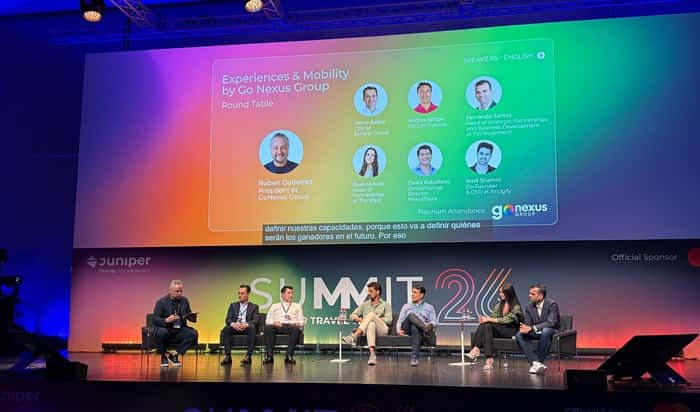
For years, the industry played a familiar game: chase visibility, climb rankings, outbid rivals, and keep the pipeline flowing. That playbook, tried and true, is now looking a little threadbare. At the recent Juniper Summit, held in the polished surroundings of the Palma Convention Centre, a panel of industry insiders made it plain that visibility is no longer the crown jewel. Trust is.
And not the fluffy, marketing-deck kind. The hard-earned, data-backed, customer-validated kind that algorithms can measure, weigh, and quietly reward.
The new gatekeeper doesn’t blink
Moderated by Rubén Gutiérrez, the session on AI and distribution drew voices from across the sector. The message landed early and stayed put.
Andrés Spitzer, CEO of Civitatis, delivered the line that hung in the room like a well-aimed dart: “It’s no longer about who appears first in search results, but about who AI trusts.”
It’s a neat sentence, but it carries a rather inconvenient truth. The old scramble for top-of-page dominance is being replaced by something less visible and far less forgiving. Algorithms are now filtering, ranking, and, crucially, deciding.
And they don’t care for spin.
If your product doesn’t consistently deliver, if your data is messy, if your reviews wobble well, you don’t get a second chance. You simply don’t get shown.
From noise to nuance
Spitzer pointed to something many operators would rather not dwell on: in an AI-mediated world, even the largest inventories can become invisible. Scale alone won’t save you.
What will? Clean, structured content. Genuine customer feedback. A brand that doesn’t promise the moon and deliver a postcard.
Civitatis, with more than five million reviews, is leaning into that reality. Those reviews aren’t just social proof anymore, they’re signals. Signals that machines read as carefully as any traveller scanning a TripAdvisor page over breakfast.
It’s not about shouting louder. It’s about being believed.
Distribution’s unfinished business
For all the talk of transformation, distribution still resembles a jigsaw puzzle tipped onto the floor.
Fernando Santos of TUI Musement offered a measured critique. The industry, he suggested, remains hooked on the quick win, the single conversion, rather than the longer relationship.
“AI allows us to deliver the right product to the right customer at the right time not just once, but multiple times.”
It’s a shift from transactions to continuity. From the one-off booking to the ongoing conversation.
Yet Santos was careful not to lose sight of the obvious. Travel, at its heart, is still human. The greeting at the hotel desk. The guide who knows just where to stand for sunset. The driver who takes the long way round because it’s prettier.
AI might orchestrate the journey, but it doesn’t pour the welcome drink.
Expertise, democratised
On the demand side, David Rebolledo from NexusTours highlighted a subtle but significant shift. The knowledge once locked inside seasoned agents is now being unbundled and delivered at scale.
In practical terms, that means fewer barriers for travellers and fewer excuses for friction.
People expect answers now. Not after five clicks and a comparison chart, but immediately. Preferably tailored. Ideally spot-on.
And once they’ve had that experience, going back feels like swapping a smartphone for a rotary dial.
Big is no longer beautiful
There was a time when having “everything” was the competitive edge. More hotels, more tours, more destinations stack it high and let the customer sort it out.
Amit Shamni of Bridgify offered a tidy correction: “We don’t want to give travellers a library; we want to give them the right book.”
It’s a line worth lingering on. AI doesn’t reward abundance; it rewards relevance.
That thinking is already reshaping how travel is packaged. Dynamic bundles of experiences, stitched together with transport and events, are moving from novelty to the norm. Less catalogue, more curation.
The vanishing interface
If you’ve noticed fewer clicks and more conversations, you’re not imagining it.
Travellers are drifting away from browsing grids and filters, toward chat and voice. They’re not searching, they’re asking.
And when they ask, they expect an answer, not a list.
Spitzer noted that once users grow accustomed to this way of interacting, there’s little appetite to return to the old ways. It’s rather like flying business class, hard to go back to the middle seat.
Beneath the bonnet
Jaime Sastre of Juniper Group framed AI as a three-layer shift.
At the supply end, it trims costs and sharpens operations. In distribution, it speeds up connectivity. And at the orchestration level, it opens the door to smarter cross-selling and contextual recommendations.
In short, it’s not a feature, it’s infrastructure.
Still, Sastre offered a gentle reminder that the industry is feeling its way forward. “The future is not written.” Which is another way of saying: don’t get too comfortable.
Transparency bites both ways
With AI laying options side by side, the spotlight burns a little brighter.
Desiree Kats of Transferz warned that in commoditised sectors, ground transport being a prime example, this transparency tightens margins.
When everything is visible, price becomes the easiest lever.
But not the only one.
Operators who invest in reliability, integration and service quality still have room to manoeuvre. Being cheapest might win the click, but being dependable wins the return.
When machines book for machines
Looking ahead, the notion of AI agents booking travel on behalf of users is no longer science fiction.
Shamni suggested that within two to three years, as much as 15% to 20% of bookings could be handled by AI agents, chatbots or voice systems.
That’s not a tweak, that’s a rewire.
In that world, your customer might not be a person at all, but another system. Which makes structured data, clean integrations and consistent performance not just important, but essential.
And so, back to trust
Strip away the jargon and the architecture diagrams, and one idea keeps surfacing.
Trust.
Spitzer captured it with a line that deserves to be pinned above every product manager’s desk: “We don’t sell experiences we sell memories. And those memories need to be real, repeatable and trustworthy.”
There’s a certain old-world wisdom in that. Travel has always been about the stories people carry home. AI may decide which story gets told, but it can’t make a bad one good.
A familiar plea, newly urgent
In closing, Gutiérrez returned to a well-worn industry theme: fragmentation.
“We are losing too much energy on inefficiencies… If we work together and focus on transparency and integration, the opportunity to grow is enormous.”
It’s a call the industry has heard before. But this time, there’s a twist.
If travel doesn’t sort itself out, the algorithms will sort it out instead.
And they won’t ask politely.