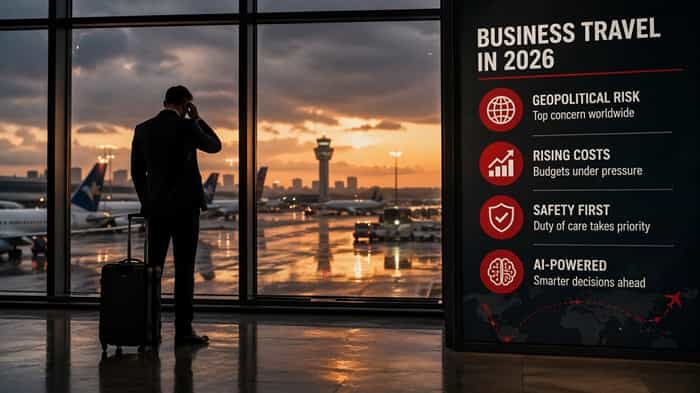
Business travel, it seems, is not packing up and going home. But it is, increasingly, pausing at the departure gate and asking a few more questions before boarding.
That’s the mood captured in the latest snapshot from the Global Business Travel Association (GBTA), and it’s a telling one. The global corporate travel engine is still humming along, flights booked, meetings held, deals pursued, but there’s a noticeable tightening of the grip on the wheel.
Call it caution. Call it maturity. Either way, the industry has stopped charging ahead and started looking over its shoulder.
As Suzanne Neufang puts it, with the sort of understatement seasoned executives favour:
“What we’re seeing is not a broad pullback from business travel, but a more deliberate and carefully managed approach to it.”
Deliberate is a polite word. Careful might be closer to the mark.
The World Has Become the Problem
For years, the business travel conversation revolved around the usual suspects: fares, availability, and a touch of airline brinkmanship. Today, the conversation has taken a more serious turn.
Geopolitics now sits squarely at the top of the worry list, cited by 79% of respondents as the defining risk shaping travel decisions in 2026. In Europe, that concern borders on universal.
And one can see why.
When conflicts redraw flight paths, when regions flicker between accessible and off-limits, and when safety briefings become as important as boarding passes, travel ceases to be routine. It becomes, quite simply, a judgment call.
Half of organisations are already adjusting routes or suspending travel to certain regions altogether. Others are revisiting duty-of-care policies with the sort of attention normally reserved for legal contracts.
This isn’t theoretical. It’s operational.
Confidence Has Left the Building (Quietly)
Back in January, there was a sense, tentative perhaps, that business travel had found its footing again. Not booming, but steady. Predictable enough to plan around.
That sentiment hasn’t lasted.
Global optimism has slipped from 59% to 41% in the space of a quarter. Pessimism, meanwhile, has crept up from a modest 9% to a far more noticeable 24%.
Not a collapse, but certainly a recalibration.
Europe tells the story in sharper tones. What was once a reasonably upbeat outlook has flipped, with pessimists now outnumbering optimists. It’s the only region where the mood has turned decisively, and it hasn’t done so by half measures.
North America is holding its nerve for now, but even there, the edges of confidence are beginning to fray.
The industry isn’t losing faith. But it is losing certainty.
The Price of Movement
Then there’s the matter of cost, the quiet constant that never quite leaves the room.
An emphatic 82% of respondents now cite affordability as a key concern. That’s not a statistical quirk; it’s a reflection of lived experience. Airfares remain stubborn, hotel rates have discovered new heights, and the simple act of moving people across borders has become a more expensive exercise than many budgets anticipated.
And yet, spending persists.
Nearly half of travel buyers still expect overall spend to rise, not because they are travelling more, but because it simply costs more to travel.
It’s a peculiar dynamic: fewer certainties, higher costs, and still the expectation that business gets done.
Add to that a growing concern for employee safety, now flagged by 67% of respondents, and the equation becomes even more complex. Travel is no longer just about ROI. It’s about responsibility.
Still Moving, Just Not Quite as Freely
For all the hand-wringing, business travel has not ground to a halt. It has, however, become more selective.
About 30% of organisations expect travel volumes to increase this year. A larger share, 41%, anticipates things will hold steady. But the shift lies in the growing minority who expect a decline. At 28%, that figure has climbed notably since January.
It suggests a quiet filtering process. Not every trip makes the cut anymore.
Suppliers are reading the same room. Revenue expectations have softened, and the number anticipating a downturn has risen sharply. It’s not a crisis, but it is a more complicated way to earn a living.
Meetings: Trimmed, Tweaked, But Not Tossed
If travel is being scrutinised, meetings are being reimagined.
More than half of organisations have adjusted their approach in recent months. Some events have migrated online. Others have been scaled back, relocated, or simply reconsidered.
There’s a pragmatism to it, almost a sense of “do we really need to fly everyone in for this?”
Interestingly, 38% of buyers say they’re now less inclined to host multinational meetings in the United States than they were six months ago. A subtle shift, but a telling one.
And yet, for all the talk of virtual efficiency, certain realities refuse to budge.
Sales meetings. Client engagements. Conferences where deals are struck over coffee rather than screens. These remain stubbornly, almost reassuringly, in-person affairs.
The industry may experiment with alternatives, but it hasn’t abandoned the fundamentals.
The Travel Manager Steps Forward
Behind the scenes, a quiet transformation is underway.
Travel managers, once the unsung logisticians of the corporate world, are stepping into a far more strategic role. Seven in ten buyers say their importance increases during periods of disruption, which, in 2026, feels like most of the time.
They are no longer just booking travel. They are managing risk, shaping policy, advising leadership, and occasionally delivering the uncomfortable truth about what is and isn’t possible.
Encouragingly, confidence in their ability remains strong. A remarkable 92% of organisations believe they can support their travellers effectively during major disruption.
That’s not optimism. That’s trust earned the hard way.
AI: Less Hype, More Help
Then there’s artificial intelligence, no longer the shiny new toy, but increasingly a tool of quiet utility.
More than two in five organisations are actively rolling out AI solutions, while others are tapping into capabilities already built into their systems. The focus is refreshingly practical: better forecasting, clearer insights, smarter decision-making.
Of course, there are concerns about data privacy, chief among them, but the direction is unmistakable.
AI isn’t replacing judgment. It’s supporting it.
The Final Word
Business travel in 2026 is not collapsing under pressure. But it is changing shape.
It is more cautious, more considered, and, in many ways, more grown-up. The easy optimism of recovery has been replaced by something steadier, less exuberant, perhaps, but far more grounded.
Trips still happen. Meetings still matter. Business still gets done.
But the industry has learned, once again, that movement comes with conditions and that certainty, like a good upgrade, is never guaranteed.
For those who prefer their insights straight from the source, the full GBTA findings can be found here:
https://gbta.org/research/gbta-business-travel-industry-outlook-polls.