

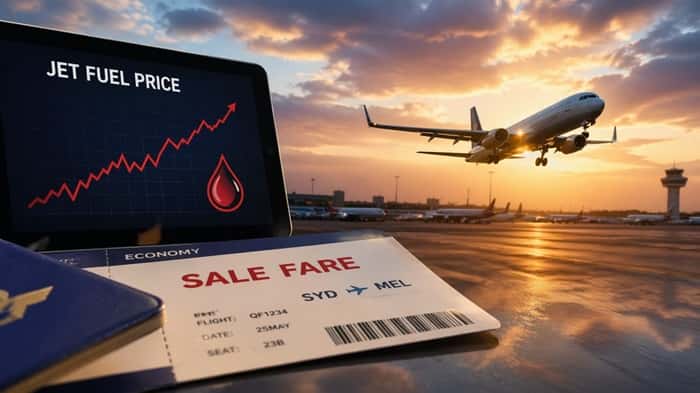
By any measure, it’s a curious moment in aviation, one where the price of getting airborne is rising sharply, yet the ticket in your hand may well be cheaper than expected.
The balancing act airlines can’t avoid
There was a time not so long ago, when rising fuel costs meant one thing for travellers: brace yourself. Fares would climb, quietly at first, then with increasing confidence. It was the industry’s oldest reflex.
Not this time.
Across Australia, airlines are simultaneously lifting fares in some corridors while aggressively discounting others. It sounds contradictory. It isn’t. It’s a strategy, albeit one that requires a steady nerve and a fair bit of mathematical wizardry.
According to Justin Brownjohn, Senior Manager at the RMIT Aviation Academy, the industry is navigating a convergence of pressures rarely seen so neatly aligned.
“It is an interesting time to be operating an airline in Australia. In one part of the market, we have a large disruption to fuel oil supply chains causing the cost of jet fuel to increase rapidly. In another, there is a cost-of-living crisis causing the travelling public to rethink their well-deserved holidays, which is causing the discounting of fares.”
In other words, airlines are being squeezed at both ends, costs climbing from below, demand softening from above.
Discounting with intent, not desperation
At first glance, a sale looks like a sale. But as Brownjohn points out, there’s more at play than simply filling empty seats.
“While there are, of course, supply and demand market forces at play, what we’re currently seeing is a little more nuanced. The nuance is coming from the addition of capacity adjustments.”
That nuance matters. Airlines aren’t merely reacting; they’re repositioning.
“The Australian travelling public is used to seeing fares increase due to reduced capacity, but right now we are seeing airlines actively trying to attract passengers and feed them to parts of their network that are struggling.”
This is where the industry’s famed revenue management, sometimes referred to, only half-jokingly, as the “dark arts”, comes into its own.
Feeding the network, protecting the yield
Behind every airfare sits a complex calculus. Airlines are not selling seats in isolation; they’re managing entire networks, each route feeding into another like a carefully engineered ecosystem.
“This is not just a simple sale to fill seats, this is an attempt to shift capacity to ensure routes are sustainable to ride out the current turbulence but also to create availability elsewhere in the system where higher fares from more price-elastic consumers can be commanded to offset the losses elsewhere.”
Translated: discount one route to keep it alive, free up capacity elsewhere, and recover margin from travellers less sensitive to price.
It’s a juggling act that relies on deep data, instinct honed over decades, and a willingness to accept short-term pain for longer-term stability.
The unforgiving economics of an empty seat
Airlines, perhaps more than any other business, live with a brutal truth: unsold inventory has no afterlife.
“There is a reason revenue management is sometimes called the dark arts of aviation. Available inventory is always being optimised to gain the most yield. Once a flight departs and that seat is empty, it is spoiled revenue the airline can never get back.”
There it is, the cold arithmetic of the sky. A vacant seat isn’t just lost revenue; it’s unrecoverable revenue. And in an environment where costs are rising sharply, that’s a luxury airlines simply can’t afford.
A market in transition
What emerges is a portrait of an industry in flux. Airlines are no longer simply raising fares in response to cost pressures; they are selectively discounting, redistributing capacity, and recalibrating networks in real time.
For travellers, it presents a paradoxical opportunity. Bargains exist, sometimes surprisingly generous ones, but they are rarely accidental. They are targeted, deliberate, and often fleeting.
For the industry, it is a test of discipline. Those who manage the balance well will emerge stronger. Those who misread the signals may find themselves chasing demand that never quite materialises.
And somewhere in the middle sits the Australian traveller watching fares rise, fall, and occasionally do both at once.
Not confusion. Not chaos. Just aviation, doing what it has always done best: adapting, calculating, and quietly reshaping the journey.
by Octavia Koo- (c) 2026.
Read Time: 3 minutes.
About the Author.
 Octavia Koo arrived in Australia in the early eighties with little fuss and a good eye. Sydney suited her. At UNSW, she studied Arts, then found her footing in graphic design before drifting, quite naturally, into the digital side of things, building websites and shaping words that made people want to stay.
Singapore followed, and with it, the fast pace of tourism platforms and ITB Asia. Long before SEO became a buzzword, Octavia understood how stories travelled online. That’s where she met Stephen, and the seed for something more was planted.
A few years later, she joined Global Travel Media.
Today, Octavia works with quiet assurance, blending art, instinct and experience to produce stories that don’t shout; they simply work and linger.











