

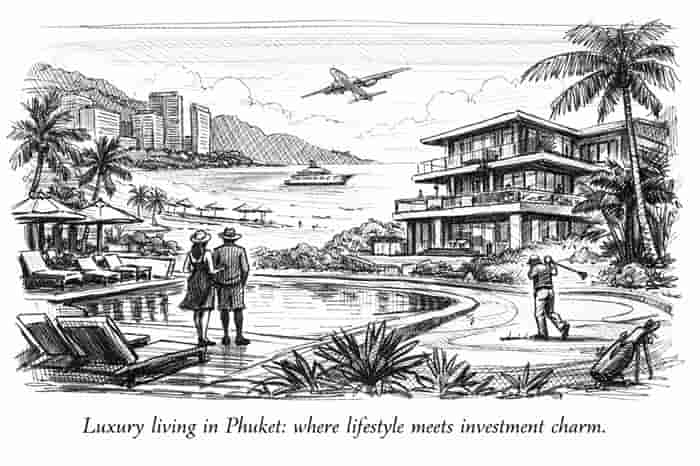
Phuket has always known how to put on a show. Sunsets arrive on cue, beaches deliver their postcard promise, and the island has long traded comfortably on its reputation as Thailand’s crown jewel of leisure travel. But something rather more consequential is unfolding beneath the surface, and it has little to do with cocktails or cabanas.
The island is quietly, and quite deliberately, repositioning itself as a global lifestyle investment hub. And the driving force is not geography, but branding.
At a recent forum hosted by C9 Hotelworks, industry insiders gathered to unpack one of the region’s most intriguing economic shifts: the rise of branded residences as a bridge between tourism and long-term capital.
The message was crisp, if not entirely surprising, that buyers are no longer purchasing property in the traditional sense. They are buying into a narrative.
“Buyers are not just picking a house anymore; they are choosing a lifestyle they feel part of,” said Bill Barnett, who moderated the session with the air of a man who has seen a few property cycles come and go. “That emotional connection is what’s lifting pricing ceilings across the region.”
It is, in many respects, a shift from bricks and mortar to brand and meaning.
Identity over inventory
For developers, the formula is becoming increasingly clear. A branded residence must deliver on two fronts: tangible assurance and intangible aspiration.
Titiwat Kuvijitsuwan of Capstone Asset framed it succinctly. “The first is quality assurance. An international brand gives buyers confidence in what they are getting, particularly in emerging markets,” he said. “The second is emotional when a brand aligns with a buyer’s identity, that’s where the premium is created.”
That premium, it seems, is no longer modest.
Across Phuket and comparable resort destinations, branded developments are commanding significant uplifts over non-branded counterparts. The reason is straightforward enough: buyers are not merely hedging their investments; they are curating their lifestyles.

(From Left to Right) Titiwat Kuvijitsuwan, Founder and CEO of Capstone Asset; Kara Wang, Director of Sales Channels at Banyan Group Residences; James Thackray, Head of Western International Agency Relations at Etro Residences
From guest to owner
Hospitality brands, perhaps unsurprisingly, are proving particularly adept at this transition.
Kara Wang from Banyan Group noted that many buyers begin their journey not in a sales office, but in a hotel suite.
“They already know the brand story. That emotional relationship is established before the purchase,” she explained. “But beyond that, buyers are thinking about reputation, rental returns, and exit strategy from day one. It’s a very informed decision.”
In other words, today’s purchaser arrives educated and expects both lifestyle dividends and financial discipline.
This convergence of travel experience and ownership is particularly evident in Phuket’s integrated resort developments. These are not standalone properties but carefully choreographed ecosystems where beach clubs, golf courses, wellness centres and concierge services operate as extensions of the home.
“Buyers are willing to pay for access to beach clubs, golf, and a full-service lifestyle ecosystem,” Wang added. “It’s about convenience and belonging to something larger than the property itself.”
Luxury’s long memory
At the upper end of the market, where understatement is rarely part of the vocabulary, the equation becomes even more nuanced.
James Thackray of Etro Residences pointed to the enduring power of brand heritage.
“People may dream about owning a luxury brand for decades,” he said. “When that brand becomes a home, it’s incredibly compelling. Combine that with limited supply, and you create a very powerful value proposition.”
Scarcity, after all, remains the oldest trick in the luxury playbook, and it works just as effectively in Phuket as in Paris or Milan.
The complexity behind the curtain
Of course, the glossy brochure tells only part of the story.
Delivering a branded residence is, by all accounts, a rather intricate exercise. Every detail from architectural design to operational management must align with the brand’s promise. And that promise, once made, cannot be diluted.
“It adds layers at every stage from design to operations,” Kuvijitsuwan noted. “But today’s buyers are sophisticated. If you strip away the branding, the product still has to stand on its own.”
There is, in that observation, a quiet warning. Branding may open the door, but product integrity keeps it from closing.
Technology waits politely
For all the talk of digital transformation, luxury real estate remains stubbornly human.
Artificial intelligence and virtual tools are finding their place in discovery and visualisation, but they are not replacing the fundamentals. Relationships, storytelling and first-hand experience continue to carry the day as they always have in high-value transactions.
It is a reminder that, even in a digitised age, trust is still built face-to-face.
A cautious optimism
Looking ahead, the tone among industry players is measured rather than exuberant, reflecting broader global uncertainties.
“We’re cautiously optimistic,” Kuvijitsuwan said. “The year has started strong, and demand is holding.”
Wang echoed the sentiment, noting increasing interest from high-net-worth individuals seeking alternatives to traditional urban investments and finding Phuket’s blend of lifestyle and liquidity rather appealing.
For Thackray, the next chapter is about reach. “Global brands allow us to connect with entirely new audiences,” he said. “That’s the next frontier.”
From destination to destiny
Barnett, closing the discussion with a characteristic turn of phrase, summed it up neatly: “In 2026, what we know is that we don’t know.”
And yet, for all the uncertainty, one trend appears firmly set.
Tourism is no longer simply about arrival and departure. In places like Phuket, it is evolving into something far more enduring, a pathway to ownership, identity and long-term engagement.
Or, put more plainly, visitors are no longer content to pass through.
They are staying on and buying in.












