

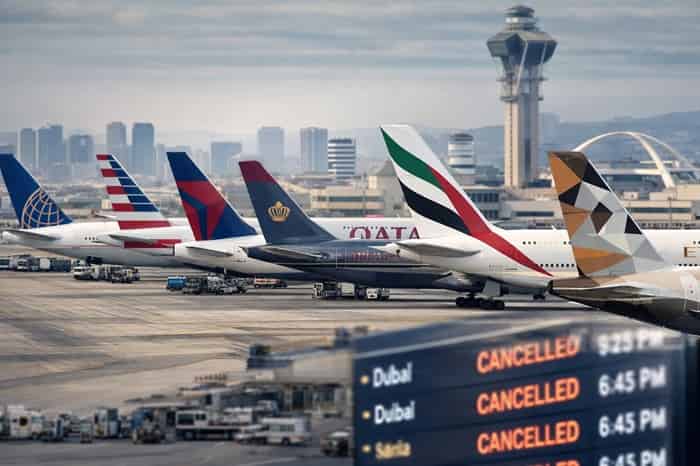
Airlines like to think they’re masters of the skies. The truth, as ever, is rather less romantic. When geopolitics flexes its muscles, even the biggest carriers quietly fold their wings.
That’s precisely what’s playing out now.
Fresh data from Italy-based travel intelligence firm Mabrian and analytics specialist The Data Appeal Company shows a sharp retreat in air connectivity between the Americas and the Middle East following the escalation of the Iran conflict. Not a wobble. Not a seasonal adjustment. A genuine pullback.
And nowhere is that more evident than in the United States.
Seat capacity from 14 major US airports into the Middle East has dropped a hefty 59.1% between mid-April and the end of May. For an industry that measures success in fractions of a percent, that’s the sort of number that gets boardrooms leaning forward.
Airlines waste no time cutting risk
There’s an old rule in aviation: if the map looks messy, redraw it.
That’s exactly what the big US carriers have done. United Airlines, American Airlines and Delta Air Lines have all quietly trimmed or suspended services, while their Middle Eastern counterparts have been equally pragmatic.
Leading the retreat is Qatar Airways, where US-bound seat capacity has tumbled by 60.5%. Royal Jordanian has cut back by 23.7%, while Emirates and Etihad Airways have eased capacity by 21% and 18.4% respectively.
In short, even the industry’s most battle-hardened long-haul operators are stepping carefully.
Carlos Cendra of Mabrian put it plainly: “The scale of the decline underscores the sensitivity of long-haul international travel to geopolitical instability, particularly in corridors reliant on complex airspace operations and demand confidence.”
It’s the sort of statement that reads politely but carries weight. When confidence goes, premium cabins empty first.
Business travel takes the first hit
If leisure travellers are cautious, corporate travellers are positively surgical. They don’t gamble on uncertainty; they avoid it.
Cendra notes that these routes play a “critical role” in global business travel, and that role is under pressure right now. Boardrooms don’t like unpredictability, and neither do travel managers trying to move executives through contested airspace.
The result? Fewer flights, fewer seats, and a noticeable pause in long-haul ambition.
Brazil feels it, Mexico shrugs
Step south into Latin America and the picture becomes more uneven.
Brazil, with its established links to the Middle East, is feeling the squeeze. Routes from São Paulo and Rio de Janeiro to hubs like Dubai, Doha and Istanbul have all softened.
Emirates has trimmed Brazil–Dubai capacity by 10.2%, while Qatar Airways has taken a far sharper knife to São Paulo–Doha, cutting 57.9% of seats. Turkish Airlines, by comparison, has barely blinked, nudging capacity down just 2.3% on São Paulo–Istanbul.
Mexico, meanwhile, is something of an outlier. With only a single direct Middle East route again, courtesy of Turkish Airlines, the impact has been minimal, with a modest 3.2% reduction.
Sometimes, having less at stake turns out to be a strategic advantage.
The quiet influence of rising costs
Of course, geopolitics isn’t working alone here. Fuel prices are creeping upward, and airlines are responding the way they always do by tightening supply and watching demand.
The Mabrian analysis hints at a broader shift: as costs rise and uncertainty lingers, travellers may well pivot closer to home. Domestic and regional markets tend to pick up the slack when long-haul confidence dips.
It’s not a new story. But it’s one the industry keeps relearning.
A familiar lesson, freshly delivered
Aviation has always been exquisitely sensitive to global events. It thrives on stability and shrinks from unpredictability.
What we’re seeing now is a textbook case. Routes trimmed, capacity pulled, risk reduced. Sensible decisions, all of them, but not without consequence.
For the moment, the skies between the Americas and the Middle East are thinner, quieter, and a little more cautious.
And if history is any guide, they’ll stay that way until confidence rather than conflict takes the lead again.
by Sandra Jones – (c) 2026.
Read Time: 4 minutes.
About the Author.
 Sandra has spent a working lifetime quietly rescuing journeys, one itinerary, one anxious caller, one impossible connection at a time. Years in Australia’s finest travel agencies taught her the art of calm, how to find a flight in a fog of cancellations, how to soothe a traveller when luggage wanders, how to turn nine frantic days in Europe into something resembling sense. Qualified, seasoned, endlessly patient, she learned that good travel advice is part logistics, part listening.
But the storyteller in her was always waiting its turn. Writing offered a new map, a way to turn experience into reflection, detail into delight. At Global Travel Media, Sandra now writes the truths only insiders know: the mishaps, the laughter, the grace found between gates and goodbyes. She reminds us that travel, for all its fuss, is still one of life’s better ideas.











