

There are cities that welcome visitors politely, and then there’s Osaka, which practically grabs you by the sleeve, hands you something fried, and insists you enjoy yourself.
This is Japan’s commercial heart with its tie loosened. Less formal than Tokyo, less reflective than Kyoto, and far more willing to show you a good time without ceremony. It’s a place built on trade, appetite, and a long-standing belief that life is best approached with a bit of flavour.
That flavour, incidentally, is served hot, usually as takoyaki or something equally indulgent. You don’t so much dine in Osaka as participate in it.
But beneath the neon and noise sits something more important for travellers: reliability. Japan still does the fundamentals better than almost anywhere: safe streets, trains that behave, and a culture of hospitality that doesn’t need to announce itself.
And lately, thanks to a softer yen, it’s also become rather good value.
Follow the Crowd. They Usually Know Something
If Osaka has a gravitational centre for international visitors right now, it’s Universal Studios Japan.
The numbers tell the story. Families, couples, school groups, the lot drawn in by blockbuster attractions and the sort of immersive worlds that make reality feel briefly optional. It’s busy, it’s loud, and it works.
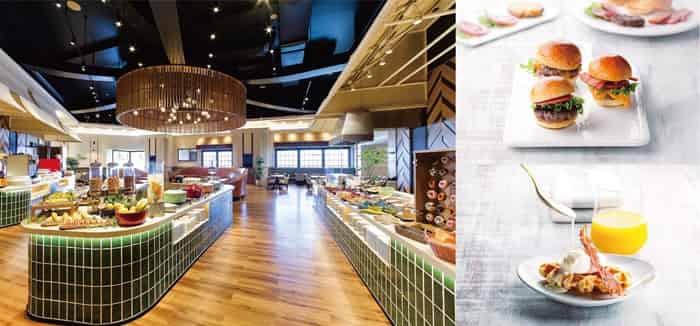
At GREEN WALL DINING, breakfast is treated as more than a box-ticking exercise. There’s a range of Japanese and Western, but more importantly, there’s personality.
The Croffle Benedict is a case in point. Slightly indulgent, slightly playful, entirely unnecessary and all the better for it. A croissant-waffle hybrid topped with the usual suspects, it’s the kind of dish that makes you wonder why more hotels don’t try a little harder.
Add freshly squeezed juice and a spread that actually invites repeat visits, and you begin to understand why guests rate the breakfast so highly.
Timing Your Stay: A Practical Note
Osaka doesn’t have an off switch, but it does have peaks.
Golden Week in May is lively and busy. Summer is equally energetic, with long days and warm nights that suit the city’s temperament.
Staying within walking distance of USJ during these periods isn’t a luxury; it’s common sense. It allows for flexibility, early starts, midday breaks, and late returns without the logistical fatigue.
That’s where this hotel quietly wins.
The Business Case for Simplicity
From an industry standpoint, there’s nothing radical here. No bold experiments, no design statements that demand interpretation.
Instead, it’s a lesson in execution.
330 rooms, well managed. Facilities that do their job. A location that carries much of the weight. And oversight from Hotel Management Japan Co., Ltd., that understands consistency beats novelty nine times out of ten.
In a crowded Osaka market, that’s not just sensible, it’s competitive.
Japan Still Gets the Basics Right
For all the talk of innovation, what continues to draw travellers to Japan is something more traditional.
It works.
Transport runs. Streets feel safe. Service is delivered with a level of care that hasn’t been engineered or scripted; it’s simply how things are done.
And Osaka, for all its energy, sits comfortably within that framework.
Final Word
There’s a tendency in travel writing to oversell to turn a decent hotel into a life-changing experience.
This isn’t that.
Oriental Hotel Universal City is a smart, well-positioned property that understands exactly why its guests are there and makes their stay easier.
Nothing more. Nothing less.
And in a city that rarely slows down, that’s precisely what you want.












