

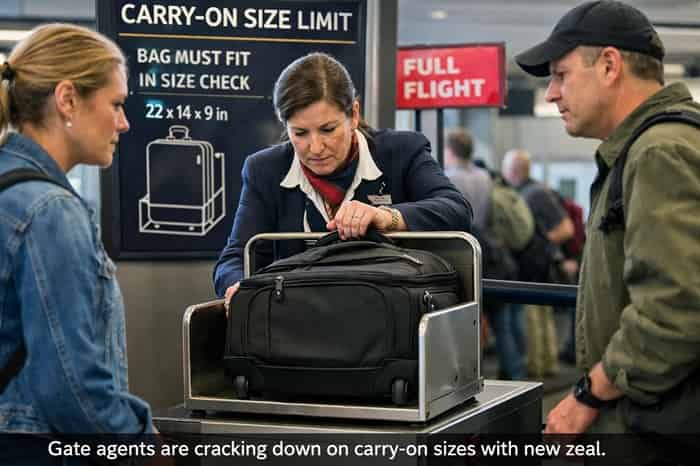
There was a time not so long ago when carry-on luggage slipped quietly through airport gates with barely a second glance. Those days, it seems, have been ushered out alongside complimentary meals and generous legroom.
A new survey from Global Rescue suggests travellers are broadly aware of identification rules but are lagging when it comes to a more immediate, and arguably more frustrating, reality: airlines are finally enforcing carry-on limits with real intent.
The Winter 2026 Traveller Sentiment and Safety Survey reveals a curious contradiction. While awareness of the United States’ REAL ID requirement is near-universal, compliance with stricter baggage enforcement measures remains uneven at best.
The Quiet Policy Shift Travellers Didn’t See Coming
Technically, nothing has changed. Carry-on size limits have not been rewritten. But enforcement, long treated as optional, has been tightened with the sort of quiet efficiency airlines tend to favour.
Gate agents are now measuring full exterior dimensions, including wheels, handles and those optimistic side pockets that expand just enough to cause trouble. If it doesn’t fit, it doesn’t fly, at least not in the cabin.
And travellers are only partially aware.
- 27% admit they are not at all aware of stricter enforcement
- 25% say they are only slightly aware
- 27% are moderately aware
- Just 19% consider themselves very aware
In other words, more than half of travellers are still catching up.
“Airlines are enforcing carry-on rules more aggressively, and many travellers are still catching up,” said Dan Richards, CEO of Global Rescue and a member of the US Travel and Tourism Advisory Board at the US Department of Commerce.
“These policies may seem minor, but they can cause significant disruption if travellers are unprepared.”
It’s a polite way of saying: expect gate-side negotiations to become less forgiving.
Men, Women and the Art of Packing
The survey also uncovers a subtle, almost anthropological divide in how travellers approach compliance.
Women, it seems, are more inclined to adapt early and decisively. Nearly 68% say they would simply obtain luggage that meets airline requirements. Men, by contrast, are more likely to take a calculated risk or at least a financial one, with one in five willing to pay additional fees if caught out.
There’s a certain logic to both approaches. One invests upfront in certainty; the other gambles on leniency. Increasingly, however, airlines appear less interested in accommodating either optimism or improvisation.
Geography Matters But Not How You’d Expect
Interestingly, awareness levels also vary by geography.
Non-US travellers show slightly higher levels of complete unawareness (31%), yet US travellers cluster more heavily in the “moderately aware” category. The difference appears to reflect exposure rather than education; those flying frequently within the US are encountering these enforcement shifts in real time.
Experience, in this case, is proving a better teacher than policy briefings.
REAL ID: A Rare Success Story
If carry-on compliance is a work in progress, awareness of REAL ID rules is a masterclass in effective communication.
A striking 87% of travellers report being very familiar with the requirement, with fewer than 5% admitting to limited awareness. In an industry where messaging often gets lost between booking confirmations and boarding calls, that level of clarity is noteworthy.
“REAL ID messaging has clearly reached travellers,” Richards said.
“The challenge now is ensuring travellers consistently carry compliant identification, especially as enforcement becomes routine.”
Few Direct Impacts For Now
Despite the tightening rules, actual disruption remains relatively rare.
Only 2% of travellers report additional screening due to non-compliant identification, and fewer than 1% have experienced delays. Most 68% say the issue simply doesn’t apply because they consistently travel with the correct documentation.
Yet observation tells a slightly different story.
- 16% have seen another traveller pulled aside for additional screening
- 10% have witnessed delays
- 4% have seen someone denied access to security or boarding
It’s the classic airport paradox: it rarely happens to you until it does.
Preparation: The Last Remaining Advantage
What emerges from the data is not panic, nor even widespread disruption, but a clear shift in expectations. Airlines are tightening the screws on compliance, and the margin for error is narrowing.
The seasoned traveller, once adept at squeezing an extra centimetre or kilo past the gate, may need to adjust their playbook.
Because while rules haven’t changed on paper, enforcement has changed in practice. And in aviation, as ever, practice tends to win.
For more information, visit Global Rescue.
by Jason Smith – (c) 2026.
Read Time: 4 minutes.
About the Author.
 Jason Smith didn’t learn travel from textbooks. He learned it in airports, taxis and hotel lobbies, watching the business unfold long before he played his own part. Half American, half Asian, he grew up around the quiet workings of tourism, where people come and go, and stories rarely stand still.
Bangkok came first, then formal study, then a career that carried him through Singapore, Malaysia and Vietnam. Each place left something behind. In the end, Thailand felt like home, and I landed a senior role in hotel sales.
Then everything stopped. Borders shut, planes grounded, and Jason found himself back in America with time to reflect.
Now at Global Travel Media, he writes travel as it really is, not polished, not perfect, but human, and all the better for it.











