

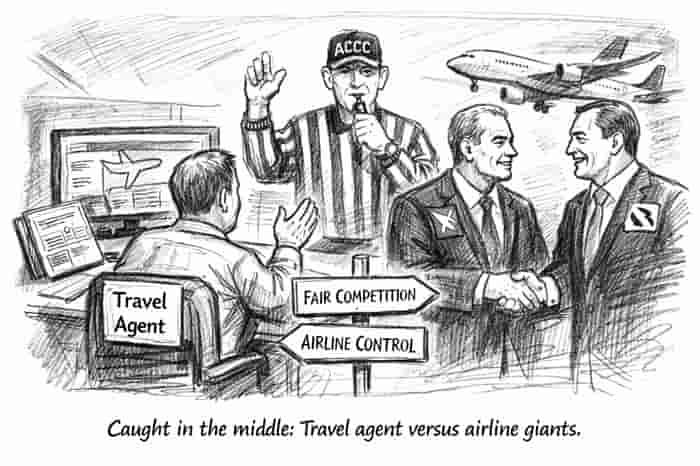
There’s a quiet tension building in Australia’s travel corridors, and it has nothing to do with turbulence at 30,000 feet. This time, it’s about who controls the sale of the seat before anyone even boards.
The Australian Travel Industry Association (ATIA) has stepped squarely into the regulatory spotlight, urging the Australian Competition and Consumer Commission (ACCC) to impose firm “guardrails” on the proposed re-authorisation of the Qantas-American Airlines Joint Business Agreement.
The alliance itself is not the issue, at least not on the surface. Coordinated schedules and aligned frequent flyer perks are, in industry terms, business as usual. What has ATIA raising an eyebrow and a well-argued submission is the less visible layer: how these airlines might jointly handle distribution through travel agents and tour operators.
The Quiet Power of the Travel Trade
Behind every airfare comparison screen and tailored itinerary sits a travel professional doing what algorithms still struggle to replicate judgment.
ATIA’s submission underscores that agents and tour operators act as a vital competitive counterweight. They compare fares, swap products, and most importantly, hold airlines to account at the point of sale.
Remove that independence, ATIA argues, and the market begins to tilt.
If airlines are permitted to coordinate their engagement with agents’ commissions, fare access, and distribution channels, the pressure to remain competitive weakens. The result? Less room for negotiation, fewer options for travellers, and a subtle but significant shift in market power.
Small Business, Big Stakes
This isn’t a niche concern. According to ATIA, 92 per cent of its members are small business operators who rely on fair access to fares and transparent commercial terms to survive, let alone thrive.
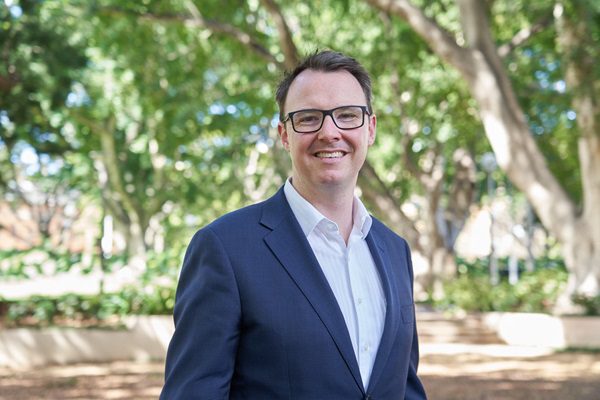
ATIA CEO Dean Long
Dean Long, ATIA’s CEO, did not mince words:
“ATIA is committed to a level playing field where all our members including retail, corporate, and mobile agents can compete fairly. We don’t oppose these major airline partnerships but we are fighting for the safeguards that ensure travel professionals, including the 92% of our members who are small businesses, can continue to negotiate independently.”
It’s a pragmatic stance. Partnerships are welcome but not at the expense of competition.
A $19.6 Billion Reminder
The travel trade’s influence is often underestimated, perhaps because it operates behind the scenes. Yet ATIA puts the figure at more than $19.6 billion annually in indirect market value, supporting over 19.8 million Australians who still prefer human expertise over digital guesswork.
Long again:
“The travel trade is responsible for an indirect market worth over $19.6 billion annually, supporting over 19.8 million Australians who choose to book through an expert. When airlines coordinate their distribution strategies, it weakens the ability of travel agents to act as independent advisors. We are asking the ACCC to put a ‘referee’ in place so that the travel trade can continue to compare, contrast, and steer demand based on merit, rather than facing coordinated restrictions from the major carriers.”
There is a call for a referee. Not to stop the game, but to ensure it’s played fairly.
The Bigger Picture
At its heart, this is not simply a dispute about airline alliances. It’s a question of balance.
Too much coordination, and competition fades into polite compliance. Too little oversight, and smaller players risk being edged out by scale alone.
ATIA’s push for guardrails is, in many ways, a defence of the traditional travel ecosystem, one where expertise, independence, and competition still carry weight.
And in an era increasingly dominated by consolidation and control, that’s a position worth paying attention to.
by Anne Keam – (c) 2026.
Read Time: 2 minutes.
About the Author.
 Anne Keam’s story begins in Queensland, on a grain farm in the state’s wide western reaches, where the days were long and the lessons simple: work hard, look after your own, and don’t make a fuss. Those early years left their mark.
She later studied Arts at the University of Queensland, before doing what felt natural at the time, heading back home to the family property. But the world was calling. Anne packed a backpack and went looking, spending years on the road and finding herself most alive in South America. She wrote everything down along the way. Those notebooks, full of dust, colour and curiosity, eventually became her blog, a quiet, personal record of seeing the world and learning from it.











