

As the 2026 Coachella festival approaches — set to take place in Indio, California, across two weekends (April 10–12 and April 17–19) — a new analysis by Mabrian and The Data Appeal Company (part of Almawave, Almaviva Group) highlights its impact as a major driver of tourism demand and spending in Greater Palm Springs.
Across the two festival weekends, Coachella is expected to bring approximately 125,000 attendees per weekend, for a total of 250,000 visitors. According to Data Appeal insight, accommodation patterns indicate that up to 30% of travelers are expected to arrive three days in advance and remain for up to two days after, extending average stays and boosting demand across the hospitality sector, driven in part by early arrivals for camping, satellite events and multi-night hotel packages.
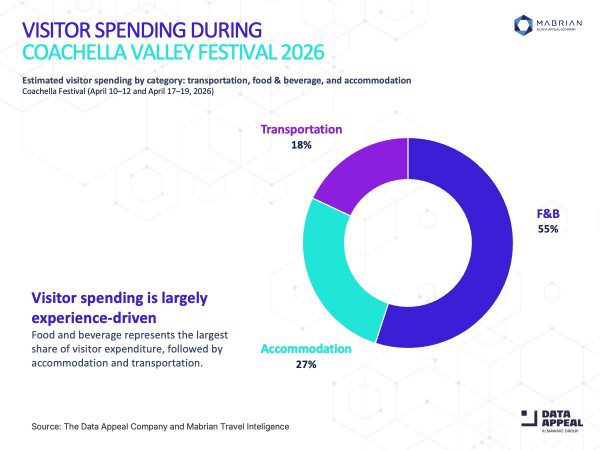
Spending patterns during the event reflect a typical festival-driven consumption model that ultimately fuels local businesses and the economy. Food and beverage accounts for the largest share of expenditure (55%), followed by accommodation (27%) and transportation (18%). According to the Visit Greater Palm Springs’ 2025 estimates, dining out is also the top activity for 69% of visitors, reinforcing the central role of social and experiential consumption during the festival.
According to Maria Pradissitto, North America Market Manager at The Data Appeal Company, “This spending breakdown offers a clear picture of the profile and behavior of travelers attending the festival, reflected by official studies. A substantial share of visitors arrives by car—primarily from nearby regions—while commercial air travel accounts for a smaller portion of arrivals, alongside more tailored and privately arranged travel solutions.”
Coachella Festival to Generate $20 million in Direct Tourism Spending
The accommodation sector in Palm Springs is capturing a significant share of this demand increase around Coachella Festival. Hotel prices are set to rise by +26% compared to equivalent festival weekends in 2025, and by +61.6% relative to the two preceding weekends. This growth highlights both the intensity of demand compression during the event window and the market’s ability to yield-manage effectively under peak conditions.
“The accommodation supply mix is highly diversified, extending beyond traditional hotels to include on-site camping, short-term rentals, and alternative lodging formats,” explains Pradissitto. In fact, in terms of accommodation, Coachella supports a diverse ecosystem of lodging options, ranging from three-to four-night hotel packages, safari campgrounds, to premium stays in Palm Springs and Palm Desert, paired with shuttle transport to the festival venue. “This broader ecosystem enables the destination to absorb incremental demand while maintaining elevated pricing levels across all asset classes,” the Data Appeal expert states.
In tourist direct spending* alone, the Coachella Festival is projected to generate more than $20 million in the area, setting it as one of the most valuable tourism magnets for the region and defining elements of its music-driven economy.











