

For an industry that once measured success in straight lines and upward graphs, the latest outlook from the Pacific Asia Travel Association reads less like a victory lap and more like a cautious nod across the boardroom table.
Yes, the numbers are back. Yes, the appetite to travel across the Asia Pacific is alive and kicking. But there’s always a but. These days, the path to 2028 is shaping up as anything but predictable.
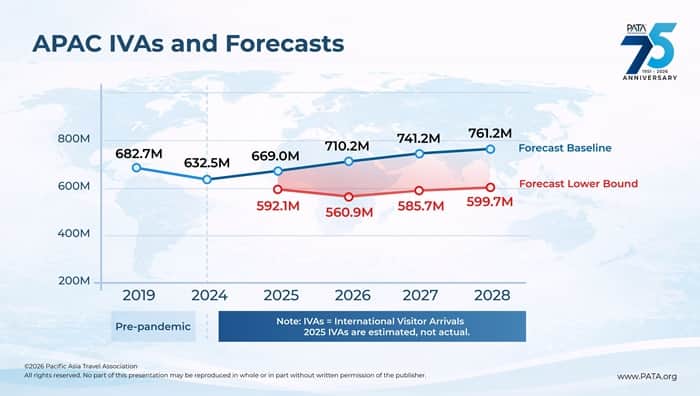
According to PATA’s freshly minted Asia Pacific Visitor Forecasts 2026–2028, international arrivals are set to push beyond pre-pandemic levels from 2026 onwards, with a headline figure of 761.2 million visitors by 2028 under the baseline scenario.
Not bad. Not bad at all.
But before anyone reaches for the champagne, there’s a second column in the ledger that deserves equal attention.
A more cautious scenario, one weighed down by geopolitical tensions, economic jitters and climate disruptions, puts the figure closer to 599.7 million. That’s still respectable, but it lands at around 88% of 2019 levels, a reminder that recovery, like travel itself, rarely runs on schedule.
Growth Is Back Certainty Isn’t
PATA CEO Noor Ahmad Hamid doesn’t sugar-coat it.
“International tourism is entering a more complex phase where growth continues, but under increasing pressure,” he said.
There it is, the line that matters.
The industry is no longer dealing with a clean rebound. It’s managing a balancing act. Demand is strong, certainly, but it’s being tugged in different directions by forces well outside tourism’s control.
Hamid points to the obvious culprits: geopolitical tensions, economic volatility, climate-related disruption, but the real message sits between the lines: the era of easy forecasting is over.
“In this environment, growth is no longer linear or guaranteed,” he added.
That’s not a warning. That’s a recalibration.
A Different Kind of Recovery
What’s unfolding across the Asia Pacific isn’t just a rebound, it’s a reshaping.
Professor Haiyan Song, one of the report’s key contributors, suggests the numbers tell only part of the story. Beneath them sits a tourism economy undergoing structural change.
Digital transformation is accelerating. AI is quietly reshaping how travel is marketed, booked and experienced. Aviation capacity remains uneven. Costs well, they’re heading in only one direction.
And then there’s climate, no longer an abstract talking point but a real-world operational challenge.
All of which means destinations aren’t simply reopening, they’re reinventing.
The Usual Heavyweights Hold Their Ground
Some things, reassuringly, don’t change.
China, the United States and Türkiye are expected to remain firmly entrenched as the region’s top destinations through to 2028. Scale, connectivity and brand power still count for plenty.
On the supply side, China, Hong Kong SAR, the United States and Korea (ROK) continue to dominate as source markets, even as airlines juggle capacity constraints and rising costs.
But there’s movement in the middle ranks.
Japan and Hong Kong SAR are staging notable comebacks, edging back into stronger positions after a slower restart.
And then there are the overachievers, the destinations that didn’t just recover but sprinted ahead. Mongolia, Japan, Chile, the Maldives and Sri Lanka are all tracking at 150% or more of their 2019 levels.
That’s not recovery. That’s momentum.
A Patchwork, Not a Wave
Here’s where the story gets interesting and a touch uncomfortable.
By 2028, 27 of the 39 destinations covered are expected to exceed pre-pandemic arrivals.
Which leaves 12 that won’t.
It’s a quiet but telling statistic. The recovery isn’t universal. It’s selective, uneven, and in some cases, stubbornly slow.
For an industry built on global movement, that unevenness matters.
It affects air routes. It shapes pricing. It dictates where investment flows and where it hesitates.
Resilience Becomes the Business Model
If the past few years taught the travel industry anything, it’s that hope is not a strategy.
PATA’s message is refreshingly pragmatic. Destinations need to diversify source markets, relying too heavily on one or two is a gamble few can now afford. Public–private collaboration needs to move from polite discussion to practical action.
And decision-making? It has to be faster, sharper, and grounded in real-time data.
In short: less guesswork, more groundwork.
The Bottom Line
There’s no denying the momentum. Asia Pacific tourism is back in the game, and in many places, it’s playing to win.
But this is not the industry of 2019.
It’s leaner, more complex, and whether it likes it or not, more exposed to global forces well beyond its control.
The outlook to 2028 is strong. Encouraging, even.
Just don’t mistake it for straightforward.
Because if there’s one thing this report makes abundantly clear, it’s that the next chapter of travel won’t be written in straight lines, it’ll be written in adjustments, pivots, and the occasional sharp turn.
And perhaps, in its own way, that’s exactly how travel has always been.
by Maysa Punchanit – (c) 2026.
Read Time: 4 minutes.
About the Author.
 Maysa Punchanit has never waited for life to become easy. She’s far too practical for that. Instead, she’s built her path the way many strong women do, step by step, job by job, learning something useful everywhere she’s been.
Her working life has taken her through hospitality, sales, beauty therapy and the fast-moving world of social media, where she partnered with some of Thailand’s best-known companies. Along the way, she discovered a steady voice for blogging, warm, direct and grounded in real experience rather than marketing spin.
Being a single mother sharpened her resolve rather than slowing her stride. If anything, it gave her purpose.
Now with Destination Thailand News and Global Travel Media, Maysa arrives not as a newcomer, but as someone quietly battle-tested, resilient, capable and ready for the next chapter.











