

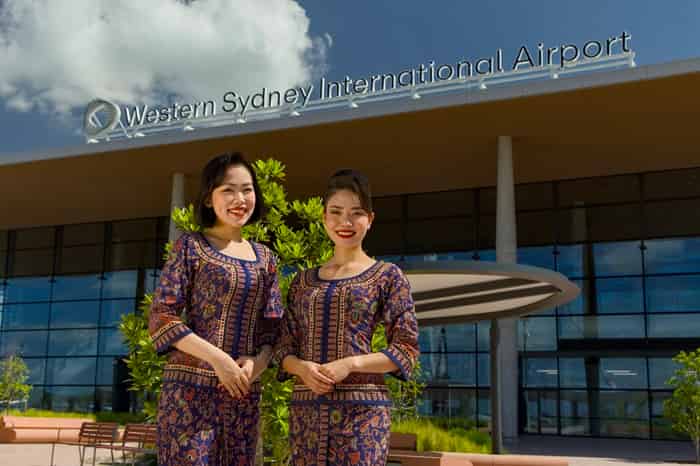
There are moments in aviation that quietly alter the map. Then there are those that do it with the lights blazing at full throttle, and Western Sydney International Airport (Nancy-Bird Walton) has chosen the latter.
In a move that signals not just progress but a decisive shift in Australia’s aviation landscape, travellers can now purchase the first international tickets from Sydney’s long-awaited second airport. And fittingly, it is Singapore Airlines, a carrier synonymous with polish and precision, that has been handed the ceremonial first departure.
After decades of debate, planning and, at times, political theatre, Western Sydney is no longer waiting for its moment. It has arrived, and it departs just before midnight.
A Gateway Fifty Years in the Making
For a nation that prides itself on distance, Australia has historically been rather conservative about adding new international gateways. Western Sydney International (WSI) breaks that mould.
As CEO Simon Hickey put it, this is Australia’s first international greenfield airport in more than half a century, a statistic that says as much about the past as it does about the ambition of the future.
“We mark a terrific milestone moment today with our first international airline partner… now giving passengers the first opportunity to book tickets from Western Sydney International Airport,” Hickey said.
And it is not merely another runway. It is a 24-hour operation, something Sydney has long envied in cities like Melbourne, designed to absorb demand, unlock flexibility, and, quite frankly, give travellers a better deal.
The Midnight Advantage
Let’s talk about that departure time. It matters.
The inaugural Singapore Airlines service will leave WSI at 11:55 pm, arriving in Singapore just after dawn, a schedule that seasoned travellers will recognise as close to ideal. Sleep on the way, land refreshed, and connect seamlessly into Asia, Europe, or beyond.
is not just any transit point. It is routinely ranked among the world’s best and, more importantly, connects to more than 130 destinations across the Singapore Airlines network.
This is where Western Sydney’s proposition sharpens: convenience meets connectivity.
The Aircraft and the Experience
Singapore Airlines is not cutting corners here. The route will be operated by the Airbus A350-900, a modern, efficient aircraft that reflects the airline’s premium positioning.
- 303 seats total
- 40 Business Class
- 263 Economy Class
It is a configuration designed to appeal to both corporate travellers seeking productivity and leisure travellers seeking value.
And as Dai Haoyu noted, the strategy is straightforward:
“Singapore Airlines’ services to Australia’s newest gateway… will deliver more choice and strengthen connectivity.”
Choice, in aviation, is everything. And for Western Sydney’s three million residents, it has often been in short supply.
Five Flights a Day Sydney Gets Serious
With this addition, Singapore Airlines will operate five daily services to Sydney, four to Kingsford Smith and one to Western Sydney.
That is not just growth; it is a statement.
It signals confidence in the Sydney market and reinforces Australia’s position within the airline’s broader network. In total, the airline will serve eight Australian cities, a footprint that underscores just how critical this market remains.
A Boost for the Visitor Economy
If aviation is the bloodstream of tourism, then this new route is a direct injection of opportunity.
Federal Infrastructure Minister Catherine King framed it plainly:
“Daily flights will connect Western Sydney globally… connecting to every corner of the world through Changi.”
Meanwhile, NSW’s Tourism Minister Steve Kamper sees something even bigger, a pathway to the state’s ambitious $91 billion visitor economy target by 2035.
“This new offering is going to provide the world with direct access to one of the nation’s fastest growing visitor economies,” he said.
It is not hyperbole. Western Sydney is already Australia’s third-largest economy, and until now, it has lacked a direct international aviation gateway.
That gap has now closed.
Business Events: The Quiet Winner
While leisure headlines dominate, the business events sector may well be the biggest beneficiary.
Business Events Sydney CEO Amanda Lampe highlighted a point often overlooked outside the industry: certainty.
Global conferences are planned years in advance. Air access is not a luxury it is a prerequisite.
“Improved international air connectivity… is a significant enabler for the region’s visitor economy growth and global engagement,” Lampe said.
And the pipeline is already impressive:
- 2,200 delegates for the International Society of Paediatric Oncology (2027)
- 1,500 delegates for IEEE Decision and Control (2028)
- 7,000 delegates for robotics and systems conference (2028)
- 5,500 delegates for the ophthalmology congress (2030)
These are not small gatherings. They are economic engines bringing research, investment, and influence.
ATIA: More Routes, Better Value
From the travel trade’s perspective, the reaction has been unequivocally positive.
Dean Long, CEO of the Australian Travel Industry Association, did not mince words:
“Today is a massive leap forward for Sydneysiders and their connection to the world.”
He pointed to something that travellers care deeply about: price.
“The prices… are extremely attractive. New supply at lower prices at higher value means great outcomes for the Australian traveller.”
There it is: the economic reality. More seats typically mean sharper fares, and sharper fares tend to move markets.
And in a period of global uncertainty, particularly across parts of the Middle East, travellers are increasingly seeking safe, reliable routing options. Singapore delivers precisely that.
Western Sydney’s Broader Story
Beyond aviation, a deeper narrative is unfolding here.
Western Sydney has long been the engine room of population growth, but not always the beneficiary of infrastructure parity. This airport begins to rebalance that equation.
It connects directly to:
- The Blue Mountains
- Regional New South Wales
- A culturally diverse population base
- Emerging economic precincts
In short, it brings the world to a region that, until now, has often had to travel east to reach it.
The Strategic Play
From a strategic standpoint, this is not just about flights. It is about positioning.
Western Sydney International is:
- A 24-hour airport
- Designed with modern passenger flow in mind
- Built to accommodate future growth without the legacy constraints of older infrastructure
And paired with a premium global carrier, it enters the market with credibility from day one.
Hickey summarised it neatly:
“Our 24-hour capacity, coupled with Singapore Airlines’ extensive global connectivity, will open our city to the world in new and exciting ways.”
A New Competitive Dynamic
It would be naïve to suggest this does not change the competitive landscape.
Sydney Kingsford Smith Airport has long been the primary gateway. It remains so, but it is no longer alone.
Airlines now have options. Travellers now have alternatives. And competition, as history repeatedly shows, tends to sharpen service and pricing alike.
The Traveller’s Perspective
For the average traveller, the implications are refreshingly simple:
- More choice
- Better timing
- Potentially lower fares
- Easier access for Western Sydney residents
And perhaps most importantly, a sense that Sydney’s aviation offering is finally catching up with its global stature.
Final Boarding Call
There is a certain poetry to a midnight departure, a quiet lift-off into something new.
Western Sydney International Airport has been talked about for decades. Now, it is selling tickets.
Not plans. Not projections. Tickets.
And with Singapore Airlines at the helm of its first international route, it is not merely opening it is arriving with intent.
For travellers, for industry, and for the city itself, this is more than an airport launch.
It is the beginning of a new aviation chapter one, written not from the east, but from the west.
by Jill Walsh – (c) 2026.
Read Time: 7 minutes.
About the Writer.
 Michelle Warner has always carried stories the way others carry passports lightly, faithfully, and with purpose. She learned her craft in newsrooms, shaping sentences with care, before swapping deadlines for departures as a flight attendant with some of the world’s great airlines. Years aloft sharpened her eye for character and deepened her fondness for the small, dignified rituals of travel, the quiet kindness of strangers, the poetry of arrival, the patience learned between time zones.
Now grounded by choice, Michelle has come home to writing with the same calm authority she once brought to turbulent cabins. Her prose blends an editor’s discipline with a traveller’s wonder, tinged with humour and reverence for the golden age of travel. Each piece feels like a handwritten boarding pass gracious, observant, and unmistakably alive.
=====================================











