

Airlines have always liked a good headline. Bigger planes, longer routes, shinier seats, the usual aviation theatre designed to convince passengers that this time, truly, things will be different.
But every now and then, an announcement lands that carries a bit more weight than the average press release puff piece.
United Airlines’ decision to bring in more than 250 aircraft by 2028 is one of those moments.
Not because airlines don’t order planes, they do, constantly, but because of what sits behind this one: a very deliberate, very expensive bet that premium travel is no longer a luxury add-on. It’s the main event.
And United, it seems, wants front-row seats.
Not Just More Planes, a Different Playbook
For years, airlines have chased efficiency like a dog after a tennis ball. Pack more seats in, shave a few costs, and hope nobody notices the shrinking legroom.
United has decided to pivot, or perhaps more accurately, swing the pendulum back.
CEO Scott Kirby didn’t dress it up:
“Today we accelerate our plans and elevate our offerings to the next level…”
It’s corporate speak, yes. But beneath it sits a simple truth: United believes travellers will pay for a better experience, and it’s building an entire fleet strategy around that idea.
Since 2021, the airline has quietly laid the groundwork. More Dreamliners, more MAX aircraft, more A321neos. Retrofit programs are ticking along. Premium seats up 40% across North America.
This latest move? It’s the exclamation mark.
The Curious Case of the “Coastliner”
Now, here’s where things get interesting and just a little bit cheeky.
United is taking a narrowbody aircraft, the Airbus A321neo, and giving it the sort of treatment usually reserved for long-haul heavyweights.
They’re calling it the “Coastliner”.
It will shuttle between Los Angeles, San Francisco, and Newark, routes already busy enough to resemble airborne highways, but with a twist. Proper lie-flat Polaris seats. Direct aisle access. Lounge entry.
Domestic flights, international-style.
For years, US transcontinental routes have flirted with premium. This is United putting a ring on it.
And yes, there’s even a snack bar in economy. A small touch, perhaps, but one that quietly acknowledges what passengers have been saying for years: sometimes it’s the simple things that matter.
The A321XLR: Long Legs, Sharper Teeth
If the Coastliner is about comfort, the A321XLR is about reach.
This aircraft allows United to do something airlines love: open new routes without the financial gamble of filling a widebody.
Smaller European cities. Secondary South American markets. Places that don’t quite justify a Dreamliner but are far too interesting to ignore.
And it does so without asking passengers to sacrifice comfort. Thirty-two premium seats, modern cabins, proper screens, all the things that stop a seven-hour flight from feeling like a punishment.
In short: fewer excuses for airlines to offer second-rate experiences on “smaller” routes.
A Regional Jet That Thinks It’s Private
Then there’s the CRJ450, an aircraft that sounds, at first glance, like a step backwards.
It isn’t.
United has taken the regional jet, long the punching bag of frequent flyers, and given it something approaching dignity.
No overhead bins in first class. A luggage closet instead. Space, light, and a sense that you haven’t accidentally boarded a flying shoebox.
Even better, Starlink Wi-Fi is on board. Which means, for once, the phrase “staying connected” might actually mean something.
It’s a small aircraft doing a very big job: making regional travel feel less like a compromise.
The Dreamliner Gets Its Moment
Of course, the real glamour still sits at the front of the long-haul fleet.
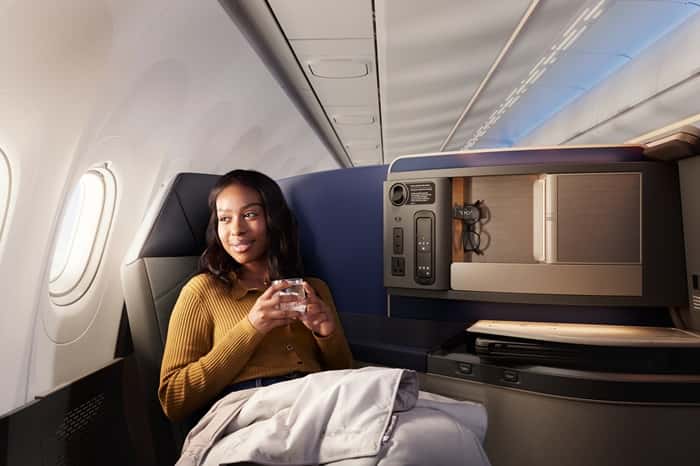
United’s updated Boeing 787-9, dressed up in what it calls the “Elevated” interior, is, frankly, a statement piece.
Bigger suites. Sliding doors. Proper privacy. Screens large enough to rival your lounge room television. And yes, caviar, for those inclined.
It’s easy to roll your eyes at such indulgence. But in a competitive global market, perception matters. And nothing says “premium airline” quite like a seat that feels more like a hotel than an aircraft.
The first of these jets takes off from San Francisco to Singapore, a route that already carries its fair share of expectation.
Now it carries a bit more theatre as well.
The Quiet Revolution in the Economy
Here’s the part many airlines still miss.
While United is clearly chasing premium dollars, it hasn’t forgotten the back of the plane.
Better blankets. Decent earbuds. Screens everywhere. Faster Wi-Fi.
None of it is revolutionary on its own. But together, it signals something important: economy passengers are no longer an afterthought.
They’re customers. And increasingly, repeat ones.
A Numbers Game With Intent
By the time the dust settles, United’s incoming fleet will include everything from Dreamliners to MAX jets, A321 variants to regional aircraft.
On paper, it’s scale.
In reality, it’s a strategy.
Each aircraft fills a gap. Each product targets a traveller. Each route becomes a little more viable.
And stitched together, it creates something airlines have been chasing for years: a network that feels seamless, regardless of where you sit.
So, What’s Really Going On?
Strip away the branding, the polished interiors, the carefully worded quotes, and a clearer picture emerges.
United is betting that:
- Travellers will keep paying for comfort
- Premium cabins will continue to outperform economy margins
- Consistency across routes matters more than ever
It’s not a reckless bet. But it’s not a cheap one either.
And in an industry known for its short memory and thinner margins, that makes it worth watching.
Final Approach
Airlines love to talk about transformation. Most of the time, it’s little more than a fresh coat of paint.
This feels different.
United isn’t just adding aircraft. It’s reshaping how those aircraft are used and, more importantly, how passengers experience them.
Will it work? That depends on whether travellers follow the money.
But for now, one thing is clear.
United isn’t waiting to find out.
by Susan Ng – (c) 2026.
Read Time: 7 minutes.
About the Writer.
 With the polish of an international hotel professional and the instincts of a born storyteller, Susan Ng learned hospitality where it truly lives behind reception desks, in banquet halls, beside linen carts. She understands that excellence isn’t announced; it’s felt, in the small, quiet gestures that linger long after checkout.
Away from the bustle, her curiosity found a new front desk: the blank page. Her blog, candid and gently wry, drew readers who recognised truth when they saw it. She wrote about grace and imperfection with the steady eye of someone who had lived both.
Today, at Global Travel Media, Susan brings that same warmth and insight to her stories. Expect writing that is polished, generous, and reassuring, like the perfect welcome after a long journey.











