

There are moments in aviation when the map changes overnight.
Not gradually. Not politely. Just suddenly, as if someone had taken a red pen to the sky.
That’s where the industry finds itself again.
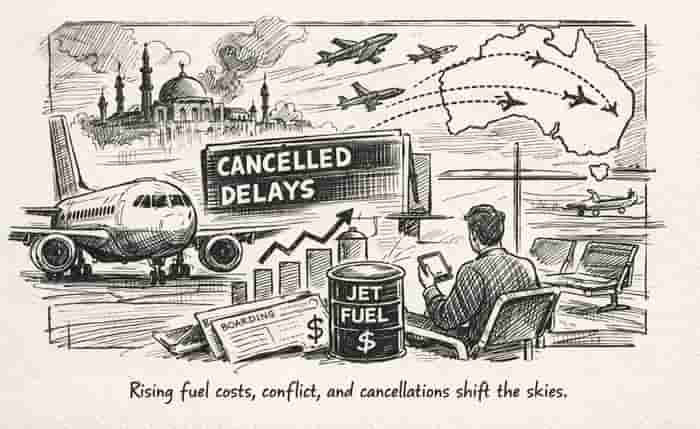
Half a world away, conflict in the Middle East is reshaping global flight paths, closing airspace, stretching routes and quietly pushing costs higher. And here in Australia, the Australian Competition and Consumer Commission is watching closely because what begins as disruption abroad has a habit of ending up in the price of a seat between Sydney and Perth.
The regulator’s latest Domestic Airline Competition report reads less like a routine quarterly update and more like a gentle clearing of the throat: pay attention, because this could escalate.
The Long Reach of a Distant Conflict
The Middle East has always been aviation’s great crossroads, a place where east meets west, and airlines stitch together long-haul journeys with elegant efficiency.
When that corridor tightens, everything shifts.
Flights to Europe are being rerouted or cancelled altogether. Aircraft are flying longer sectors. Crews are working harder. Schedules are being rewritten on the fly, sometimes literally.
And as ACCC Commissioner Anna Brakey observed, the consequences are already spreading.
“The Middle East plays a critical role in global aviation, and we’ve already seen airline operations affected worldwide, with potential for impacts to flow into our domestic market.”
It’s a measured statement, but the subtext is clear: what happens up there doesn’t stay up there.
When Plans Unravel, So Do Expectations
For travellers, the question quickly becomes practical.
If a flight is cancelled or delayed because of all this, what are you actually entitled to?
The answer, as ever, sits somewhere between policy wording and patience.
Under Australian Consumer Law, compensation is not automatic when disruptions are caused by third parties, such as governments closing airspace or imposing restrictions. In those cases, the airline may not be on the hook as passengers might hope.
Instead, the fine print of the ticket takes centre stage.
That’s not new, of course. But it’s a timely reminder.
“We have been encouraging consumers with an upcoming international flight to contact their airline to understand their options,” Ms Brakey said.
In other words: don’t assume, ask.
Fuel: The Slow Burn
While flight disruptions grab the headlines, the more enduring story may well be fuel.
Jet fuel prices have begun to edge upward again, nudged along by instability in a region that plays an outsized role in global energy markets.
Australian carriers have some protection. Most hedge a portion of their fuel requirements, smoothing out short-term spikes.
But hedging is not a shield forever; it’s more like a buffer.
“Major Australian airlines typically hedge a proportion of their fuel needs,” Ms Brakey said.
“However, if jet fuel prices remain elevated for a prolonged period, airline costs may increase and this could ultimately lead to higher domestic airfares.”
It’s the kind of sentence the industry knows well. It doesn’t shout, it accumulates.
A Subtle Shift in the Map
There’s another consequence unfolding, less obvious but equally important.
With Middle Eastern hubs constrained, traffic is being redirected. Travellers heading to Europe are increasingly funnelling through Asia, placing pressure on routes that were already busy.
Capacity, as always, is finite.
And when demand begins to crowd the system, prices tend to follow.
Airlines are entitled to respond to those pressures by adjusting fares based on demand, supply and cost inputs. What they cannot do is dress those increases up in misleading explanations.
The ACCC has made it clear it is paying attention.
“While market conditions will ultimately determine the cost of flying, we are closely monitoring price movements, market behaviour and the airlines’ representations to consumers,” Ms Brakey said.
It’s not quite a warning shot, but it’s close enough.
Reliability: Better, But Still Not Brilliant
Back home, the domestic market is showing signs of improvement, though not quite a return to its former self.
On-time performance has edged upward after a sluggish November, reaching 78.4 per cent in January 2026. Respectable, perhaps, but still shy of the long-term average of 80.5 per cent.
Cancellations sit at 2.1 per cent again, close to normal, but not entirely comfortable.
Performance, however, is not evenly spread.
Regional Express Airlines and Virgin Australia are setting the pace, both delivering cancellation rates under 1 per cent, the sort of numbers that win quiet loyalty.
Elsewhere, it’s less tidy.
Jetstar continues to lag, with an on-time arrival rate of 67.7 per cent and a cancellation rate of 3.2 per cent. Qantas, too, recorded a higher-than-average cancellation rate of 2.7 per cent.
“Jetstar’s on time performance… was well below the industry long term average, which is a concern for passengers,” Ms Brakey noted.
One suspects passengers have already reached that conclusion themselves.
More Seats, Fewer Passengers
In a curious twist, airlines are currently adding capacity faster than passengers are filling it.
Seat numbers rose by 2 per cent in January compared to a year earlier, marking six straight months where supply has outpaced demand.
It’s a welcome shift after years of constraint, though the system is still not back to full strength. Capacity remains 3.3 per cent below pre-pandemic levels.
Airfares have eased slightly in recent months, but remain 4.3 per cent higher than this time last year.
Seasonality is doing its usual work. Demand surged through the Christmas period before softening in January, as leisure travel wound down and corporate travel stayed relatively subdued.
The next lift is already on the calendar: Easter and ANZAC Day, when Australians traditionally take to the skies again.
A Market That Still Lacks Rivals
If there is a deeper issue underpinning all of this, it is competition or the lack of it.
Between them, the Qantas Group and Virgin Australia account for nearly 99 per cent of domestic flights.
It is, by any measure, a concentrated market.
Financially, both carriers are thriving. Qantas posted an underlying EBIT of $1.59 billion for the first half of the financial year, while Virgin Australia delivered $490 million, up 11.7 per cent.
Strong numbers, certainly. But they raise familiar questions.
“High barriers to entry… contribute to a concerning lack of competition and choice for consumers,” Ms Brakey said.
It’s an observation that has lingered over the industry for years and shows little sign of fading.
The Shape of What’s Next
For now, the domestic market holds steady.
Flights are operating. Capacity is growing. Prices, while elevated, are not spiralling.
But the conditions are shifting.
Fuel is creeping up. Global routes are bending out of shape. Demand is redistributing in ways that rarely favour lower fares.
And hovering over it all is a simple truth the industry understands well: aviation is global, whether you’re flying internationally or not.
What begins as a disruption in distant airspace rarely stays there for long.
by Anne Keam – (c) 2026.
Read Time: 6 minutes.
About the Writer.
 Anne Keam’s story begins in Queensland, on a grain farm in the state’s wide western reaches, where the days were long and the lessons simple: work hard, look after your own, and don’t make a fuss. Those early years left their mark.
She later studied Arts at the University of Queensland, before doing what felt natural at the time, heading back home to the family property. But the world was calling. Anne packed a backpack and went looking, spending years on the road and finding herself most alive in South America. She wrote everything down along the way. Those notebooks, full of dust, colour and curiosity, eventually became her blog, a quiet, personal record of seeing the world and learning from it.











