

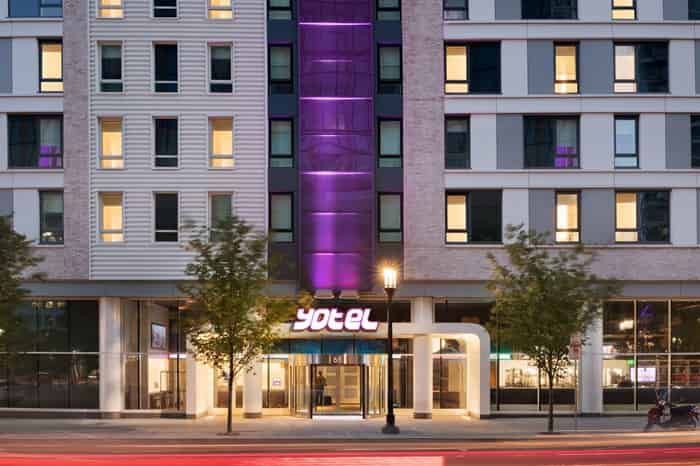
If ever there was a sign that the hotel giants are sharpening their pencils and their strategy, it’s Hilton’s latest play with YOTEL. Not a takeover, not a rebrand, but something altogether more modern: a partnership that keeps the soul intact while quietly wiring it into one of the world’s most powerful hospitality engines.
Hilton has announced an exclusive agreement with YOTEL, the design-led, tech-forward brand that has long traded on efficiency with a dash of futurism. The deal, while neatly wrapped in corporate language, boils down to something quite simple: Hilton gets fresh lifestyle credentials in urban markets, and YOTEL gets a global megaphone.
It’s a tidy piece of business.
YOTEL, which first popped up in London back in 2007 with a concept that felt part airline cabin, part sci-fi film set, has since spread to major cities including New York, Tokyo, Amsterdam, Glasgow and Singapore. It’s calling card? Cleverly compact rooms, beds that morph at the push of a button, and an unapologetic embrace of technology from automated luggage storage to streamlined check-ins.
In other words, it’s a brand built for travellers who pack light and think fast.
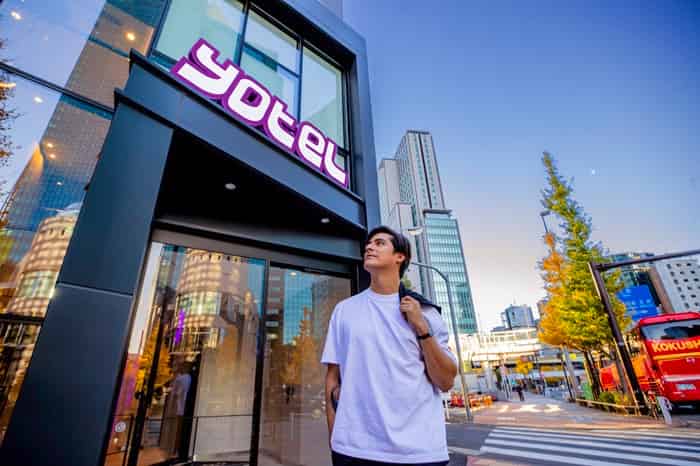
YOTEL-Exterior with Guest
Now, through Hilton’s vast distribution system, that proposition is about to reach a far wider audience.
Christian Charnaux, Hilton’s executive vice president and chief development officer, framed the move with the sort of measured optimism one expects from a seasoned operator. He noted that bringing YOTEL into Hilton’s orbit strengthens the company’s “network effect”, a phrase that sounds technical but, in practice, means more visibility, more bookings and more loyalty engagement.
And loyalty, in this game, is everything.
Hilton Honors, now boasting close to 250 million members, is less a programme and more a global ecosystem. Plug YOTEL into that, and suddenly a niche, design-driven brand finds itself in front of millions of travellers who might never have considered it before.
Yet, importantly, Hilton is not attempting to repaint YOTEL in its own colours.
Phil Andreopoulos, YOTEL’s chief executive, was quick to underline that point. The partnership, he said, is about access, not identity. A subtle distinction, but a crucial one. YOTEL will continue to operate its 23 hotels across 10 countries independently, managing its brand and experience without interference.
That restraint speaks volumes about where the industry is heading.
For years, large hotel groups chased growth through ownership or heavy-handed brand standardisation. Today, the smarter money is on “asset-light” expansion that leverages platforms, loyalty programmes and distribution muscle, while allowing individual brands to retain their character.
Hilton’s newly minted Select by Hilton platform is a case in point. YOTEL becomes its first independent brand, effectively serving as a test case for how this looser, more flexible model can work at scale.
It’s a pragmatic evolution. Travellers, after all, have grown weary of sameness. They want consistency where it matters: service, reliability, rewards but also a sense of place and personality. YOTEL, with its space-saving ingenuity and urban edge, offers precisely that.
From a commercial perspective, the upside is clear. Hilton extends its reach into the fast-growing lifestyle segment without building from scratch. YOTEL, meanwhile, gains immediate access to Hilton’s booking channels, technology platforms and loyalty base, arguably the hardest pieces of the puzzle to assemble independently.
The timing is also noteworthy.
Urban travel is rebounding with purpose, particularly among younger, tech-savvy travellers who value efficiency over excess. The traditional hotel room, large, predictable and often underutilised, is giving way to something leaner, smarter and more adaptable.
YOTEL has been playing in that space for years. Hilton, by contrast, has recognised the shift and moved quickly to ensure it doesn’t miss the turn.
The first YOTEL properties integrated into Hilton’s system are expected to be bookable through Hilton channels later in 2026. When that happens, Hilton Honors members will be able to earn and redeem points at participating YOTEL hotels, adding yet another layer of appeal.
And therein lies the quiet brilliance of the deal.
Nothing changes, everything changes yet.
Guests will still encounter the same compact cabins, the same transformable SmartBeds, the same crisp, contemporary aesthetic. But behind the scenes, the machinery will be humming at a different scale entirely.
For Hilton, it’s a calculated expansion. For YOTEL, it’s a growth accelerator. For travellers, it’s one more option in an increasingly diverse accommodation landscape.
And for an industry that has spent the past few years recalibrating, it feels like a move grounded not in reinvention, but in refinement, an old-fashioned principle, executed with modern precision.
by Prae Lee – (c) 2026.
Read Time: 5 minutes.
About the Writer.
 You can tell a great deal about a person by how they meet a Bangkok morning. Prae Lee doesn’t charge into it; she glides, unhurried, as if time itself has agreed to behave. There is a calm assurance about her, the sort earned by knowing both your roots and your destination.
A graduate of Chulalongkorn University, she earned her business degree with quiet pride, then further polished it in Singapore and Australia. Travel didn’t change her. It refined what was already there: curiosity, discipline, grace.
Back in Bangkok, she slipped modern life into the family business, mastering social media with an instinct for listening and selling with Thai gentleness.
Prae never seeks attention, yet everything she touches grows brighter.
Now with Global Travel Media, she writes with authenticity, drawing on culture, travel and a rare, steady confidence.











