

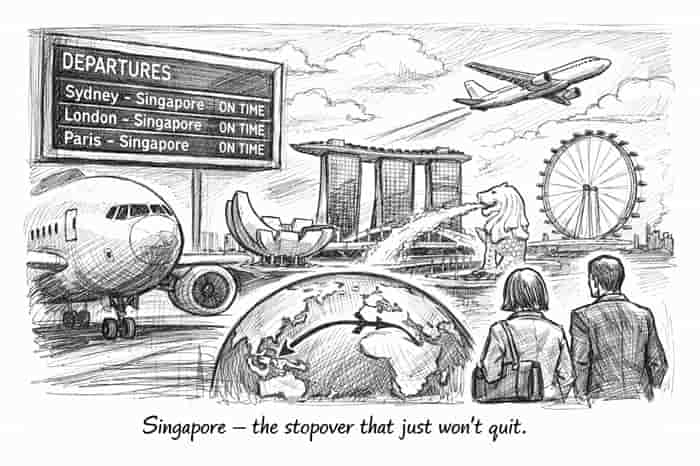
When airspace closes, aviation does what it has always done: it adapts. And when it adapts, it tends to fall back on the tried-and-true.
Right now, that means Singapore.
As tensions in the Middle East continue to reshape long-haul flight paths, Singapore’s Changi Airport has quietly resumed its role as the dependable hinge between Australia and Europe. Not glamorous, perhaps, but highly effective.
New figures from Flight Centre Travel Group’s corporate divisions, FCM Travel and Corporate Traveller, tell the story without fuss. Bookings between Australia and Europe via Singapore jumped 38 per cent in the two weeks from 2 to 15 March, compared with the fortnight prior.
That is not panic buying. It is recalibration.
Business travel doesn’t wait

Melissa Elf, Global COO of FCM Travel and Corporate Traveller
Corporate travel has never been sentimental. It moves when it must, and right now, it must.
Deals are still being negotiated, projects are still advancing, and executives are still boarding flights, albeit on slightly longer routes. Cancelling, as ever, is the least attractive option.
Melissa Elf, Global COO of FCM Travel and Corporate Traveller, put it plainly:
“The safety and well-being of our customers and staff is our top priority we continue to closely and actively monitor the situation.”
Then, with a touch more realism:
“Business travel is known for its resilience and flexibility, with companies looking at alternative routes that are safe to travel through, rather than cancelling. Global economies don’t stop, and our latest data show that corporates continue to find ways to get deals done through alternative routes.”
There it is, the quiet truth of the sector. The meetings still happen. The route simply changes.
Asia holds the line
While Middle Eastern corridors remain uncertain, Asian hubs, Singapore foremost among them, have kept the lights on.
“The majority of Europe to Australia flight connections operate via Asian hubs, not the Middle East, including Singapore and other regional airports, with these routes continuing to operate normally,” Elf said.
In other words, the system is bending, not breaking.
Seats are the new currency
Of course, reliability has a price. And at present, that price is available.
As traffic consolidates through fewer corridors, capacity tightens. Seats that were once easy to secure now require quick decisions and, occasionally, a bit of luck.
“Travel Managers and passengers should note that seat availability on these alternative routes is limited and subject to rapid change. Securing a booking is essential,” Elf added.
For corporate travel managers, this is where the real work begins, navigating shifting inventory, juggling fare classes, and keeping travellers moving without blowing out budgets.
The machinery behind the movement
It is also a reminder of the value of a well-run travel programme.
Access to multiple booking systems, the ability to re-ticket at pace, and the expertise to untangle fare rules are no longer background functions; they are frontline tools.
“As a travel management company, we continue to assist as we can access different inventory systems, manage re-bookings, and handle ticketing complexities, significantly easing the burden on travellers and their companies,” Elf said.
Not glamorous work. But essential.
A familiar centre of gravity
There is something faintly reassuring about Singapore’s return to centre stage.
Long before non-stop flights promised to redraw the map, Changi built its reputation on consistency, connectivity and an almost stubborn refusal to falter under pressure.
That reputation is now paying dividends.
As routes stretch, detour and occasionally disappear, airlines and corporates alike are gravitating towards what they know works.
And right now, what works is Singapore.
by Anne Keam – (c) 2026.
Read Time: 3 minutes.
About the Writer.
 Anne Keam’s story begins in Queensland, on a grain farm in the state’s wide western reaches, where the days were long and the lessons simple: work hard, look after your own, and don’t make a fuss. Those early years left their mark.
She later studied Arts at the University of Queensland, before doing what felt natural at the time, heading back home to the family property. But the world was calling. Anne packed a backpack and went looking, spending years on the road and finding herself most alive in South America. She wrote everything down along the way. Those notebooks, full of dust, colour and curiosity, eventually became her blog, a quiet, personal record of seeing the world and learning from it.











