

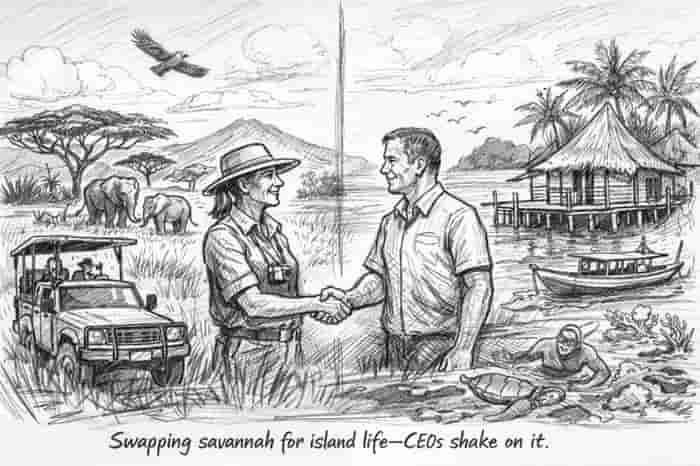
There are easier ways to run a tourism business than handing your keys to someone else and hopping on a plane to the other side of the world. Most CEOs, quite sensibly, don’t.
But in April, that’s exactly what’s happening.
Louise Cottar of Cottar’s Safaris in Kenya’s Maasai Mara and Andrew Dixon of Nikoi and Cempedak Islands in Indonesia have decided that if you’re serious about sustainability, you don’t just talk about it you test it. Preferably somewhere completely unfamiliar.
So, for a month, they’ll swap.
Not symbolically. Not for a boardroom tour and a few polite lunches. Properly. Boots on the ground, sleeves rolled up, inside each other’s operations.
It’s a move that feels almost old-fashioned in its honesty and rather modern in its intent.
Both businesses sit in rarefied air as Long Run Global Ecosphere Retreats®, a designation held by just a dozen properties worldwide. It’s the sort of accreditation that signals you’re doing more than ticking boxes. Conservation, community, culture and commerce, what the industry likes to call the “4Cs”, are expected to be lived, not laminated.
Still, even the best operators can become a little too comfortable in their own ecosystems.
That’s where this exchange becomes interesting.
Cottar will trade the vast, wildlife-rich plains of the Maasai Mara for the contained, fragile ecosystems of Indonesia’s private islands. Dixon heads the other way, swapping coral reefs for big game and community conservancies that operate on a very different scale and with very different stakes.
On paper, they couldn’t be further apart.
In practice, perhaps not.
“While our environments couldn’t be more different… our core challenges in regenerative tourism are remarkably similar,” Dixon said, with the sort of understatement that tends to come from experience rather than theory.
And that’s the crux of it.
Strip away the scenery and the guest brochures, and most high-end sustainable tourism businesses are wrestling with the same questions: how to protect what you rely on, how to bring local communities along for the ride, and how to deliver a guest experience that justifies the price without compromising the place.
None of that is solved in a strategy document.
Which is why this isn’t a study tour, it’s an operational reality check.
Cottar puts it plainly: “when sustainability leaders collaborate openly, progress accelerates.”
It’s a neat line, but there’s more behind it than sentiment. What’s being tested here is something the industry doesn’t always do well: radical transparency.
Letting another operator step into your business to see what works, what doesn’t, and where cracks might be forming requires a certain level of confidence. Or perhaps a willingness to be uncomfortable.
Either way, it’s not common.
For Dixon, the appeal is equally practical. Observing how Cottar’s balances conservation with community engagement in the Maasai Mara, arguably one of the most scrutinised wildlife regions in the world, offers lessons that don’t come from reports or conferences.
And for Cottar, Indonesia’s island model presents a different kind of challenge altogether. Marine ecosystems, tighter geographic constraints, and a guest experience shaped as much by isolation as by design.
Two worlds. Same pressures.
If there’s a commercial angle, and there always is, it sits in resilience.
Regenerative tourism isn’t a fringe concept anymore. Guests are asking harder questions. Investors are paying closer attention. And regulators, slowly but surely, are catching up.
Standing still is not an option.
By stepping outside their own operations, both CEOs are effectively stress-testing their assumptions. What holds up in a different environment? What doesn’t? And what can be adapted without losing the brand’s essence?
Those answers tend to be more useful than any consultant’s report.
There’s also a broader signal here that the industry would do well to notice.
Tourism, for all its talk of collaboration, often operates in silos. Best practice is shared selectively. Competitive advantage is guarded carefully.
This exchange flips that on its head.
Not with fanfare, but with action.
No grand declarations. Just two operators willing to compare notes the hard way by living each other’s reality.
Whether it sparks a trend remains to be seen. The sector has a habit of admiring good ideas without necessarily adopting them.
But if nothing else, it’s a reminder that the fundamentals of good tourism respect for place, people, and product haven’t changed.
Only the expectations have.
Further Information
https://www.cottars.com; https://www.nikoi.com; https://www.cempedak.com.
by Michelle Warner – (c) 2026.
Read Time: 5 minutes.
About the Writer.
 Michelle Warner has always carried stories the way others carry passports lightly, faithfully, and with purpose. She learned her craft in newsrooms, shaping sentences with care, before swapping deadlines for departures as a flight attendant with some of the world’s great airlines. Years aloft sharpened her eye for character and deepened her fondness for the small, dignified rituals of travel, the quiet kindness of strangers, the poetry of arrival, the patience learned between time zones.
Now grounded by choice, Michelle has come home to writing with the same calm authority she once brought to turbulent cabins. Her prose blends an editor’s discipline with a traveller’s wonder, tinged with humour and reverence for the golden age of travel. Each piece feels like a handwritten boarding pass, gracious, observant, and unmistakably alive.











