

In an age where travel often feels like a competitive sport, how many cities, how many landmarks, how many selfies before lunch, a quiet counter-movement is gathering momentum.
Travellers are slowing down.
Not out of necessity, but by choice.
The idea behind slow travel is disarmingly simple: spend more time in fewer places and actually experience them. Walk the streets. Feel the landscape. Stay long enough to notice the details.
Few places reward that philosophy more generously than the Great Karoo of South Africa, a vast semi-arid region where the sky feels impossibly large and time appears to move at its own deliberate pace.
At the heart of it sits the historic town of Robert Sobukwe, formerly known as Graaff-Reinet, a place that looks as though it was designed for travellers who prefer the scenic route over the fast lane.
The luxury of space
The Karoo has always been defined by its openness.
Locals sometimes call it the “Land of Great Thirst”, not only because rain is scarce but because the landscape stretches endlessly across the horizon. It’s a place of wide plains, lonely farm roads and dramatic geological formations where silence feels almost tangible.
For modern travellers, that sense of space has become something of a luxury.
And increasingly, visitors are discovering that the best way to experience it isn’t from the seat of a vehicle but from the saddle of a bicycle or simply on foot.
Gravel cycling has quietly become one of the region’s great drawcards. The network of dusty farm roads and mountain passes surrounding Robert Sobukwe offers kilometre after kilometre of uninterrupted riding.
Cyclists with a taste for adventure often tackle Ouberg Pass, a winding climb that rewards the effort with sweeping views across the rugged Sneeuberg Mountains.
Others opt for gentler rides through farmland toward Nieu-Bethesda, the eccentric little village famous for the Owl House, a curious sculpture garden that has become one of South Africa’s most unusual artistic landmarks.
Either way, it’s travel that unfolds at the pace of your legs.
Earning the view
For many visitors, that physical connection to the landscape is precisely the appeal.
“We are seeing a significant shift in what international traveller seeks,” says Tebello Polisane-Casper, General Manager of Drostdy Hotel, a heritage property in the centre of Robert Sobukwe.
“It is no longer enough to just see the Karoo from a car window. People want to earn the view. They want dust on their boots and the sun on their faces.”
It’s a sentiment that resonates strongly with the growing slow-travel community of travellers who believe the journey should feel like an experience rather than a checklist.
Hiking into the Karoo wilderness
If cycling offers one perspective on the Karoo, hiking provides another entirely.
The nearby Camdeboo National Park curves around the town like a protective amphitheatre, offering trails that range from leisurely strolls to demanding mountain climbs.
One of the local favourites is the Eerstefontein Day Walk, which meanders through dense succulent vegetation where Cape Mountain Zebra graze quietly among the rocks.
For those seeking a more strenuous outing, the Driekoppe Trail climbs into the rugged folds of the Sneeuberg range.
Reaching the higher ridgelines reveals what might be the Karoo’s greatest trick: perspective.
From up there, the plains seem to roll forever.
It’s difficult not to feel small in the best possible way.
A view 100 million years in the making
Of course, no visit to Robert Sobukwe would be complete without a stop at the Valley of Desolation, perhaps the Karoo’s most famous geological wonder.
Towering columns of dolerite rise dramatically from the valley floor, some reaching heights of 120 metres, the result of volcanic activity and erosion that began more than 100 million years ago.
Most visitors admire the scene from the lookout.
Those with a little curiosity (and steady footing) follow the Crag Lizard Trail, a short scramble along the cliff tops where the full scale of the valley becomes unmistakable.
Despite its ominous name, the valley isn’t truly desolate.
It’s simply quiet.
Very quiet.
The other side of adventure
Naturally, a day spent cycling dusty roads or hiking mountain trails tends to sharpen the appetite.
Fortunately, Robert Sobukwe has an answer.
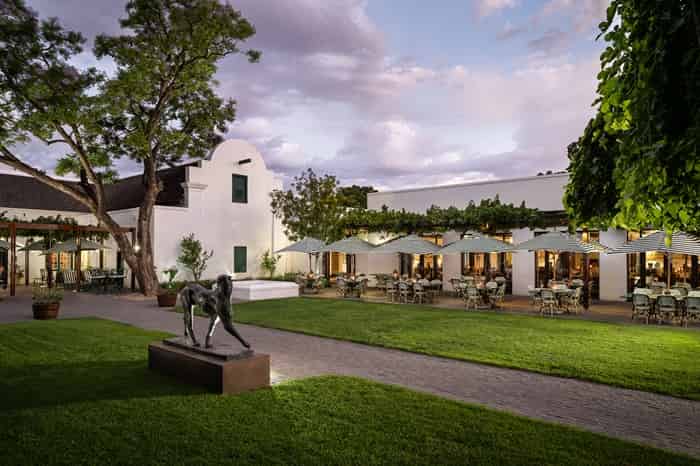
Back in town, the Drostdy Hotel provides something that might best be described as the civilised end of adventure.
Set within beautifully restored Cape Dutch buildings, the hotel combines historic charm with modern comfort and, perhaps most importantly, an excellent restaurant.
As Polisane-Casper explains, today’s travellers are looking for balance.
“They want the adventure during the day,” she says, “but they also want to know there’s a great meal, a glass of South African wine and a comfortable bed waiting at the end of it.”
In other words: effort followed by reward.
The beauty of slowing down
Ultimately, the Karoo doesn’t try to impress visitors with spectacle or spectacle alone.
Instead, it offers something quieter.
A landscape that encourages reflection. Roads that seem to stretch forever. A sky so vast it almost demands you stop and look up.
In a travel industry that often celebrates speed and scale, the Karoo offers a gentle reminder that sometimes the best journeys happen when we slow down.
And in the process, notice the horizon properly.
by Michelle Warner – (c) 2026.
Read Time: 4 minutes.
About the Writer.
 Michelle Warner has always carried stories the way others carry passports lightly, faithfully, and with purpose. She learned her craft in newsrooms, shaping sentences with care, before swapping deadlines for departures as a flight attendant with some of the world’s great airlines. Years aloft sharpened her eye for character and deepened her fondness for the small, dignified rituals of travel, the quiet kindness of strangers, the poetry of arrival, the patience learned between time zones.
Now grounded by choice, Michelle has come home to writing with the same calm authority she once brought to turbulent cabins. Her prose blends an editor’s discipline with a traveller’s wonder, tinged with humour and reverence for the golden age of travel. Each piece feels like a handwritten boarding pass, gracious, observant, and unmistakably alive.











