

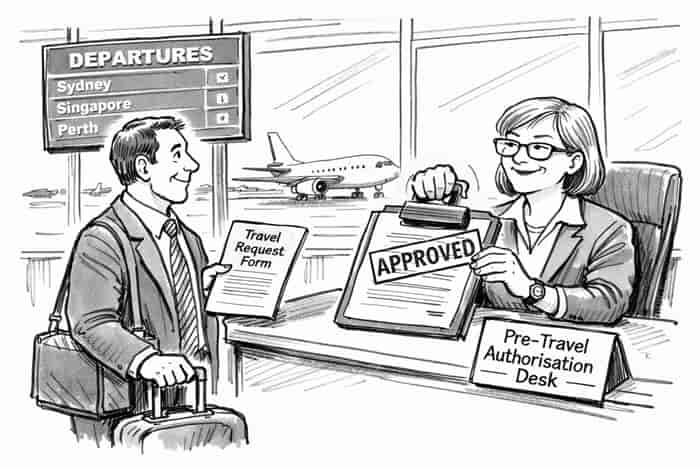
For years, the way Australian companies managed travel spend followed a ritual so familiar no one really questioned it.
An employee booked a flight. The trip happened. Receipts appeared weeks later in an expense claim. Finance checked the paperwork. Someone grumbled about policy breaches. Life moved on.
It was hardly elegant, but it worked mostly.
Now, as corporate travel roars back across Australia, finance teams are quietly changing the rules. Increasingly, they want approval before the suitcase is packed, not after the expense claim lands.
The shift has a name that sounds bureaucratic but carries real financial weight: pre-travel authorisation.
And according to SAP Concur, it is rapidly becoming the next big focus in corporate travel governance.
Business Travel Is Back And So Is Scrutiny
Anyone who thought corporate travel might fade into the Zoom era has been proven wrong.
Airports are busier again. Airline schedules are thickening. Sales teams are once more clocking frequent flyer miles.
SAP Concur’s data confirms the rebound.
According to the company, flight bookings in Australia rose nearly 10 per cent in 2025 compared with the previous year, while March 2025 saw bookings surge more than 44 per cent compared with March 2024.
Jonathan Beeby, managing director of enterprise at SAP Concur, says the numbers tell a simple story: business travel is back with enthusiasm.
But the resurgence has also sparked a new conversation inside boardrooms.
“SAP Concur data shows that flight bookings in Australia increased almost 10 per cent in 2025 compared to 2024. In the same period, March 2025 recorded the highest velocity, with corporate bookings surging more than 44 per cent compared to March 2024, reflecting a sharp rebound in corporate travel demand.”
And with that rebound comes a rather uncomfortable question for finance leaders.
“But this rebound comes with new pressures. Finance, procurement, and audit leaders are now asking a more fundamental question: is retrospective compliance enough, or should organisations embed stronger controls earlier in the travel lifecycle? For many, the answer is shifting decisively toward pre-travel authorisation.”
In plain English, it means companies want fewer surprises on the expense report.
The Trouble with Fixing Things Afterwards
Travel and expense spending has always been a tricky category.
Unlike office supplies or software licences, travel decisions happen fast. Prices change hourly. Trips are often booked by employees working to tight deadlines.
Which means policies are frequently broken not maliciously, but accidentally.
The traditional approach has been to catch those breaches after the fact.
But as governance expectations tighten across Australia, boards and auditors are increasingly uneasy about explaining overspend after the money has already gone.
Beeby is blunt about the limitation.
“From an audit perspective, reviewing expense claims after travel has taken place offers little ability for correction. Non-compliance may be identified, but the financial commitment has already been made.”
In other words, once the ticket is issued, the horse has already bolted.
Moving the Decision Earlier
Pre-travel authorisation simply moves the checkpoint forward.
Before a trip is booked, the employee submits a request outlining the business purpose, expected cost and any exceptions to policy. The request is then approved, usually by a manager or finance lead, before bookings proceed.
It sounds almost old-fashioned in its logic.
Spend money after approval, not before.
Modern platforms such as Concur Request help automate the process, linking approval workflows directly to booking and expense systems.
The result is something auditors love: a clear record showing who approved the trip, when, and why.
For finance departments accustomed to chasing receipts weeks later, that visibility is a welcome change.
The Hidden Benefit: Seeing Costs Before They Arrive
There is another advantage that often goes unnoticed: financial foresight.
In many organisations, travel costs only become visible once expense claims are submitted. By then, the quarter’s budget may already be under pressure.
Capturing expected travel costs upfront changes that picture.
“Capturing estimated travel costs upfront shifts this dynamic,” Beeby explains.
“Finance teams gain insight into upcoming plans and can manage budgets proactively. This matters in Australia’s geographically dispersed market, where domestic airfares and accommodation costs can vary significantly depending on timing and destination.”
Anyone who has tried booking flights between Perth and Sydney during a major conference week will appreciate that point.
Prices can swing wildly depending on timing, demand and destination.
With early visibility, managers can ask sensible questions before costs escalate.
Do we need three people at the meeting? Could the trip happen next week instead? Is economy class perfectly adequate?
Questions that rarely surface once the boarding pass is already printed.
Surprisingly, Travellers Often Prefer It
One common concern is that pre-approval will slow employees down.
Yet many organisations report the opposite.
Anyone who has had an expense claim rejected weeks after returning home knows the frustration. Finance queries. Missing receipts. Awkward explanations.
Pre-travel authorisation clears up most of those issues before the trip even happens.
Companies are also becoming smarter about where approvals are required. Routine domestic trips often pass quickly through the system, while higher-cost journeys, international travel, premium cabins or unusual accommodation receive closer scrutiny.
The result is less friction, not more.
And in Australia’s tight labour market, where employee experience matters, that clarity is surprisingly welcome.
Governance Is Moving Upstream
What we are really seeing is a cultural shift in corporate travel management.
Instead of enforcing policy after the fact, organisations are helping employees make better decisions at the outset.
Policies become guidance rather than punishment.
That doesn’t mean audits disappear.
Quite the opposite.
“This does not remove the need for post-travel audit; rather, it strengthens that need,” Beeby says.
Comparing estimated costs with actual expenses gives finance teams far deeper insight into travel behaviour and forecasting accuracy.
It also highlights something every seasoned traveller knows: plans change.
But when those changes are visible, they are easier to manage.
The Journey Starts Before the Trip
As Australian corporate travel continues its comeback, organisations are rediscovering an old truth of financial management.
Control works best before the spending happens.
For years, companies accepted a reactive approach to travel expenses because the alternatives were cumbersome.
Technology has removed that excuse.
Now the conversation is shifting.
The question is no longer whether corporate travel should be controlled. That was never in doubt.
The real question is when that control should occur.
Increasingly, finance leaders across Australia are arriving at the same answer.
Not after the trip.
Before the journey even begins.
by My Thanh Pham – (c) 2026.
Read Time: 5 minutes.
About the Writer.
 My Thanh Pham has lived more of a life of travel than most people ever do. After studying tourism, she went straight into the work of building journeys across South-East Asia, temples, beaches, night trains, and all, quietly fixing the messy bits so others could enjoy the ride.
She was never meant to stay behind a desk. Airline life followed, dividing her days between reservations and the airport floor, right where travel shows its true colours. Missed flights, tight hugs, frayed tempers, sudden joy, she saw it all, close up.
Now at Global Travel Media, My Thanh has traded ticket stubs for a keyboard. She writes the way she once worked: steady, clear-eyed and respectful of the road’s unpredictable rhythm, guiding readers through a world she knows from the inside.











