

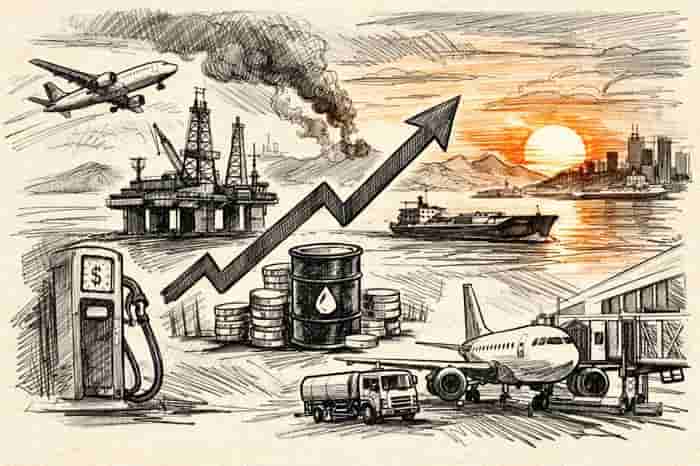
The global oil market has delivered a sharp reminder this week that geopolitics and energy rarely travel far apart.
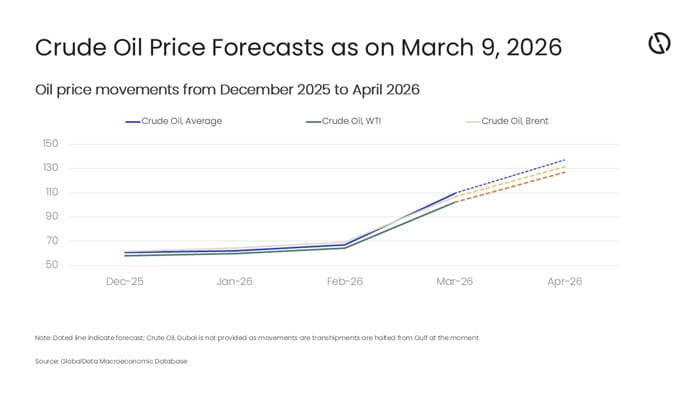
On 9 March, benchmark crude prices surged past US$115 a barrel, with Brent briefly flirting with US$120 — its highest level in nearly four years. The move was swift, dramatic and, for anyone watching airline fuel bills or global inflation trends, more than a little unsettling.
For the travel sector already juggling post-pandemic recovery, fluctuating demand and stubbornly high operating costs, the surge is being watched closely.
According to analysts at GlobalData, the rally signals a shift in how markets perceive the escalating Gulf conflict: what began as a logistics disruption affecting tanker movements is now increasingly viewed as a potential supply shock.
And that distinction matters.
Jaison Davis, Economic Research Analyst at GlobalData, explains that only days ago, the market narrative looked far less dramatic.
“GlobalData’s 2 March 2026 analysis said the escalating Gulf conflict could push oil toward $100 a barrel by late March, mainly due to logistics disruptions and heightened maritime security risks that would restrict tanker movements and raise shipping insurance costs,” Davis said.
But the situation has moved faster than anticipated.
“Since then, the conflict has intensified faster than expected, triggering a new wave of volatility.”
From Shipping Problem to Supply Threat
Initially, markets reacted primarily to the threat of disrupted shipping in the Strait of Hormuz, one of the world’s most critical energy corridors.
Every day, millions of barrels of crude pass through the narrow waterway linking the Persian Gulf to global markets. When tensions rise there, freight costs climb, insurers raise premiums and cargoes slow.
But the current price spike suggests something more serious is now being priced in.
“The latest price spike indicates that the market is rapidly transitioning from pricing in a logistics disruption to factoring in a potential supply shock,” Davis said.
“Initially, traders reacted to maritime risks in the Strait of Hormuz, which raised shipping costs and delayed cargoes. However, recent developments suggest that actual production and export volumes across key Gulf producers are now at risk.”
In plain terms, markets are beginning to worry that the world might not simply struggle to move oil, but might struggle to produce enough of it.
A Market Running With Thin Margins
One reason prices have moved so aggressively is the limited spare capacity in the global oil supply.
Davis notes that the jump from below US$100 to above US$115 highlights how little buffer there is.
“The pace at which oil prices moved from below $100 to above $115 highlights how thin the market’s spare capacity buffer has become,” he said.
“Even relatively small disruptions to Gulf production can trigger outsized price movements because the region accounts for a disproportionate share of globally traded crude.”
That concentration is precisely what makes the Strait of Hormuz such a strategic flashpoint.
Exports from Saudi Arabia, Iraq, Kuwait and the United Arab Emirates, some of the world’s largest producers, all rely heavily on the narrow shipping route.
When tensions rise there, the consequences ripple quickly through the global economy.
Airlines Watching Fuel Bills Carefully
For aviation, the stakes are obvious.
Fuel remains one of the highest operating costs for airlines, often accounting for 20–30 per cent of total expenditure. A sustained spike in oil prices inevitably feeds through to jet fuel, squeezing margins and occasionally nudging fares upward.
In the past, such surges have forced airlines to revisit hedging strategies or quietly trim capacity on less profitable routes.
For travellers, the effects can take time to appear, but they rarely disappear entirely.
Inflation, Markets and the Bigger Picture
Beyond aviation, the price surge is already prompting concern across financial markets.
“Financial markets have already begun pricing in the broader macroeconomic consequences of the oil shock,” Davis said.
“These include rising inflation expectations, currency volatility and pressure on equity markets across energy-importing economies.”
If Brent crude remains above US$110, Davis warns inflation risks could intensify across major importing economies, a headache for central banks already navigating fragile economic recoveries.
Three Paths for Oil
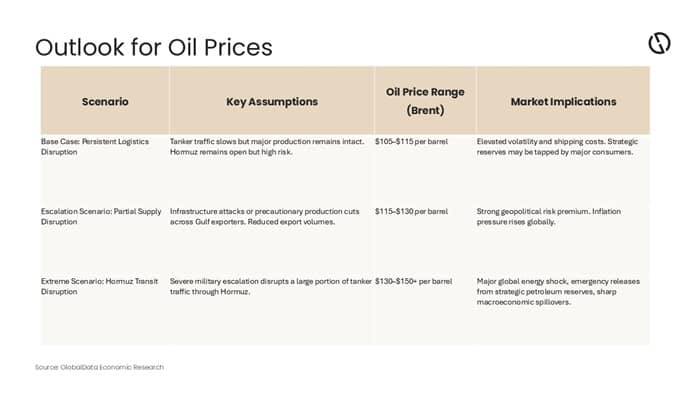
GlobalData’s updated outlook now frames the situation around three potential conflict-driven scenarios, largely defined by how events unfold in the Gulf.
The first and most optimistic involves stabilisation in maritime traffic through the Strait of Hormuz within weeks.
Should that occur, prices may retreat from their current highs as markets unwind the geopolitical risk premium.
But the second scenario sees tensions persisting, keeping tanker flows constrained and insurance costs elevated, conditions that would sustain volatile, elevated oil prices.
The third, more serious possibility involves direct threats to export infrastructure or production facilities, which could push the market into a structural supply deficit.
That scenario would almost certainly send prices significantly higher.
Diplomacy Could Calm the Waters
There is, however, a potential off-ramp.
Davis notes that regional diplomacy, particularly involving GCC states and Turkey, could help encourage international mediation and de-escalation.
If successful, tanker flows could stabilise, freight costs fall, and oil prices gradually return to pre-crisis levels.
But even then, volatility would likely linger.
“Oil markets will remain acutely sensitive to developments in the Gulf region,” Davis said.
“Pricing dynamics are increasingly shaped by security conditions and the resilience of export routes through the Strait of Hormuz.”
In other words, the oil market, much like the travel industry itself, has learned a familiar lesson over the past few years.
When geopolitics enters the room, certainty tends to leave.
And right now, the global energy market is listening very carefully to events unfolding in the Gulf.
by Alison Jenkins – (c) 2026.
Read Time: 3 minutes.
About the Writer.
 Alison Jenkins has lived most of her working life in the slipstream of aviation, where timetables matter, and people matter more. In airline sales, she built a reputation the old-fashioned way: by knowing her clients, her routes, and never missing the human detail.
Quick with a smile, quicker with a solution, she made deals with warmth and kept her edge intact.
Trade shows, FAMILS, airport lounges and hotel lobbies became her second address. And somewhere along the way, notebook in hand, she began writing the journeys rather than selling them. Her reports grew lively, observant, full of the small truths only travellers notice.
That was the moment it dawned on her: she wasn’t simply travelling. She belonged in its stories.











