


If the global aviation network has learned anything over the decades, it is this: when the skies close in one direction, the traffic simply finds another way.
That principle is playing out in real time as the ongoing Middle East conflict forces airlines and corporate travel planners to redraw their maps yet again.
While traditional flight corridors across the Gulf face disruption and uncertainty, the world’s business travellers have quietly shifted east. The result is a sudden surge in passenger flows through Asia’s major aviation gateways, particularly China.
Fresh figures from Flight Centre Travel Group’s corporate divisions, FCM Travel and Corporate Traveller, reveal that passenger volumes through key Asian hub airports have climbed 17 per cent in just the past few days.
And China, in particular, has seen traffic rocket.
Passenger flows through Chinese hub airports have surged 86 per cent, according to the latest corporate booking data, while Malaysia has recorded a 13 per cent rise.
In practical terms, that means thousands of business travellers who might previously have crossed the Middle East are now moving through Asian corridors instead.
The global aviation system, once again, is adapting on the fly.
Business Travel Doesn’t Wait
Corporate travel has always been less sentimental than leisure tourism.
Holidaymakers may postpone trips when geopolitical headlines turn ugly. Business travellers rarely have that luxury.
Deals must still be negotiated. Contracts signed. Supply chains maintained.
That’s why the latest travel data offers a useful reminder: while routes may change, commerce rarely stops.
Melissa Elf, Global Chief Operating Officer for FCM Travel and Corporate Traveller, says companies are already adjusting quickly to the evolving aviation landscape.
“The safety and well-being of our customers and staff is our top priority during this challenging time we’re closely and actively monitoring the situation,” Elf said.
“Business travel is known for its resilience and flexibility, with companies looking at alternative routes that are safe to travel through, rather than cancelling. Global economies don’t stop, and our latest data show that corporates continue to find ways through alternative routes to get deals done.”
It’s a widely shared pragmatic view across the travel management sector.
While geopolitical disruptions may dominate headlines, corporate travel managers are quietly solving problems in the background, often within hours.
Asia Steps Into the Gap
The surge through Asian hubs is not entirely surprising.
Many long-haul flights between Europe and Australia already bypass the Middle East, routing instead through major Asian aviation centres.
Cities such as Shanghai, Beijing, Singapore and Hong Kong have long functioned as critical transit points for global aviation.
Now they are becoming even more important.
“The majority of Europe to Australia flight connections operate via Asian hubs, not the Middle East, including China, Singapore, Hong Kong, and other major regional airports, with these routes continuing to operate normally,” Elf said.
For multinational companies, these routes are not merely convenient; they are essential.
Business travel sits at the heart of global commerce, enabling everything from mining contracts in Western Australia to technology partnerships across Asia.
When those travel pathways shift, entire supply chains shift with them.
The Quiet Work of Travel Managers
Behind the scenes, corporate travel managers are facing a far more complicated task.
Flight availability on these alternative routes is tightening rapidly as airlines redirect aircraft and passengers crowd onto the same corridors.
Inventory changes quickly.

Melissa Elf, Global COO, FCM Travel and Corporate Traveller.
Seat availability disappears just as quickly.
Elf said companies need to act fast to secure travel arrangements in the current environment.
“Travel Managers and passengers should note that seat availability on these alternative routes is limited and subject to rapid change. Securing a booking is essential.”
This is where travel management companies earn their keep.
Large corporate travel programmes allow organisations to tap into multiple airline reservation systems, manage rebookings and handle the sometimes maddening complexity of international ticketing.
“As a travel management company, we continue to assist as we can access different inventory systems, manage re-bookings, and handle ticketing complexities, significantly easing the burden on travellers and their companies,” Elf added.
For frequent corporate travellers, that support can make the difference between arriving on time or not arriving at all.
Meanwhile, Tourism Sentiment Wobbles
While business travel appears relatively resilient, leisure tourism is responding more cautiously.
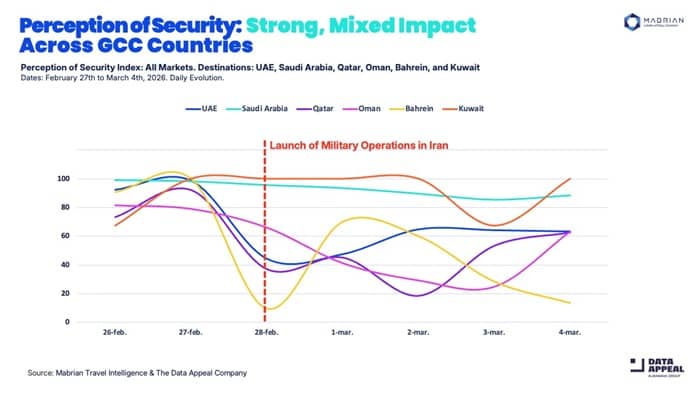
New analysis from global travel intelligence firm Mabrian, part of the Almawave-Almaviva Group, suggests that the conflict is already affecting how travellers perceive safety across parts of the Middle East.
Using its Perception of Security Index (PSI), which tracks traveller sentiment, Mabrian has recorded sharp declines across several Gulf destinations over the past month.
Bahrain experienced the most dramatic drop, with security perception plunging 81 points.
Oman followed with a decline of 56.7 points, while Qatar fell by 54.9 points.
The United Arab Emirates, although still comparatively stable, recorded a 48.3-point drop, while Saudi Arabia declined by 13.6 points.
For destinations that have spent years building reputations for stability, such changes are significant.
The Ripple Effect Beyond the Gulf
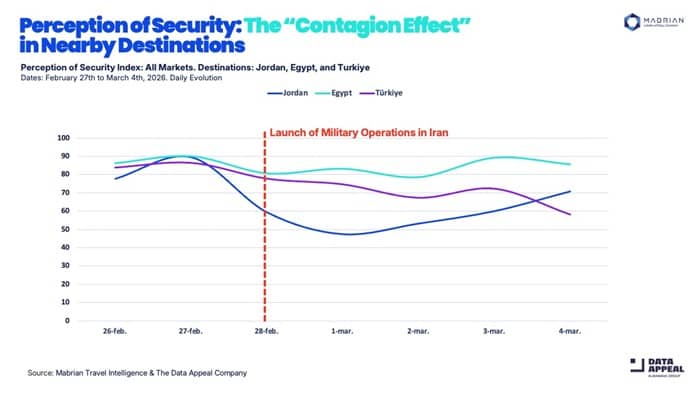
The effects are not limited to the Gulf states.
Neighbouring destinations such as Jordan, Egypt and Türkiye are also experiencing what analysts describe as a spillover effect.
Jordan’s PSI score dropped 30.3 points, while Türkiye declined 25.8 points.
Egypt has proved slightly more resilient, slipping only 7.6 points, although recovery remains uncertain.
Carlos Cendra, Director of Marketing and Communications at Mabrian, says the situation demonstrates how fragile traveller confidence can be.
“These destinations have worked meticulously to position themselves as stable and secure environments,” Cendra said.
“In fact, our forecast for early 2026 showed that Western Asia was gaining market share in international travel demand, with three GCC cities ranking among the world’s top 10 destinations for growth in travel intent during the first half of the year.”
“This sudden trend shift highlights how crucial it is for destinations to closely monitor travellers’ perceptions, particularly safety sentiment, an extremely strategic, yet inherently fragile and volatile asset.”
American Travellers Most Sensitive
The data also shows that US travellers are reacting particularly strongly to security concerns.
Across several Gulf destinations, perception scores among American travellers have dropped more sharply than those from European markets.
Kuwait saw a dramatic 87.3-point decline among US travellers.
The UAE dropped 79.2 points, while Saudi Arabia fell 17.8 points.
Egypt also experienced a significant 32.6-point decline in American safety sentiment.
While perception does not always translate directly into booking behaviour, the trend is closely watched by tourism authorities.
Travel Demand Begins to Shift
Mabrian’s data suggest three potential shifts in global travel demand are emerging.
The first is a renewed interest in closer-to-home travel, particularly among European tourists.
German travellers are showing growing interest in Morocco and Greece, while Italian travellers are turning toward Croatia, Spain and Norway.
British travellers are also exploring alternatives such as Malta, Morocco and Montenegro.
A second trend is the continued strength of demand for Asia, driven largely by strong direct air connectivity.
Destinations such as Japan, Thailand, Vietnam and the Philippines remain highly attractive, although airfare levels will ultimately determine whether interest converts into bookings.
Finally, long-haul “bucket list” destinations are also gaining attention.
British travellers are showing increased interest in South Africa and the Maldives, while Latin America, particularly Peru and Brazil, is attracting growing attention from European travellers.
Aviation’s Old Truth
For the travel industry, the situation offers a familiar lesson.
Air routes may change. Traveller sentiment may fluctuate. But the global travel system rarely stops.
Instead, it adjusts sometimes quietly, sometimes dramatically.
Right now, those adjustments are happening across Asia’s aviation hubs.
And if the latest data is any guide, China’s airports are once again proving just how central they are to the world’s travel network.
Commerce, as ever, is finding another way to fly.
by Michelle Warner – (c) 2026.
Read Time: 7 minutes.
About the Writer.
 Michelle Warner has always carried stories the way others carry passports lightly, faithfully, and with purpose. She learned her craft in newsrooms, shaping sentences with care, before swapping deadlines for departures as a flight attendant with some of the world’s great airlines. Years aloft sharpened her eye for character and deepened her fondness for the small, dignified rituals of travel, the quiet kindness of strangers, the poetry of arrival, the patience learned between time zones.
Now grounded by choice, Michelle has come home to writing with the same calm authority she once brought to turbulent cabins. Her prose blends an editor’s discipline with a traveller’s wonder, tinged with humour and reverence for the golden age of travel. Each piece feels like a handwritten boarding pass, gracious, observant, and unmistakably alive.











