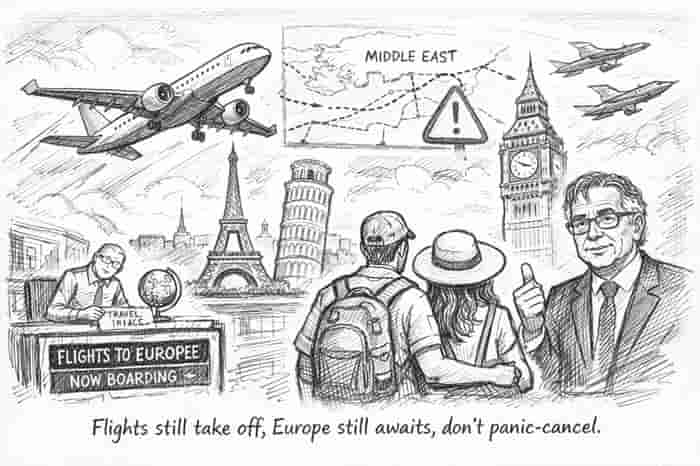
A small misunderstanding can travel faster than a Boeing at cruising altitude. And this week, a few headlines managed precisely that.
The Australian Travel Industry Association (ATIA) and aviation safety specialist Professor Ron Bartsch have stepped in to set the record straight after media reports incorrectly suggested Australians should cancel travel to Europe for the next six months.
They shouldn’t.
In fact, quite the opposite.
The confusion stems from comments Professor Bartsch made earlier about the operational challenges caused by restricted Middle East airspace, particularly the knock-on effects for flight corridors, hub operations and fuel costs. Sensible aviation analysis, in other words. But somewhere between commentary and headline, nuance went missing.
Bartsch was quick to correct the record.
“My comments this morning were about the operational complexities created by Middle East airspace restrictions the impact on flight corridors, hub disruptions and fuel costs which will continue to be felt for the next 6 months,” he said.
“I did not advise Australians to cancel their travel plans to Europe. Aviation is an adaptive industry. Airlines are rerouting, alternatives exist, and travellers should be making decisions based on accurate information, not headlines that misrepresent what was said.”
It is, frankly, a classic case of aviation reality colliding with modern media velocity.
Airlines Continue Flying
Despite the geopolitical tensions affecting some airspace over the Middle East, flights between Australia and Europe have not been grounded.
Far from it.
Etihad Airways and Emirates continue operating services, while Asian carriers, including Singapore Airlines and several Chinese airlines, are maintaining normal schedules and offering alternative routings into Europe.
Qantas flights to Europe are also continuing without interruption.
Notably, Qantas does not operate flights into the Middle East, meaning its European routes are unaffected by the specific airspace complications currently being discussed.
For travellers, the message is simple: the aviation system is adjusting, just as it always has.
Airlines reroute. Schedules shift. Fuel costs fluctuate. But the industry’s ability to adapt is one of its defining strengths.
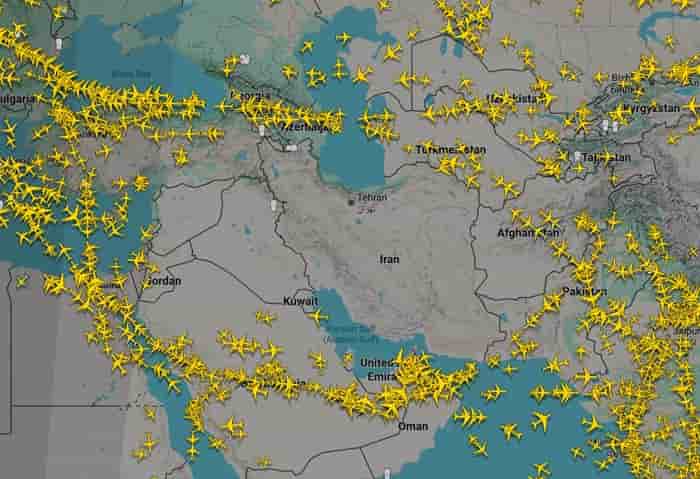
A FlightRadar24 snapshot of Europe-bound flight paths across Middle Eastern airspace, captured at 1500hrs on 6 March 2026.
ATIA: Do Not Panic-Cancel
If there’s one piece of advice the travel industry wants Australians to hear clearly, it’s this: do not cancel your trip prematurely.
ATIA chief executive Dean Long says the sector has weathered far more complex disruptions than this.
“There are plenty of safe ways to get to Europe and the aviation sector has and will continue to adapt,” Long said.
“Asia is open and operating. We have flights coming out of the Middle East. There will be some delays and a bit more disruption than what we’re used to but no one in the travel industry is going to put you in a place where it’s unsafe.”
For travellers already booked to depart soon, patience is not just prudent, it protects your wallet.
Long stresses that travellers should never cancel flights themselves if disruptions are possible.
“Importantly, do not cancel. Whether you are booked to travel in the next weeks or planning to travel in coming months,” he said.
“If you’re booked to travel shortly via the Middle East, it is critical that you do not panic-cancel but rather wait for your airline to cancel as otherwise you are erasing all of your rights of a refund or rebook.”
It’s a small but crucial technicality many travellers miss.
Airlines offer refunds or rebookings when they cancel flights. If passengers cancel first, those rights can disappear faster than a last-minute upgrade.
Talk to a Travel Professional
For those travelling later in the year, the advice is reassuringly traditional: speak to a travel professional.
ATIA recommends consulting accredited travel agents or tour operators, who can quickly identify alternative routes if necessary.
Routes through Asia, particularly Singapore, Hong Kong and mainland China, remain widely available and reliable.
And as any seasoned traveller will tell you, there’s usually more than one way to reach Paris.
Practical Advice for Travellers
ATIA has also issued several practical steps for Australians planning to travel soon:
• Download your airline’s mobile app and check the “Manage My Booking” section before heading to the airport
• Register with SmartTraveller:
• If already in the Middle East and needing to return home, register with DFAT, as regional airlines are assisting Australians with repatriation
• If travelling in the next few weeks, do not panic-cancel
• If travelling in the coming months, consult your accredited travel agent about alternative routes
Aviation’s Long History of Adaptation
Veterans of the travel industry know that aviation has always operated in a world of moving parts.
Volcanic ash clouds. Security closures. Weather disruptions. Airspace restrictions. Every few years, the skies throw something new into the mix.
And yet the aircraft keep flying.
Professor Bartsch’s central point, lost briefly in the noise, remains a simple one: aviation is remarkably resilient.
Airlines adjust flight paths, open new hubs and adapt their schedules faster than most industries can rewrite a press release.
For Australians dreaming of European summer holidays, the skies remain very much open.
The only thing travellers should cancel right now is unnecessary panic.