

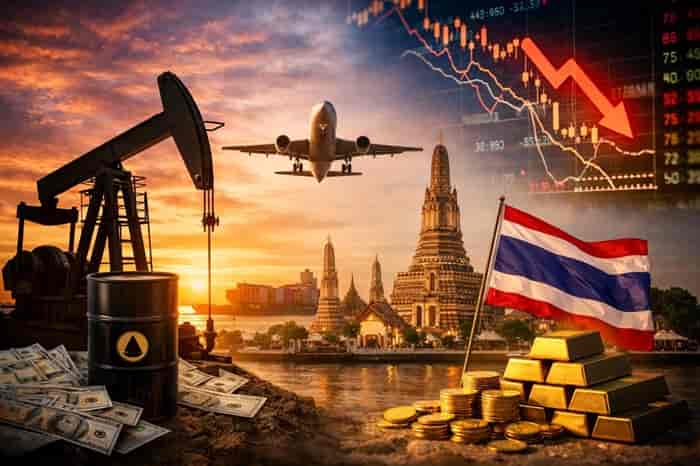
In travel, as in life, some worries arrive with great drama. Others creep in quietly, almost politely, and settle into the conversation.
Right now, across Thailand’s travel industry, the subject quietly hovering over coffee cups and airport lounges is oil.
No panic, mind you. Not yet.
But anyone who has spent time around airline executives knows that fuel prices tend to focus attention rather quickly.
Analysts have begun circling a number that carries psychological weight: US$115 a barrel. As long as oil stays comfortably below that line, the consensus is that Thailand and much of Asia should be able to absorb the impact without too much difficulty.
Push decisively beyond it, however, and the conversation becomes a little less relaxed.
Thailand’s position in this particular story is fairly straightforward. The country imports much of its energy, which means higher oil prices move quickly through the economy. Transport costs edge upwards, logistics firms start recalculating budgets and airlines, inevitably, begin sharpening their pencils.
None of this is unfamiliar territory.
The aviation business has spent decades learning to live with the occasional shock from oil markets. Fuel is one of the industry’s highest costs, and when prices move, airline accountants tend to notice before anyone else.
Across Southeast Asia, the situation is broadly similar. Higher energy costs ripple through shipping, trucking and manufacturing. It becomes more expensive to move goods, more expensive to move people, and eventually, more expensive to move tourists.
Further north, Japan and South Korea are watching the same numbers with equal interest. Both rely heavily on imported fuel, and rising energy costs have a habit of creeping into everything from airline fares to supermarket shelves.
Even Australia and New Zealand, despite their natural resources, cannot entirely escape the arithmetic of aviation fuel. Geography plays its part here. Long distances and long-haul flights mean that fuel costs matter sometimes, rather a lot.
Financial markets, never fond of uncertainty, have already begun adjusting their posture.
Energy companies have enjoyed a modest lift in share prices, while airlines and tourism-related stocks have attracted more cautious attention. Investors, as ever, prefer the predictable.
Central banks are also watching closely. Higher fuel prices feed into inflation, which complicates the already delicate task of managing interest rates and economic recovery.
For the travel industry, however, the effects tend to manifest more practically.
Short-haul travel within Asia usually proves surprisingly resilient. Flights are shorter, aircraft turn around quickly, and regional demand remains strong. Airlines can adjust capacity relatively easily if required.
Long-haul routes tell a different story.
Flights linking Asia with Europe, North America and Oceania require large fuel loads and operate on thinner margins. When oil prices rise, airlines eventually face a choice: raise fares slightly, trim services, or quietly absorb the price increases.
None of those options is particularly cheerful.
Thailand’s tourism sector, thankfully, approaches this moment in better shape than during previous crises. Visitor markets are more diverse, regional travel remains robust and domestic tourism continues to provide a steady backbone for the industry.
Still, if fuel prices stay elevated for long enough, the effect tends to reach the traveller’s wallet.
Higher airfares rarely stop travel entirely, but they do encourage a little hesitation, particularly when it comes to long-haul holidays.
That could slow some of the enthusiasm currently building toward 2026, although few observers believe it will derail the broader recovery.
Meanwhile, investors have been quietly rediscovering gold, the traditional safe harbour whenever markets feel uneasy. Prices have edged upwards as traders hedge their bets on how long current tensions may last.
Whether that trend continues will depend largely on the oil market itself.
If energy prices settle, confidence tends to follow.
If they do not, the ripple effects will eventually spread well beyond stock exchanges and airline spreadsheets.
In travel, fuel has always been the unseen companion on every journey. When it becomes expensive, the entire industry tends to notice.
For now, Thailand is simply watching the numbers calmly, carefully, and with the quiet patience that comes from having seen this story unfold more than once.
By Andrew J. Wood and edited by Jill Walsh – (c) 2026.
Read Time: 3 minutes.
About the Writer.
 Andrew J. Wood has lived in Thailand since 1991. He is a former Director of Skål International and a Past President of Skål International Asia, Skål International Thailand, and Skål International Bangkok.
A former hotelier with senior management experience at leading hospitality groups, including Shangri-La, Minor International, Landmark and Royal Cliff, he writes regularly for international travel and hospitality publications.
His work focuses on tourism trends across Asia, sustainable tourism development, and the future of travel and hospitality in the Asia-Pacific region.











