

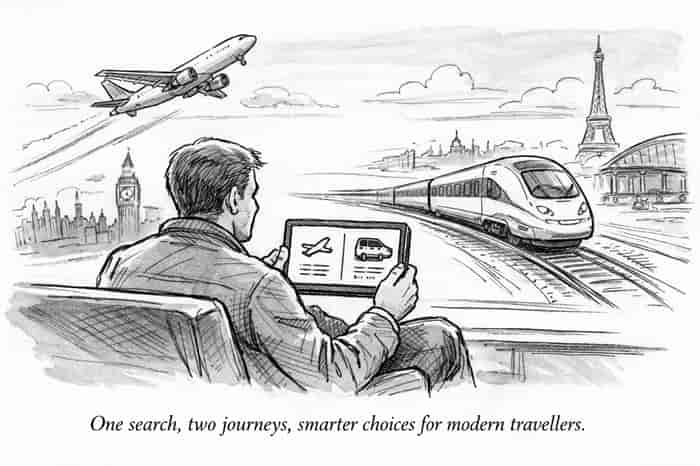
There are moments in travel tech where you wonder why something didn’t exist years ago. This is one of them.
Skyscanner has quietly rolled out a new feature that places trains and flights side by side in a single search, a simple idea that feels almost obvious, yet surprisingly overdue.
For Australian travellers who spend half their lives long-hauling into Europe before zig-zagging across the continent, the change is more than cosmetic. It’s practical. And potentially game-changing.
“We’re delighted to now be able to offer travellers the opportunity to see both flight and select train options alongside each other,” said Brian Plaum, Skyscanner Travel Expert. “There are many journeys where both modes of transport are available and this view should be a valuable addition to travellers’ decision making.”
Translation? Fewer tabs. Less guesswork. Better decisions.
Until now, comparing rail with air often meant bouncing between aggregators, rail sites and airline apps, hardly the frictionless planning experience the industry keeps promising. Skyscanner’s update collapses that clutter into a single, clean comparison showing time and price at a glance.
And especially in Europe, that matters.
Because while aviation dominates the long haul, rail has always owned the middle distance. On the right routes, trains don’t just compete; they win. No baggage stress, city-centre arrivals, scenery instead of seatbelts.
The new functionality already spans selected domestic and cross-border routes across the UK, Spain, Italy, Germany, France, Switzerland, the Netherlands and even South Korea. For Australians heading north after touching down in London, Paris or Rome, that’s immediately useful.
Importantly, Skyscanner hasn’t dumped every timetable into the mix. Train results only appear where they genuinely make sense, typically direct journeys under eight hours or simple connections within a 90-day booking window. It’s curated, not chaotic.
And the economics are compelling.
Take Venice to Munich: roughly AUD 71 by train, compared with about AUD 197 by plane. London to Edinburgh? Rail is still around 40 per cent cheaper on average. Even heavily trafficked routes like Paris to Amsterdam show solid savings once the dust settles.
Of course, seasoned travellers know headline airfares rarely tell the full story. Add luggage, transfers, airport time and early starts, and rail’s value proposition becomes clearer.
Then there’s the sustainability layer, the elephant in every modern travel conversation. Skyscanner’s own data suggests one in four travellers want to see train options alongside flights, and more than 80 per cent say sustainability matters, even if many remain unsure how to act on it.
By placing lower-emission rail options in the same decision frame, Skyscanner isn’t preaching. It’s enabling. And that’s a far more effective nudge.
“There are obvious examples where this new feature makes sense for domestic travel, but we see great benefits for holidaymakers hopping around Europe and even further afield,” Plaum added.
“Using the new Skyscanner search to compare trains and flights will be especially useful when travelling for specific events. Following a musician or sports team to a fixed destination might mean travellers are not as aware of the various options available.”
That last point resonates. Event-driven travel concerts, tournaments, and festivals are booming, and it rarely follows neat A-to-B patterns. Tools that simplify those messy itineraries tend to stick.
From a trade perspective, the rollout is another sign that the lines between transport categories are continuing to blur. Aggregators are no longer just about air. They’re becoming mobility platforms stitching together planes, trains and whatever comes next.
For advisors and suppliers, that shift is worth watching. The more comparison tools improve, the higher expectations rise.
For travellers, though, the takeaway is refreshingly uncomplicated. One search. More clarity. Better choices.
The feature is already live via Skyscanner’s web platform, with app visibility expected to follow. And while it may not rewrite the rules of travel overnight, it’s the kind of incremental improvement that quietly changes behaviour.
Not flashy. Not loud. Just useful.
And in travel, that’s often what lasts.
by Kanda Limw – (c) 2026.
Read Time: 4 minutes.
About the Writer.
 Kanda Limw is one of those rare people every office quietly depends on. She doesn’t fuss or fanfare her way through the day; she simply notices what needs doing and gets on with it, often before anyone else has drawn breath.
Years behind the scenes have taught her that good administration isn’t about control; it’s about care. Diaries align, tensions soften, loose ends disappear. When the day threatens to tilt, Kanda steadies it without drama.
There’s something reassuringly old-fashioned about her reliability. She listens properly, remembers the small things, and does what she says she will.
Kanda has no appetite for the spotlight. Yet ask anyone who works alongside her, and they’ll tell you that when she’s there, everything runs just a little smoother.











