

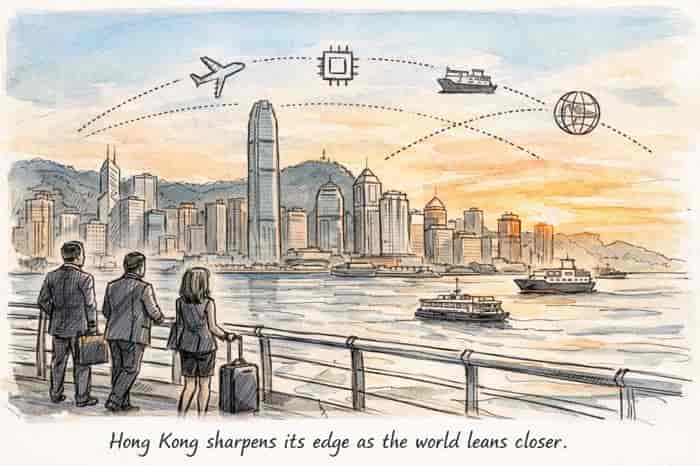
Every now and then, Hong Kong rolls out a Budget that feels less like housekeeping and more like a signal flare. This week’s 2026–27 edition sits firmly in that camp.
Unveiled by Financial Secretary Paul Chan, the latest blueprint doesn’t try to reinvent the harbour city. Instead, it sharpens the edges, reinforcing what Hong Kong already does well while quietly nudging it into the next economic cycle. And if you ask the Hong Kong Trade Development Council (HKTDC), that’s precisely the point.
There’s no shortage of big themes: global connectivity, innovation muscle, and the eternal balancing act between mainland gravity and international reach. But read between the lines, and the message is simpler: Hong Kong wants to stay indispensable.
A familiar playbook, tuned for a different era
Hong Kong has always traded on relevance. When the world shifts, the city adjusts its footing and keeps moving. This Budget follows that tradition, albeit with a slightly firmer tone.
The government’s decision to anchor policy around a formal five-year roadmap, paired with a HK$200 million boost to the BUD Fund, sends a clear message to SMEs: you’re still the engine room.
HKTDC Chairman Prof Frederick Ma didn’t waste time getting behind the direction, framing the Budget as both pragmatic and forward-looking. The emphasis on economic transformation and higher-quality growth will resonate with businesses still recalibrating after years of global whiplash.
And yes, there’s the usual policy language about opportunity. But behind it sits a very real commercial truth: Asia’s supply chains are shifting, and Hong Kong wants to remain the junction box.
The “superconnector” narrative rolls on
If you’ve spent any time covering Hong Kong, you’ll know the “superconnector” label gets a regular workout. Yet it persists because, frankly, it still holds.
The city occupies a peculiar sweet spot culturally Chinese, commercially global, and structurally efficient. That blend remains its calling card, particularly as companies hedge their bets across multiple markets.
HKTDC is leaning heavily into that positioning, using its global network of 51 offices and counting, to keep trade flowing in both directions. ASEAN and the Middle East are firmly in the crosshairs, alongside a broader push into emerging markets where growth curves still point north.
In practical terms, it’s less about grandstanding and more about matchmaking. Trade fairs, business missions and deal-making platforms remain the council’s bread and butter, the unglamorous but essential machinery that keeps commerce humming.
SMEs get a longer runway
For smaller players, the Budget reads as a reassurance exercise. Not flashy, but quietly useful.
Beyond funding top-ups, there’s a stronger focus on infrastructure-style support, branding help, supply-chain resilience, and access to professional services that can smooth the path offshore. In a world where expansion is often more about navigation than ambition, that matters.
HKTDC’s “go-global” toolkit continues to evolve into something resembling a concierge service for exporters. Market intelligence here, e-commerce enablement there, plus the occasional well-timed introduction. It’s not headline-grabbing work, but it’s the sort of scaffolding businesses remember.
Innovation moves from buzzword to backbone
Where the Budget does feel different is in its treatment of innovation and technology. The intent is unmistakable: Hong Kong wants more than a supporting role in the region’s tech story.
That ambition will play out visibly at InnoEX this April, the centrepiece of Business of Innovation and Technology Week. The event has steadily grown into a credible shop window for emerging technologies, pulling together startups, investors and policymakers in one slightly chaotic, always fascinating ecosystem.
For the business events sector, that’s good news. Innovation attracts movement and movement drives meetings, incentives and exhibitions. It’s a cycle Hong Kong understands well.
There’s also a more deliberate push around intellectual property integration, a subtle but important shift. Innovation is one thing; protecting it is another.
Finance reconnected with reality
Looking ahead, the Asian Financial Forum’s 20th anniversary looms large. The milestone offers more than nostalgia it’s a chance to recalibrate.
The emerging “Finance+” concept, which aims to tether capital more tightly to real-economy outcomes, reflects a broader rethink across global financial centres. Hong Kong, ever pragmatic, appears keen to lead rather than follow.
For a city built on liquidity, making finance feel tangible again is a logical evolution.
Not a reinvention, a recalibration
Strip away the policy gloss, and this Budget feels less like a pivot and more like a tightening of the bolts. Hong Kong isn’t chasing reinvention for the sake of headlines. It’s refining a model that has served it remarkably well.
There’s comfort in that continuity. But there’s also intent.
The city knows the competition is fiercer, the geopolitics messier, and the margin for complacency thinner. So it’s doing what Hong Kong has always done, leaning forward, adjusting the sails and trusting the currents it understands best.
For global trade watchers, the takeaway is clear: Hong Kong isn’t stepping out of the game. If anything, it’s stepping in with a steadier hand and a sharper sense of timing.
And in this part of the world, timing is everything.
by Charmaine Lu – (c) 2026.
Read Time: 4 minutes.
About the Writer.
 Charmaine has always carried a quiet kind of courage. She grew up in Shanghai, a city that never slows, yet found her own balance there, studying accounting for discipline and the arts for beauty. She needed both, and she knew it.
When she arrived in Sydney in the 1980s, she brought little more than a degree, a suitcase and the resolve to begin again. The harbour breeze felt like permission. She met Stephen, and together they built a life that bridged two cultures, a family, a home, and plenty of laughter.
Work was never just work. Long before search engines ruled the day, Charmaine was helping businesses be found by telling stories people wanted to read. That remains her quiet gift.
Her life isn’t a résumé. It’s grace under change structure and creativity, held together by a generous heart.











