

There’s something quietly reassuring about a solid airline result, not the headline-grabbing theatrics, but the steady drumbeat of performance that tells you the machine is humming. Qantas Group’s 1H26 earnings fall firmly into that category: not flamboyant, but deeply telling.
With a refreshed fleet rolling in, loyalty numbers climbing, and a new Sydney–Las Vegas route on the horizon, the Flying Kangaroo is signalling something more meaningful than a routine earnings beat. This is a repositioning measured, deliberate, and unmistakably long-term.
Qantas Group CEO Vanessa Hudson framed it plainly.
“As we enter an exciting new era for the Qantas Group, our focus continues to be on delivering for our customers, employees and shareholders.”
It’s a line that could easily drift into corporate speak, but this time, the numbers back it up.
Fleet Renewal Begins To Pay Dividends
If there’s a single thread running through this result, it’s fleet renewal. Not as a future promise, but as a present-day catalyst.
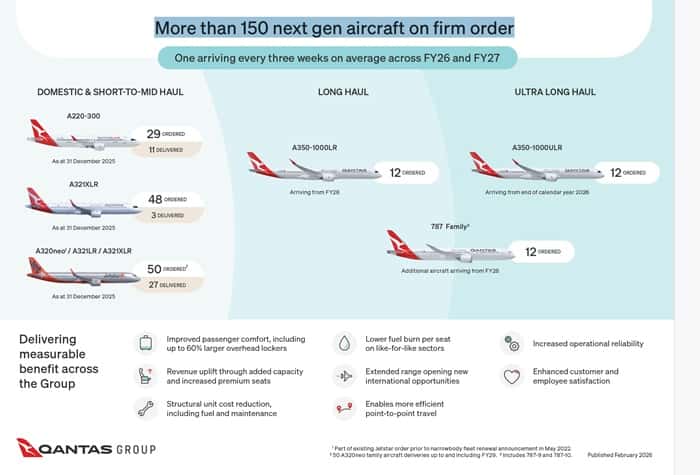
The group is mid-way through the largest aircraft overhaul in its history, and early returns are already visible. Six new aircraft joined the fleet in the first half, with another 30 expected within 18 months. These aren’t vanity upgrades; they’re operational levers.
Hudson was direct on the impact.
“These new aircraft are not only improving the experience for our customers and opening up new opportunities for our people, they’re also helping drive our financial performance.”
Jetstar, in particular, demonstrated the thesis in action. Around 60 per cent of its profit growth was tied directly to next-generation aircraft delivering efficiency gains while unlocking fresh network opportunities.
That’s the sort of operational arithmetic investors tend to appreciate.
Domestic Engine Still Running Hot
On home turf, demand remains robust, a reassuring constant in an industry that has seen more than its share of volatility.
Group Domestic delivered $1.05 billion in underlying EBIT, up 14 per cent year-on-year, driven by sustained travel demand and better operational delivery. Qantas itself lifted revenue by five per cent on a four per cent capacity increase, buoyed by business travel and premium leisure demand.
The Western Australian resources corridor continues to underpin corporate travel, while the premium leisure segment, that sweet spot between economy and indulgence, is proving remarkably resilient.
Meanwhile, Jetstar is quietly doing what Jetstar does best: filling seats.
More than 8.5 million passengers travelled domestically with the low-cost carrier during the half, and over half paid under $150 for their fare. That value narrative still resonates, even as aviation costs creep higher across the board.
International Outlook Mixed But Strategic
International performance was less exuberant but far from concerning. Underlying EBIT dipped six per cent to $463 million, largely due to rising engineering and operational costs, alongside training expenses tied to incoming aircraft.
Capacity increased modestly, aided by the return of another A380, while premium cabins continued to outperform economy demand, a pattern now well entrenched in long-haul aviation economics.
Qantas is also recalibrating its US network. Some Melbourne–Los Angeles services will transition from A380s to 787s, with the superjumbo redeployed onto the Sydney–Singapore route.
In simple terms: optimise where the demand sits.
Project Sunrise Edges Closer To Reality
Hovering over the result is the quiet gravitational pull of Project Sunrise, Qantas’ ultra-long-haul moonshot linking Australia directly to cities like London and New York.
The new Airbus A350s will be central to that ambition, and while still on the runway rather than in the air, the confidence remains intact.
Hudson hinted at that momentum, noting that the performance of existing ultra-long-haul routes continues to validate the strategy.
The industry will be watching closely. Sunrise isn’t just a route expansion, it’s a statement of intent.
Loyalty Continues Its Quiet Revolution
If the fleet is the muscle, Qantas Loyalty is the margin.
Underlying EBIT from the division climbed 12 per cent to $286 million, driven by continued engagement across its now 18.3 million members. That’s not merely scale, it’s ecosystem power.
Points earned through retail partners jumped nearly 20 per cent, with stalwarts like Woolworths and Red Energy still delivering strong returns. The relatively new David Jones partnership adds another layer, pulling fashion and lifestyle into the loyalty orbit.
Redemptions surged 17 per cent, with over 2.5 million reward seats booked in six months, roughly 14,000 per day. Even Ticketek saw a 50 per cent spike in redemptions as members used points for concerts and sport.
It’s a reminder that loyalty programs are no longer airline accessories. They’re standalone businesses with aviation attached.
Frequent Flyer Tweaks Signal Member Focus
Against that backdrop, Qantas Loyalty is rolling out comprehensive program improvements, a move likely to resonate strongly with its high-value customer base.
While full details are still emerging, the emphasis is clearly on enhancing value perception, particularly for frequent flyers navigating a more complex rewards landscape.
For an airline where loyalty drives both revenue and sentiment, the optics matter.
And then there’s the headline-grabber: Qantas will launch the first direct flight between Sydney and Las Vegas.
Not just another route, but a carefully chosen one. Las Vegas continues to punch above its weight as a leisure and events magnet, and direct connectivity from Australia has long been a missing piece.
Expect strong implications for inbound tourism, too.
Investing In People, Not Just Planes
Beyond aircraft and balance sheets lies the workforce of 30,000 employees who ultimately carry the brand.
Qantas is doubling down on capability development, supporting more than 5,600 staff through leadership programs while expanding pilot and engineering pipelines. Nearly 100 new pilots joined the Qantas Pilot Academy, and engineering apprenticeships have grown to 250.
The airline is also signalling long-term employment confidence, maintaining its target of creating 8,500 Australian jobs by 2030.
In an industry once defined by contraction headlines, that’s no small statement.
Shareholders Get Their Turn
Investors haven’t been forgotten.
The board approved a fully franked interim dividend of $300 million, up 20 per cent, alongside a planned $150 million share buyback. Liquidity remains strong at $12.6 billion, even as net debt edges to the lower end of the target range.
It’s a delicate balance: investing heavily while still returning capital.
So far, Qantas appears to be threading the needle.
Costs Loom As The Quiet Risk
Not everything is smooth cruising.
Hudson flagged rising airport charges and government fees, which have climbed at double the rate of inflation over the past year, a trend echoed globally. Fuel remains a persistent wildcard, with second-half costs forecast at roughly $2.5 billion.
The group is targeting transformation benefits of around $400 million in FY26 to offset cost pressures, a reminder that operational discipline remains critical.
Aviation margins, after all, are famously unforgiving.
Outlook: Stable, With Measured Optimism
Looking ahead, the tone is steady rather than euphoric.
Domestic unit revenue is expected to rise around three per cent in the second half, while international yields should climb between one and three per cent. Loyalty earnings are forecast to grow by 10–12 per cent for the full year.
In other words: growth, but disciplined growth.
And that may be the most telling signal of all.
The Bigger Picture
Strip away the investor deck language, and the 1H26 results reveal something quietly important: Qantas is transitioning from recovery to reinvention.
Fleet renewal is accelerating. Loyalty is compounding. Network bets are becoming more deliberate. And the balance sheet, while not bulletproof, is holding firm.
For an airline that has spent much of the past decade navigating turbulence both literal and metaphorical, that’s no small achievement.
And if the Sydney–Las Vegas route proves anything, it’s that Qantas still knows how to mix pragmatism with a dash of ambition.
Which, in aviation, is often the difference between simply flying and truly leading.
by Stephen Morton – (c) 2026.
Read Time: 8 minutes.
About the Writer.
 Stephen Morton has spent nearly fifty years shaping how the travel industry thinks, speaks and sells itself. From a family agency in 1976 to today’s digital frontier, he’s rarely followed the crowd; more often, he’s been waiting at the front long before anyone noticed the line forming.
In the mid-nineties, he pushed Agents Support Systems online while the industry still clung lovingly to the fax machine. In 2001 came e-Travel Blackboard, a daily bulletin that grew into Australia’s most read industry newsletter, expanding across New Zealand, Asia, the Americas and MICE.
Global Travel Media followed in 2009, earning international awards and spawning new titles, from Destination Thailand News to Global Cruise News and now GTM Holidays and the forthcoming GTM Mall.
Lecturer, founder, agitator Morton has always turned instinct into impact.











