

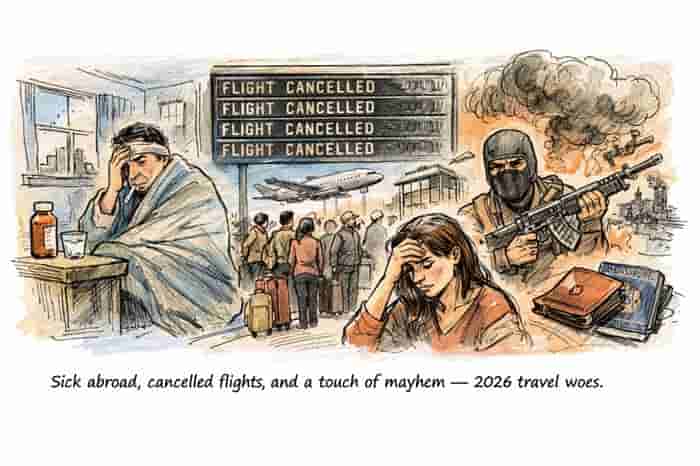
Every era of travel has its dominant anxiety. In the early days, it was distance. Later, it was costly. Then came security. Now, as we edge deeper into the 2020s, the global traveller seems preoccupied by something far more practical: staying healthy and simply getting where they’re going without the wheels falling off.
Fresh findings from the Global Rescue Winter 2026 Traveller Sentiment and Safety Survey suggest a subtle but telling shift in traveller psychology. The modern international flyer isn’t lying awake worrying about grand geopolitical dramas. They’re worrying about catching pneumonia in Prague or watching a departure board flicker to “cancelled” after months of planning.
According to the survey, 31% of experienced international travellers say illness or injury abroad is their biggest disruption concern for 2026. Not terrorism. Not lost luggage. Just the uncomfortable reality of being unwell in unfamiliar territory.
It’s an insight that rings true for anyone who has spent enough time on the road. Adventure is marvellous in theory; navigating foreign healthcare systems at midnight is rather less romantic.
Civil unrest and terrorism still loom in second place at 21%, while the old-fashioned nightmare of losing passports, cards or wallets sits at 12%. The more cinematic fears, kidnapping, war, and natural disasters, linger further down the list, present but no longer dominant.
Dan Richards, CEO of The Global Rescue Companies, put it plainly:
“When travelers think about international risk, it’s not abstract geopolitics alone. Health emergencies, instability on the ground and the ability to get home when things go wrong are driving real concern.”
The Gender Gap That Isn’t And Is
Men and women broadly agree on the biggest fear: getting sick overseas. But once you look past that, the tone shifts.
Men appear slightly more preoccupied with extreme scenarios, kidnapping or detainment, while women register stronger concern around civil unrest and war. Not dramatically different, but enough to suggest how personal experience and perception continue to shape risk tolerance.
Geography plays its part too. Non-US travellers show higher anxiety around instability than Americans, a reminder that where you sit often determines what feels close to home.
The Real Villain: Cancelled Flights
If health worries sit quietly in the background, flight disruptions are the noise everyone hears.
When asked what is most likely to ruin a trip outright, travellers delivered a near-unanimous verdict: cancelled flights. More than a third nominated cancellations as the ultimate trip-killer, and it’s easy to see why. One broken link in the aviation chain can unravel weeks of planning in minutes.
Bad weather follows close behind, then the evergreen sins of poor planning and cramming too much into too little time.
Richards again struck a chord: “Travelers can accept inconvenience, but they struggle with uncertainty.”
It’s a line most travel advisors would happily frame and hang on the wall.
A Quiet Case for Experience
Perhaps the most interesting takeaway isn’t what travellers fear, but what the findings imply. In an era where booking tools promise simplicity and algorithms promise perfection, the data quietly reinforces the value of experience.
Poor planning still derails journeys. Over-ambitious itineraries still exhaust people. Packing too much still proves unnecessary. In other words, despite all our apps and dashboards, the fundamentals of travel remain stubbornly analogue.
For the trade, that should sound oddly reassuring.
Because beneath the technology and trend reports lies a simple truth: travellers still want reassurance. They want perspective. They want someone who has seen it all before and knows which worries are worth listening to.
Certainty Becomes the New Luxury
If there is a broader lesson here, it’s that travel has entered a more pragmatic phase. The post-pandemic traveller hasn’t lost their appetite for discovery, but they have developed a sharper eye for risk.
Flexibility now matters more than spontaneity. Preparation trumps bravado. And certainty, or at least the sense of it, has become a form of luxury in its own right.
For an industry built on movement, that’s not necessarily bad news. It simply means the role of trusted advice, steady guidance and calm expertise is back where it has always belonged: front and centre.
For more details on the survey findings, visit https://www.globalrescue.com.
by Jill Walsh – (c) 2026.
Read Time: 3 minutes.
About the Writer.
 Jill Walsh has always kept a pen close and a suitcase closer. She started out on media releases, then learned the trade properly by escorting press trips around the world, discovering which stories travel well and which need a sharper edit.
Before long, she wasn’t just promoting destinations, she was representing them, translating civic ambition and local pride into words people actually wanted to read. These days, semi-retired and happily so, Jill has traded departure boards for deadlines, joining old friend and colleague Stephen at Global Travel Media on a casual basis.
Her patch is the business end of wanderlust: balance sheets, route maps, tender wins and the numbers that quietly decide where travellers go. She writes with dry humour, clean prose and an old-school respect for facts a steady voice when the market starts shouting.











