

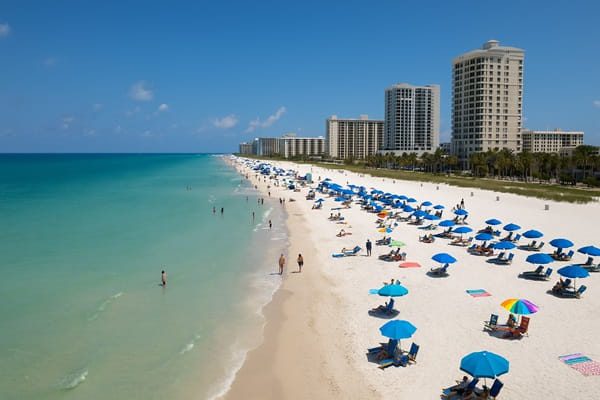
If tourism had a heavyweight division, Florida would still be holding the belt.
The Sunshine State has posted another eye-watering result, welcoming 143.3 million visitors in 2025, a fresh record that confirms what most travel professionals already suspected: Florida isn’t just back, it never really left.
The numbers, released by VISIT FLORIDA, include a particularly strong final quarter, with 33.5 million travellers arriving between October and December the state’s biggest fourth quarter ever.
For an industry that spent the early 2020s riding a rollercoaster, the takeaway is simple. Stability has become Florida’s strongest export.
Governor Ron DeSantis leaned into that narrative, positioning tourism success as the by-product of long-game planning rather than short-term luck.
“Florida continues to set the standard as the top travel destination in the nation, welcoming millions of visitors while delivering real economic benefits for our residents,” he said.
“Through strategic investments in infrastructure, public safety, and environmental stewardship, we are ensuring that Florida remains a place where families can vacation with confidence and where our tourism industry can continue to thrive.”
Political tone aside, the commercial reality is harder to argue with. Florida continues to do what mature destinations do best: deliver consistency.
The domestic engine keeps humming
The headline number looks global, but the muscle remains firmly domestic.
Of the 143.3 million visitors recorded last year, 131.1 million were Americans, roughly 91.5 per cent of the total. In other words, Florida still runs on its home crowd.
International markets are rebuilding rather than roaring, but there are signs of life in the right places. Overseas arrivals reached 9.3 million, with Canada contributing a steady 2.9 million, about where it typically lands.
Where things get interesting is further south. Latin America is once again punching above its weight, with Brazil and Argentina both delivering strong year-on-year growth. Brazil, in particular, has quietly become Florida’s second-largest international feeder market, a reminder that geography still matters in aviation maths.
Europe is also edging back into the frame, with the UK, France, Spain, Italy and the Netherlands all contributing to the rebound. Not dramatic growth, but steady and in travel, steady tends to stick.
Bryan Griffin, President and CEO of VISIT FLORIDA, framed the result as a collective effort rather than a marketing win.
“Florida tourism continues to lead the nation,” he said.
“Florida’s tourism success is a result of the people and businesses in our state who offer the world’s greatest vacation experiences, attractions, lodging, and dining options.”
It’s a familiar industry line, but it lands because it rings true. Florida’s tourism machine is broad, with theme parks, cruise ports, beaches, conventions, and diversity, as well as resilience.
A strong finish to the year
Fourth-quarter data adds useful texture to the story.
Domestic travellers made up just over 30 million of Q4 arrivals, while international visitors contributed about 3.2 million. The balance remains lopsided, but it’s been that way for decades.
Air traffic figures offer another clue to shifting traveller behaviour. Florida airports handled 27.4 million enplanements in the final quarter, up 2.8 per cent year-on-year.
Not explosive growth, but growth nonetheless.
More telling is how Americans are getting there. The air versus non-air split shows a subtle shift towards road travel, with nearly two-thirds of domestic visitors arriving by road.
That suggests a traveller who’s still willing to holiday, but increasingly mindful of value.
The quiet power of perceived value
And there it is, the word that keeps surfacing across global tourism briefings: value.
According to VISIT FLORIDA’s own marketing effectiveness research, travellers familiar with the state’s campaigns were 23 points more likely to describe Florida as offering good value compared with those who weren’t.
Perception, in travel, is currency.
When airfare volatility, exchange rates and cost-of-living pressures dominate decision-making, destinations that feel “worth it” tend to outperform those that simply look good on Instagram.
Secretary J. Alex Kelly from the Florida Department of Commerce linked the milestone to a broader economic strategy.
“As the #1 domestic travel destination, families and vacationers know that Florida has set the gold standard for the tourism industry,” he said.
“This new milestone is the direct result of strategic investments in our communities that promote job growth, bolster small businesses and fortify infrastructure.”
Why the trade should care
For Australian travel professionals, Florida’s numbers are more than trivia; they’re a temperature check.
Strong domestic travel in the US usually signals confidence across the wider leisure economy. When Americans travel in large numbers, airlines add capacity, cruise lines lean in, and long-haul flows tend to follow.
It also reinforces a quieter truth about tourism: legacy destinations rarely disappear. They bend, adapt, recalibrate and then keep going.
Florida has spent decades building infrastructure, brand equity and airlift. That kind of foundation doesn’t wobble easily.
Final visitation figures will firm up later in the year once the spreadsheets stop shifting. But barring a statistical plot twist, the direction is already clear.
Florida isn’t chasing recovery anymore.
It’s setting the pace.
by Michelle Warner – (c) 2026.
Read time: 5 minutes.
About the Writer.
 Michelle Warner has always carried stories the way others carry passports lightly, faithfully, and with purpose. She learned her craft in newsrooms, shaping sentences with care, before swapping deadlines for departures as a flight attendant with some of the world’s great airlines. Years aloft sharpened her eye for character and deepened her fondness for the small, dignified rituals of travel, the quiet kindness of strangers, the poetry of arrival, the patience learned between time zones.
Now grounded by choice, Michelle has come home to writing with the same calm authority she once brought to turbulent cabins. Her prose blends an editor’s discipline with a traveller’s wonder, tinged with humour and reverence for the golden age of travel. Each piece feels like a handwritten boarding pass, gracious, observant, and unmistakably alive.











