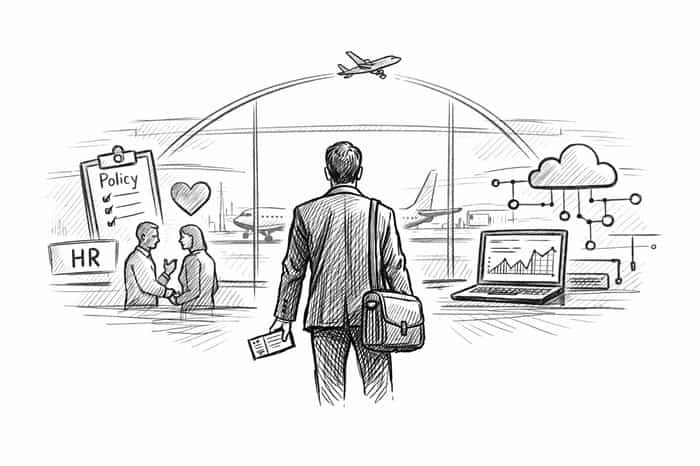
For decades, the internal geography of corporate life has been neatly divided: HR tends the people, IT minds the machinery, and finance keeps the ledger honest. But somewhere between the boarding pass and the expense claim, those tidy boundaries unravel. Business travel, as it turns out, is the organisational glue nobody quite owns, and that’s precisely the problem.
A new thought leadership release from SAP Concur argues the future of business travel depends on something far less glamorous than airport lounges or loyalty tiers: alignment. Specifically, the kind that happens when HR and IT stop working in parallel and start working in lockstep.
It’s a deceptively simple premise. Travel programs today touch almost every corner of the enterprise, including compliance, data governance, employee well-being, ESG reporting, and financial oversight. Yet many organisations still treat travel as a back-office workflow rather than a strategic lever.
Fabian Calle, managing director, small and medium business at SAP Concur Australia and New Zealand, doesn’t mince words.
“Alignment between people and technology leaders is a commercial necessity, not a cultural aspiration,” he said. “Travel touches almost every part of the organisation, and when HR, IT, and finance departments make decisions in isolation, the program cannot deliver the experience employees expect.”
That tension is familiar territory for travel managers and corporate bookers alike. The friction rarely appears in policy decks or PowerPoints. Instead, it emerges in the lived experience of the traveller, the sales executive stuck waiting on approvals, the consultant juggling clunky expense tools, the frequent flyer navigating systems that don’t speak to one another.
And when those cracks appear, they do so early.
“The employee experience is where the consequences of misalignment are often first felt,” Calle said. “Fragmented systems, slow approvals, and manual workarounds leave employees navigating policies that make sense in theory yet fall apart in practice.”
It’s not merely a usability gripe. Over time, that friction calcifies into something more corrosive: disengagement. Travel reluctance creeps in. Productivity dips. In extreme cases, employees simply opt out.
“No one wants to spend hours potentially fighting with procedures that don’t correlate across departments just to submit travel expenses or requests,” Calle added. “And no leader should want their team having to forfeit that time either.”
Travel as a cross-functional asset
At the heart of SAP Concur’s argument is a reframing exercise. Instead of treating travel as administrative overhead, organisations should recognise it as a cross-functional asset, with tentacles that stretch across culture, compliance and commercial performance.
It’s a subtle but significant shift. Once travel is viewed through that lens, the logic of collaboration becomes unavoidable.
Travel programs influence employee experience, tax reporting, data visibility and even sustainability outcomes. ESG frameworks increasingly require granular tracking of mobility emissions. Meanwhile, compliance obligations continue tightening across jurisdictions. In that environment, no single department holds all the answers.
“Collaboration does not necessarily require a reorganisation,” Calle said. “However, it does need leadership that takes a whole-of-business view of travel.”
The trick, he suggests, lies in timing. Too often, the right voices are invited after decisions are baked. By then, alignment becomes damage control rather than design.
Equally important is how change is communicated internally. Travel transformations succeed when employees understand the personal upside, faster reimbursements, fewer approval bottlenecks, and clearer guardrails.
In other words, practicality beats policy every time.
When priorities collide
Of course, the challenge isn’t philosophical. It’s operational. Each department brings its own incentives to the travel table, and they don’t always harmonise.
HR typically champions flexibility and wellbeing. IT focuses on security and system integrity. Finance, predictably, keeps a hawk eye on cost discipline.
Individually, those priorities make sense. Collectively, they can create a labyrinth.
The result? Travel policies that look tidy on paper but unravel in execution are a familiar lament in many corporate corridors.
“Most organisations want travel to feel seamless for employees while remaining cost-effective and compliant,” Calle said. “The problem arises when priorities are set independently.”
The solution, he argues, is less about compromise and more about clarity. One cohesive framework that reflects the needs of all stakeholders beats three competing rulebooks every time.
There are tangible benefits to that unity. Duty of care, for instance, becomes far more robust when HR visibility is matched with real-time technological capability. In a world shaped by geopolitical shocks, weather events, and airline volatility, that alignment is no longer a nice-to-have.
“When HR has real-time visibility into where employees are travelling, and IT works alongside this by providing the systems that support this visibility, organisations can respond faster should any disruption occur,” Calle said.
Integration over improvisation
If alignment is the philosophy, integration is the mechanics.
SAP Concur’s view is clear: fragmented platforms are the silent productivity killer of corporate travel. Every manual reconciliation, every duplicated data entry, every approval lost in digital limbo adds up.
An integrated platform, by contrast, creates flow. HR policy, IT governance and finance controls coexist in a single ecosystem. Data moves freely. Approvals accelerate. The traveller notices the difference immediately.
Personalisation also enters the frame. Travel preferences embedded within systems reduce friction on the road, while automated workflows lighten administrative load back home.
“When systems work together, it directly impacts the productivity, job satisfaction, and overall outcome of corporate travel,” Calle said. “Employees spend less time chasing approvals or reconciling expenses and more time focusing on the purpose of the trip.”
That purpose, after all, is why business travel exists. Deals are struck in meeting rooms, partnerships forged over dinners, trust built face-to-face, the intangible currency of commerce that no video call quite replicates.
The long view
What elevates the SAP Concur thesis beyond operational housekeeping is its long-term lens. Alignment today lays the groundwork for smarter decisions tomorrow.
Integrated data feeds better policy design. Compliance becomes proactive rather than reactive. Investment decisions grow more informed. Over time, the travel program evolves from a cost centre to a strategic asset.
And in a world where talent expectations are shifting rapidly, that evolution matters. Employees increasingly judge organisations not just on pay packets but on experience, including how seamlessly they can move through their working lives.
Corporate travel sits squarely in that equation.
“Corporate travel programs sit at the heart of how organisations support their people,” Calle said. “However, the benefit of these for the organisation depends on the collaboration, alignment, and integration of departments, and overall, the employee experience of the program.”
It’s a quietly radical idea: that the future of business travel won’t be defined by aircraft cabins or hotel categories, but by organisational chemistry.
In the end, perhaps the industry’s next transformation won’t happen at 35,000 feet but across the meeting table, where HR and IT finally decide to sit on the same side.