

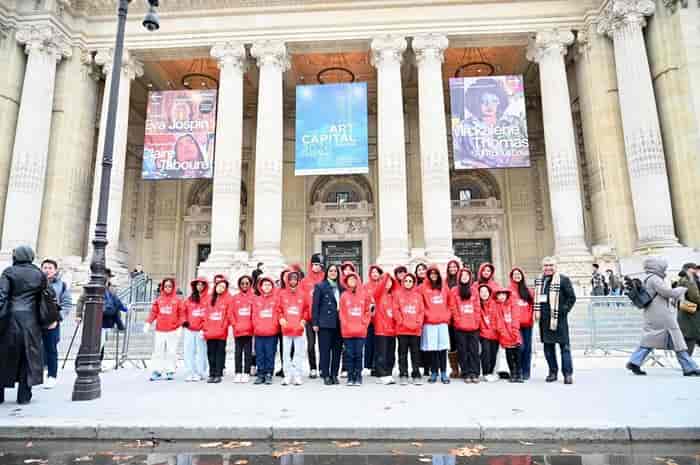
Paris doesn’t hand out respect lightly. It never has. For centuries, the city has made a habit of testing reputations under bright lights and even brighter scrutiny. So when a group of school-aged artists from Singapore quietly returned to the Grand Palais this year and didn’t just survive but belonged, you could almost hear a few Parisian eyebrows lifting.
Little Artists Art Studio is back at Art Capital 2026, and this time it wasn’t about novelty. It was about confirmation.
Twelve months ago, the studio made history when its students became the first children ever exhibited in the event’s 200-year lineage, even picking up the Prix d’Innovation. That alone would have been enough for most organisations to dine out on for a decade. But returning to the same stage a year later, confidently, calmly and without fanfare signals something far more meaningful: permanence.
And permanence, in Paris, is currency.
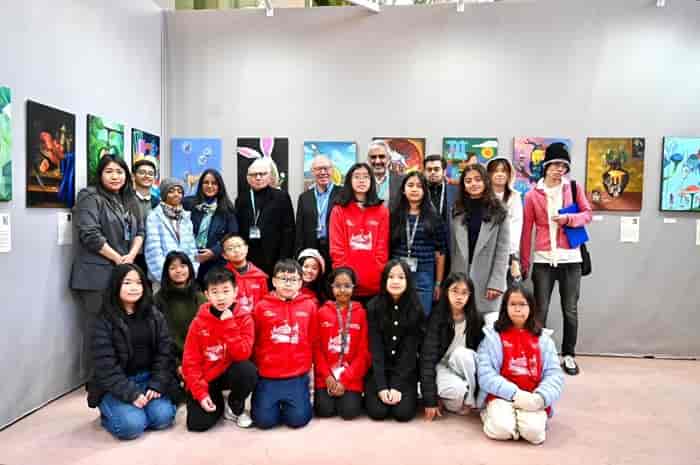
The Little Artists at Grand PalaisThe Little Artists with the Art Capital juryArt Capital Jury at Little Artists Exhibit
Held beneath the sweeping glass roof of the Grand Palais, Art Capital is no casual showcase. It’s a serious salon, anchored by the storied Société des Artistes Français and steeped in the lineage of the original Paris Salon dating back to the court of Louis XIV. More than 3,000 artists and over 150,000 visitors pass through its doors each year, including collectors who know their Monets from their marketing.
Which makes what Little Artists has achieved all the more remarkable.
This year’s presentation featured works displayed within the main salon framework, not tucked away as a curiosity, but positioned alongside seasoned practitioners. That decision alone speaks volumes. It says the conversation has shifted from “How charming” to “Let’s talk seriously”.
The works themselves spanned age groups and abilities, including neurodiverse and special-needs artists, yet what stood out wasn’t sentimentality. It was discipline. You saw confidence in brushwork, clarity in composition and, perhaps most tellingly, an absence of self-consciousness. These weren’t children trying to paint like adults. They were artists painting honestly.
Founder and director Shalini Kapoor captured the moment with characteristic humility.
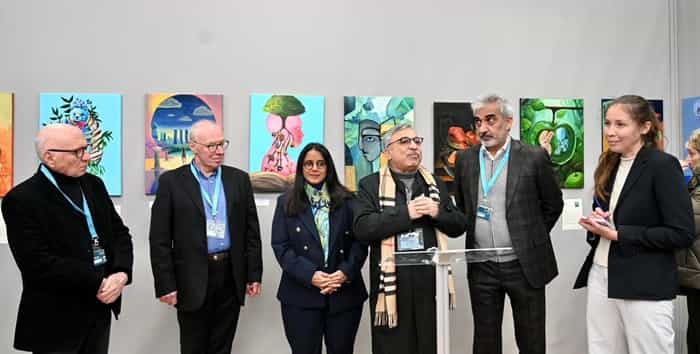
The Little Artists at Grand PalaisThe Little Artists with the Art Capital juryArt Capital Jury at Little Artists Exhibit
“To return to the Grand Palais following a historic debut is an exceptional achievement where students’ works are shown alongside mature and established artists, some whose works are also in museums. We are grateful to all the Jury who spent their time to consider our students to exhibit their work at Art Capital 2026,” she said.
There’s a quiet dignity in that kind of gratitude. It suggests an understanding that cultural milestones are rarely loud when they’re real.
Even the Paris establishment has taken notice. Bruno Madelaine, President of the Société des Artistes Français, previously admitted:
“We are not accustomed to seeing such young artists here. It is an exceptional event for us, and I am very proud of it.”
In a city where understatement doubles as approval, that’s practically a standing ovation.
What makes this story resonate beyond the art world is what it signals culturally. Singapore has spent decades building credibility as a financial and aviation powerhouse. Now, almost without theatrics, it’s cultivating something subtler, creative authority. And it’s doing it not through grand national pavilions or blockbuster sponsorships, but through classrooms and mentorship.
Little Artists, founded more than 30 years ago, has always leaned into fundamentals: rigour, process and patience. No shortcuts, no gimmicks. The payoff is evident in its alumni, many of whom have gone on to institutions such as RISD, Parsons, Central Saint Martins, and the Royal College of Art before carving out professional careers across continents.
That long arc matters. It turns what might otherwise be a charming headline into something closer to a movement.
For those of us watching the intersection of culture and travel, there’s another layer here. Events like Art Capital aren’t just art milestones; they’re global magnets. They draw curators, collectors, educators and culturally curious travellers who plan itineraries around moments of authenticity. When a Singapore studio commands attention in that arena, it quietly elevates the nation’s cultural cachet far beyond gallery walls.
And perhaps that’s the real takeaway from Paris this year.
The next generation isn’t waiting patiently for permission. They’re already showing up, hanging their work, answering questions from critics and doing what artists have always done, making sense of the world in colour and line.
Paris noticed. And when Paris notices, the world usually follows.
by Soo James – (c) 2026.
Read time: 3 minutes.
About the Writer.
 There’s nothing rehearsed about Soo James, and that’s precisely the point. Malaysian by heritage, Sydney by schooling, she arrived at UNSW to study Arts, then took a left turn into IT, not out of ambition, but curiosity. Somewhere among systems and schedules, she worked out what really held her attention: people, language, and the quiet spaces between them.
Writing followed naturally. Travel and lifestyle gave her room to observe, to listen, to notice the details others rush past. Soo writes the way good travellers move, watching the room before admiring the view, catching the gesture before chasing the headline.
At Global Travel Media, her stories don’t shout or sell. They linger. They slow you down, open a door, and gently suggest there’s more to see if you’re willing to look.











