


There’s a particular moment in travel when a destination stops trying to impress and simply starts being itself. Africa, if you listen carefully, has reached that moment.
The African Travel & Tourism Association’s latest 2026 outlook doesn’t shout. It doesn’t need to. Instead, it reads like a quiet recalibration of how the world is beginning to see the continent not as a checklist of safaris and sunsets, but as something slower, deeper and far more personal.
And the trade is noticing.

Kalandula Waterfalls – Credit Robert Haidinger, Copyright Angola Tourism Board @ Kleber Group
ATTA has paired its trends report with a full global events programme, Experience Africa returning to London, and Essence of Africa heading to Zanzibar, both built on curated meetings rather than the usual trade-show theatre. That alone says something about where things are heading. Conversations are replacing noise.
Demand, by the way, isn’t theoretical. The association’s pavilion at Indaba in Durban sold out in a single day. Fifty-six desks. Gone in 24 hours. You don’t get that kind of urgency unless buyers are sensing a shift.
Culture Moves to the Centre
For years, Africa’s cultural depth has been spoken about in the trade almost apologetically, as though it were an optional extra to the wildlife. That thinking is evaporating.
North Africa is stepping forward with quiet confidence. Cairo’s long-awaited Grand Egyptian Museum is finally becoming real rather than rumour, while Rabat’s turn as UNESCO World Book Capital in 2026 adds a scholarly polish to Morocco’s already layered appeal. These are no longer fly-in, fly-out stops. There are reasons to linger.
Further west, something more emotional is unfolding. Heritage travel, the deeply personal kind, continues to build momentum. Senegal, Sierra Leone, Benin and The Gambia are leaning into ancestry tourism with homecoming ceremonies and, in some cases, pathways to citizenship for diaspora travellers tracing their roots.
ATTA CEO Kgomotso Ramothea puts it neatly:
“The growing demand for deeper connection, learning and reflection… goes hand in hand with demand for expert-led journeys, cultural storytelling and heritage-rich itineraries.”
You can hear it in the phrasing. This isn’t mass tourism language. It’s about meaning.

Benguela Province, Praia Azul – Credit Robert Haidinger, Copyright Angola Tourism Board @ Kleber Group
Luxury Grows a Conscience
Luxury, too, is having a rethink and perhaps a necessary one.
The old formula of marble and martinis feels faintly out of step across much of Africa now. What’s emerging instead is something quieter: lodges built around conservation, experiences anchored in community, and a sense that travellers want to leave a place slightly better than they found it.
Namibia’s Nkasa Rupara National Park offers a telling snapshot. New properties are weaving guests directly into conservation work, turning a stay into participation rather than observation. It’s less about thread counts and more about the environmental, cultural, and emotional footprint.
Ramothea again:
“Storytelling, community engagement and sustainability credentials are becoming key differentiators for premium product.”
In other words, luxury is becoming less visible but more valuable.
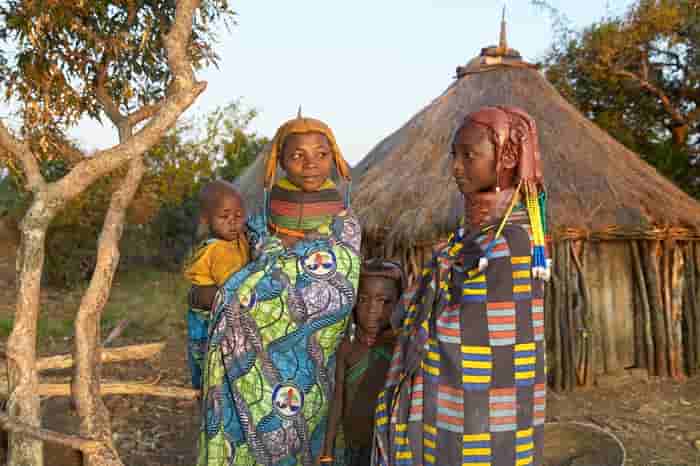
Muila tribe – Credit Robert Haidinger, Copyright Angola Tourism Board @ Kleber Group
Time Slows Down By Choice
If there’s a single thread running through ATTA’s outlook, it’s time. Or rather, the decision to spend more of it.
Slow travel isn’t new, but Africa is uniquely suited to it. Longer rail journeys, revived river cruising and improving air connectivity are quietly encouraging travellers to think beyond single-country itineraries.
Self-drive routes linking South Africa and Namibia are gaining traction. Moroccan rail journeys are turning into experiences in their own right. The Nile is evolving again, with new high-end operators entering the water, while the Congo River, long the stuff of explorers’ journals, is edging back onto itineraries with vessels designed for immersion rather than spectacle.
“There is an increased opportunity… for designing longer, more experiential itineraries,” Ramothea says.
Translation: Africa works best when you stop rushing it.
A Different Kind of Safari
Even the safari, that most iconic of African exports, is changing shape.

Namibe Province, Colinas do Canyons – Credit Robert Haidinger, Copyright Angola Tourism Board @ Kleber Group
The traditional model, where wildlife appeared almost on cue, is slowly giving way to a more reflective approach. Conservation-led travel, rewilding projects and low-impact experiences are shifting expectations, particularly among travellers who want context alongside sightings.
Across Rwanda, Uganda, Zambia, and Zimbabwe and increasingly in countries such as Madagascar and Angola, rewilding initiatives are expanding habitats and reintroducing species, often with local communities at the centre of the story.
It’s a subtle but meaningful shift. Less performance, more participation.
Ramothea describes it as a move towards experiences that go “beyond the classic safari model.”
And perhaps that’s the most telling phrase in the entire report.
New Names, Fresh Curiosity
Every year, a couple of destinations step out of the shadows. For 2026, two stand out.

Tundavala Gap – Credit Robert Haidinger, Copyright Angola Tourism Board @ Kleber Group
Algeria is one. Long overlooked, it’s quietly repositioning itself through infrastructure upgrades and visa reforms, with an eye on attracting 12 million visitors by 2030. For travellers willing to look beyond familiar North African circuits, the rewards are considerable: Roman ruins overlooking the Mediterranean, vast Saharan landscapes and cities that feel refreshingly unvarnished.
Then there’s Angola, which insiders are watching closely. A new airport near Luanda, improving air access, and broader visa-free entry are shifting perceptions. International hotel brands are arriving, but the real intrigue lies beyond the capital: waterfalls crashing through jungle, desert rock art and wildlife slowly returning to parks once written off.
“These two destinations provide travellers with exciting new adventures that few travellers have visited,” Ramothea says.
That sense of discovery matters. It always has.
Trade Energy Builds Quietly
Behind the scenes, ATTA is clearly leaning into momentum.
Experience Africa in London continues to draw qualified buyers in a tightly curated format, while Essence of Africa in Zanzibar signals a deliberate widening of the buyer pool. Add a steady programme of product webinars, and the association is doing more than reporting trends; it’s shaping the conversations around them.
Hosted places are limited, buyers are being nudged to apply early, and suppliers are turning up in force. It feels less like a cycle and more like a gathering tide.
Africa, Reframed
What emerges from all this isn’t hype. It’s a reframing.
Africa is no longer being sold purely on icons. It’s being understood through layers of culture, conservation, history, and community, the things that take time to appreciate and even longer to articulate.
For Australian agents and operators, the takeaway is simple enough. The continent’s appeal is widening, its product deepening, and its story becoming harder to summarise in a single brochure paragraph.
And perhaps that’s the point.
Africa isn’t whispering anymore. It’s speaking clearly, and travellers, finally, are taking the time to listen.
For those looking to engage more deeply with the association, ATTA membership details are available here: https://atta.travel/about/apply-to-become-a-member.html.
by Michelle Warner – (c) 2026.
Read Time: 6 minutes.
About the Writer.
 Michelle Warner has always carried stories the way others carry passports lightly, faithfully, and with purpose. She learned her craft in newsrooms, shaping sentences with care, before swapping deadlines for departures as a flight attendant with some of the world’s great airlines. Years aloft sharpened her eye for character and deepened her fondness for the small, dignified rituals of travel, the quiet kindness of strangers, the poetry of arrival, the patience learned between time zones.
Now grounded by choice, Michelle has come home to writing with the same calm authority she once brought to turbulent cabins. Her prose blends an editor’s discipline with a traveller’s wonder, tinged with humour and reverence for the golden age of travel. Each piece feels like a handwritten boarding pass, gracious, observant, and unmistakably alive.











