

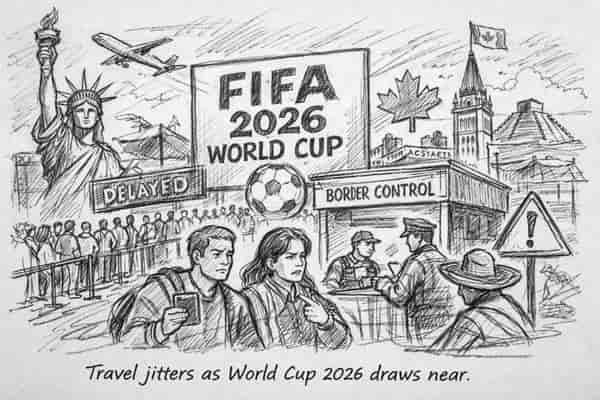
As the countdown to the FIFA World Cup 2026 gathers pace, a familiar tension is creeping into global travel conversations. Not the thrill of extra-time drama or penalty shoot-outs but the quieter, more practical concern of queues, congestion and border bottlenecks across the tournament’s three host nations: the United States, Canada and Mexico.
Fresh data from the Global Rescue Winter 2026 Traveller Sentiment and Safety Survey suggests international travellers are already weighing up whether the world’s biggest sporting event will complicate their journeys, whether or not they have the slightest intention of attending a match.
The good news first. The majority of travellers are not pressing the panic button. Around 34% of respondents say they are not avoiding travel to any of the host countries during the World Cup period, while a further 41% have no plans to travel to the US, Canada or Mexico regardless of the tournament. Only 12% remain undecided, suggesting that for most travellers, life and travel will go on much as usual.
But scratch beneath the surface and the picture becomes more nuanced, particularly for travellers arriving from outside the United States.
A Trans-Pacific Perspective Shift
Among non-US travellers, perceptions change markedly. A striking 45% say they are avoiding travel to the US during the World Cup, compared with just 2% of US-based travellers. Mexico also shows some spillover caution, with 13% of non-US respondents avoiding travel, compared with 6% of Americans.
Canada, by contrast, continues to enjoy its reputation as the calm cousin in the North American trio. Overall avoidance sits at a modest 4%, though non-US travellers are still more than three times as likely to avoid Canada as Americans (10% versus 3%).
In short, the further away travellers are from the host nations, the more wary they appear to be about what a mega-event might do to airports, borders and urban mobility.
Men, Women and Different Calculations
Gender also plays a subtle role in shaping travel sentiment. Men are slightly more likely than women to say they are not avoiding travel to any host country (35% versus 33%), while women are more likely to report having no plans to visit the host nations at all (47% compared with 40%).
Men show marginally higher avoidance of the US during the World Cup window (11% versus 9%), while women edge higher in avoiding Canada (5% versus 3%). These are not dramatic gaps, but they do underscore how perceptions of crowding and complexity can vary across traveller segments.
Congestion, Not the Game, Drives Anxiety

Dan Richards is standing in the operations room.
According to Global Rescue, the concern has less to do with football and more to do with friction.
“Mega-events like the World Cup create perceptions of congestion and complexity, even for travellers with no intention of attending matches,” said Dan Richards, CEO of The Global Rescue Companies and a member of the US Travel and Tourism Advisory Board at the US Department of Commerce.
“The data shows that while most travellers are not overly concerned, non-US travellers are far more sensitive to the potential impacts on entry, mobility and crowding.”
That sensitivity is most evident at the border.
Border Anxiety: Real but Contained
Concerns about enhanced screening, delays and entry restrictions remain relatively limited overall. More than half of respondents (54%) say they are not at all concerned about entering the US, Canada or Mexico during the World Cup period. Another 24% describe themselves as only slightly concerned.
Yet again, geography matters. While 56% of US travellers say they are not concerned, that figure drops to 45% among non-US travellers. Around 35% of non-US respondents describe themselves as moderately or very concerned, compared with 19% of Americans.
Men and women broadly align on concern levels, though women are more likely to describe themselves as slightly concerned, while men are marginally more likely to say they are very concerned.
The Biggest Surprise: Nobody’s Going to the Game
Perhaps the most telling finding is this: 84% of travellers say they are not planning to attend any World Cup matches at all. Only 4% plan to attend matches in a single host country, and no respondent intends to follow the tournament across multiple nations.
Among non-US travellers, disinterest is even higher: 92% rule out match attendance entirely, compared with 82% of US respondents.
“The World Cup’s impact extends well beyond ticket holders,” Richards noted. “Even travellers with no interest in the games are factoring the event into their decisions, particularly when it comes to border crossings and destination choice.”
What It Means for the Travel Industry
For airlines, hotels and destination managers, the message is clear and refreshingly old-fashioned. Communication, preparation and reassurance matter. Travellers don’t fear the event itself; they fear the hassle around it.
Handled well, World Cup 2026 could be a showcase for efficient borders and seamless travel. Mishandled, it risks becoming a case study in why travellers quietly choose somewhere else.
For more information, visit www.globalrescue.com.
by Michelle Warner – (c) 2026.
Read Time: 4 minutes.
About the Writer.
 Michelle Warner has always carried stories the way others carry passports lightly, faithfully, and with purpose. She learned her craft in newsrooms, shaping sentences with care, before swapping deadlines for departures as a flight attendant with some of the world’s great airlines. Years aloft sharpened her eye for character and deepened her fondness for the small, dignified rituals of travel, the quiet kindness of strangers, the poetry of arrival, the patience learned between time zones.
Now grounded by choice, Michelle has come home to writing with the same calm authority she once brought to turbulent cabins. Her prose blends an editor’s discipline with a traveller’s wonder, tinged with humour and reverence for the golden age of travel. Each piece feels like a handwritten boarding pass, gracious, observant, and unmistakably alive.











