

There was a time not terribly long ago when travellers chose destinations largely for sunshine, affordability and the promise of a decent meal that didn’t require a second mortgage. Healthcare seldom entered the conversation.
It does now.
Across Southeast Asia, private healthcare has matured quietly but convincingly, becoming a factor that seasoned travellers weigh with increasing care. Not because anyone plans to fall ill on holiday, that would show a regrettable lack of organisation, but because reassurance travels well.
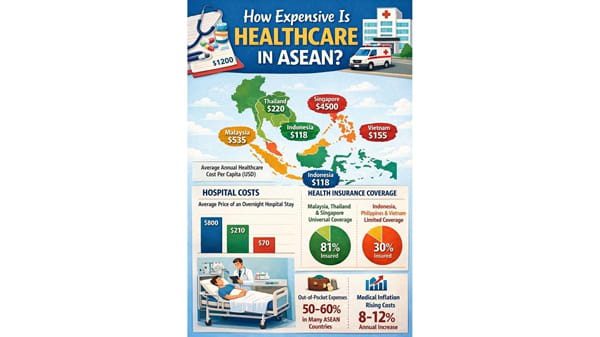
What surprises many visitors is not simply the quality available, but also the breadth of pricing options. The region offers a sliding scale of medical care, from gold-standard clinical environments to perfectly competent facilities charging a fraction of Western rates.
This analysis concerns routine private care, the sort most travellers pay for directly. Emergency treatment typically sits within the protective embrace of insurance paperwork, while medical tourism is another matter entirely: deliberate, researched, and usually scheduled with admirable precision.
It is the everyday encounters that matter most: a health check, a dental repair, an X-ray after an ill-judged step off a hotel curb.
Singapore: Impeccable and Priced Accordingly
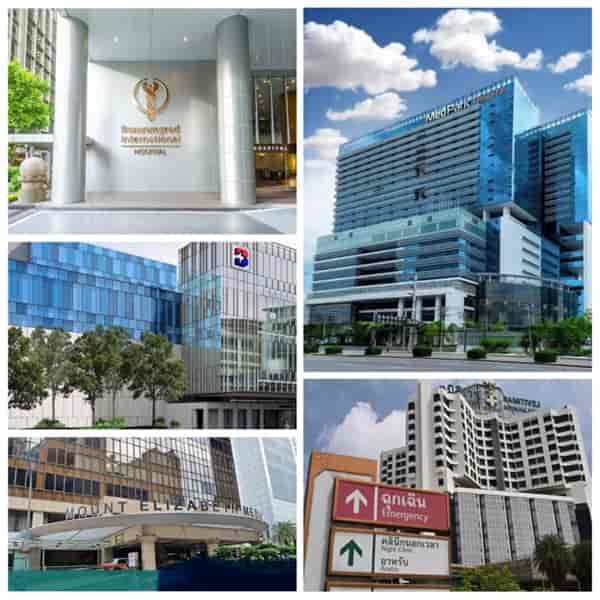
At the top of the regional ledger sits Singapore, where hospitals operate with the quiet efficiency of a well-rehearsed orchestra. Standards are exceptional, technology is cutting-edge, and waiting rooms are notably calm.
None of this is accidental, and none of it is especially cheap.
Singapore delivers certainty, a commodity some travellers are very happy to purchase, but few would mistake it for a bargain.
Thailand and Malaysia: The Comfortable Middle
Further north, Thailand and Malaysia occupy what might best be described as the sensible middle ground.
Both countries have invested heavily in modern facilities and internationally trained clinicians. The result is care that feels reassuringly first-world without the accompanying financial sting.
Thailand, in particular, has refined medical tourism into something approaching an art form. Hospitals often run with the polish of five-star hotels, and one occasionally suspects the administrative staff could organise a small royal wedding if given sufficient notice.
Preventive health screenings are popular, efficiently delivered, and priced to encourage repeat visits, a detail not lost on retirees who prefer their medical oversight to be predictable.
The Philippines and Indonesia: Capable but Uneven
The Philippines presents reasonable pricing, though travellers sometimes discover that insurance acceptance varies enough to make payment counters more familiar than expected.
Indonesia tells a similar story. In Jakarta and other major cities, care can be of high quality. Beyond them, however, geography begins to assert itself, and medical logistics may require patience, a virtue not universally abundant among the unwell.
Vietnam, Cambodia, Laos and Myanmar: Remarkably Affordable
At the lower end of the cost spectrum sit Vietnam, Cambodia, Laos and Myanmar, where routine diagnostics and dental services can cost less than a long weekend in a European capital.
Yet price, as every experienced traveller learns sooner or later, is only one measure of value.
Infrastructure and specialist depth are still evolving in parts of these markets. When treatment becomes complex, patients frequently seek care in neighbouring countries, turning regional mobility into an extension of healthcare strategy.
Indicative Cost Positioning for Routine Private Healthcare
| Service | High Cost | Mid Cost | Low Cost |
| Health check-up | Singapore | Malaysia / Thailand | Vietnam / Cambodia |
| Blood tests | Singapore | Philippines | Vietnam / Laos |
| X ray | Singapore | Thailand | Indonesia / Cambodia |
Why This Matters More Than Ever
Healthcare no longer lives in the footnotes of travel planning.
Retirees study it closely. Long-stay visitors factor it into their budgeting. Even younger travellers, outwardly carefree, show a growing preference for destinations where competent care is within comfortable reach.
What Southeast Asia offers, rather uniquely, is choice.
Travellers can calibrate their tolerance for cost against their appetite for clinical sophistication with surprising precision.
For destinations, this carries quite significance. Reliable healthcare is no longer merely supportive infrastructure; it has become part of the competitive appeal.
And for travellers?
Well, peace of mind may not appear on a boarding pass, but it remains one of the more valuable things you can carry.
Preferably unused.
by Andrew Wood and edited by Stephen Morton – (c) 2026.
Read Time: 4 minutes.
About the Writer.
 Andrew J. Wood has lived in Thailand since 1991. He is a former Director of Skål International and a Past President of Skål International Asia, Past President of Skål International Thailand, and a two-time Past President of Skål International Bangkok.
A former hotelier with senior management experience at leading hospitality groups including Shangri-La, Minor International, Landmark and Royal Cliff, he writes regularly for international travel and hospitality publications.
His work focuses on tourism trends across Asia, sustainable tourism development, and the future of travel and hospitality in the Asia-Pacific region.











