

There was a time not terribly long ago when the airport security ritual resembled a mildly choreographed theatre production: shoes off, laptops out, pockets emptied, documents nervously clutched as boarding passes to civilisation itself.
Now, the United States Transportation Security Administration is quietly rewriting that script.
Enter TSA PreCheck® Touchless ID, a biometric identity verification program designed to do something travellers have dreamed about since the first queue snaked around a terminal: make airport security almost effortless.
And yes, almost invisible.
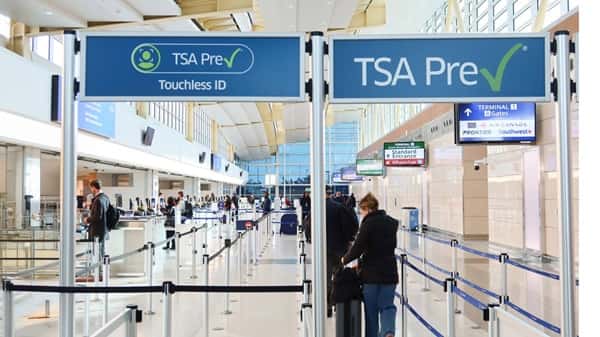
Smile for the camera, stroll through security effortlessly.
According to the January 2026 partner branding guide, the initiative “reflects TSA’s unwavering commitment to improving the travel experience for our vetted travellers.” It verifies identity without requiring a physical ID or boarding pass, signalling a decisive shift toward frictionless travel.
In plain English? Walk up, look at a camera, and continue on your way.
Civilisation marches on.
A Fast Lane That Actually Means Fast
The program promises verification in “10 seconds or less,” inviting travellers to literally walk up and walk through. For an industry where minutes often feel like hours, that is no minor claim.
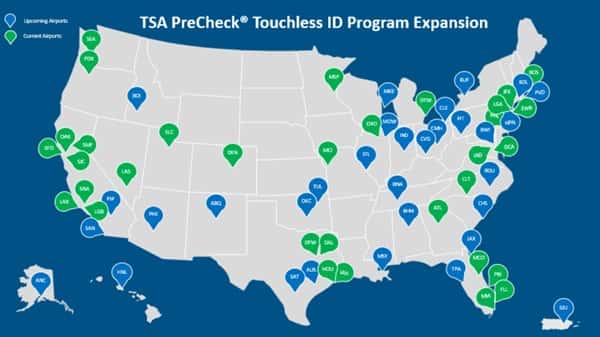
More than 14 million passengers have already opted in, and the network is expanding rapidly, growing from 15 airports to 65 in the coming months, with five participating airlines.
That sort of scale suggests this is no pilot project destined for a quiet retirement. Rather, it signals the maturation of biometric travel from novelty to operational backbone.
Airports, after all, have long been searching for the elusive balance between security and speed. Touchless ID may finally tilt that equation in favour of both.
How It Works Elegantly Simple, Firmly Secure
Participation is refreshingly straightforward.

Look here, traveller identity cleared in seconds.
Eligible travellers must:
-
Hold TSA PreCheck
-
Maintain a valid Known Traveller Number
-
Possess a valid passport
-
Link credentials via a participating airline rewards account
After scanning their passport and opting in, travellers simply check their mobile boarding pass for the Touchless ID indicator and proceed to a dedicated lane.
No fumbling for documents. No last-minute pocket archaeology.
Instead, biometric cameras confirm identity while advanced technology safeguards the process.
Importantly and reassuringly for privacy-minded passengers, photos and personal data are deleted within 24 hours of scheduled departure and are not shared or used for law enforcement or surveillance purposes.
In an age where data anxiety travels almost as frequently as passengers themselves, that reassurance matters.
Convenience Meets Common Sense
The program is positioned as:

No documents, no delays just glance and go.
-
Effortless — faster screening
-
Exclusive — available only to TSA PreCheck travellers flying participating airlines
-
Efficient — saving valuable time
-
Secure — enhancing identity verification
-
Private — with strict data deletion protocols
Or, as one might summarise over a departure lounge coffee: less queue, more cruise.
TSA describes it as “the latest and greatest tech available only to TSA PreCheck travelers,” while encouraging eligible passengers to enrol or renew to access the faster dedicated lanes.
For frequent flyers, particularly business travellers, measuring productivity in quarter-hours is self-evident.
The Indicator That Signals a New Era
Behind the scenes, even branding has been carefully engineered.

Families glide through security as biometrics take charge.
The Touchless ID boarding pass marker has a Homeland Security Blue pill-shaped graphic featuring a green digital ID icon that must not be altered, stretched, or recoloured. Consistency, it seems, is as critical in visual identity as in passenger identity.
Participating airlines are also required to execute licensing agreements and submit marketing materials for TSA approval, ensuring messaging remains compliant with privacy, security, and legal standards.
It is bureaucracy, yes, but the sensible variety that keeps aviation’s vast machinery running smoothly.
A Strategic Pivot Toward Seamless Travel
If the last decade belonged to mobile boarding passes, the next may well belong to biometrics.
Airports worldwide are experimenting with facial recognition, digital passports, and automated gates. Yet what makes Touchless ID noteworthy is not simply the technology, but the scale and institutional backing.
When a federal security authority embraces automation, the signal is unmistakable: this is infrastructure, not experimentation.
For observers in Australia and the Asia-Pacific, the implications are worth noting. Global aviation tends to move in patterns; what proves successful in the United States rarely stays there.
Today’s innovation often becomes tomorrow’s industry baseline.
The Experience Economy Comes to Security
Travel has evolved into what economists politely call an “experience economy.” Passengers expect journeys to be smooth, intuitive, and even pleasant.
Security queues have long been the stubborn exception.
Touchless ID nudges the industry closer to an airport journey that feels less procedural and more… humane.
There is something quietly revolutionary about technology that removes friction without drawing attention to itself. The best systems, after all, are the ones travellers barely notice.
Not the End of Security, Just the End of the Shuffle
Let us be clear: this is not security-lite.
Rather, it is security made smarter using biometrics to confirm identity with greater certainty while freeing travellers from repetitive manual checks.
In that sense, Touchless ID represents evolution rather than disruption.
The ritual remains.
Only the choreography improves.
Looking Ahead
With expansion accelerating and enrollment climbing into the tens of millions, TSA PreCheck Touchless ID appears poised to become a defining feature of modern airport infrastructure.
The agency is also encouraging travellers to visit, 👉 https://www.tsa.gov/touchless-id, to review participating airlines and locations.
Seasoned travellers know progress in aviation often arrives incrementally, a smarter scanner here, a faster lane there, until one day the journey feels entirely different.
Touchless ID may well be one of those moments.
Because when travellers can move from kerb to gate with little more than a glance, the airport ceases to be an obstacle.
It becomes, once again, a gateway.
And frankly, that is how travel has always been meant to feel.
by Jason Smith – (c) 2026.
Read Time: 4 minutes.
About the Writer.
 Jason Smith was educated in terminals, taxis and hotel corridors, the sort of schooling no classroom could hope to provide. Half American, half Asian, he grew up inside the quiet machinery of tourism, watching his family send strangers into the world long before he travelled himself.
Bangkok came first, then the Asian Institute of Hospitality & Management, followed by a career stitched together across Singapore, Malaysia and Vietnam. Each city left a mark. Thailand eventually claimed him, along with a corner office, as Director of Sales for one of the country’s leading hotel groups.
Then the world paused. Borders closed, skies emptied, and Jason returned to America carrying time, memory and a lifetime of stories.
Now at Global Travel Media, he writes the human side of travel check-ins, departures and everything between with warmth, clarity and an instinct for connection.











