

By any sensible measure, the global tourism industry has rediscovered its swagger. And if proof were required, it arrived this week in Madrid, nine exhibition halls wide, 10,000 companies strong and backed by a roll-call of 161 nations keen to remind the world that travel, once grounded, is again airborne.
From 21 to 25 January 2026, IFEMA MADRID will host the 46th edition of the International Tourism Fair, better known as FITUR, an event that now wears its crown with increasing confidence as the world’s leading tourism marketplace.
This year’s figures are not just healthy; they are positively strutting. FITUR 2026 will bring together 967 main exhibitors, welcome official delegations from 111 countries, up 10 per cent on last year, and record an 11 per cent surge in international participation. For an industry that only recently emerged blinking from lockdowns and balance-sheet bruises, it is a comeback worthy of applause.
And Madrid, once again, finds itself the axis around which global tourism politely spins.
A world on the move again
The revival is not anecdotal. According to UN Tourism, more than 1.1 billion international travellers crossed borders between January and September 2025, comfortably surpassing the pre-pandemic record year of 2019. The message is blunt: the world is travelling again enthusiastically, expensively and in ever more inventive ways.
FITUR’s own geography tells the story. Eighteen new nations will make their debut, with Africa and the Asia–Pacific leading the charge. Participation from Africa has jumped 34 per cent, while Asia–Pacific is up 22 per cent, figures that reflect both pent-up ambition and a rediscovered appetite for long-haul horizons.
Among the notable newcomers are Abu Dhabi, Dubai and Zanzibar, joined by fresh regional representation from Germany and the United Kingdom. It reads more like an itinerary than a trade fair guest list.
Knowledge, not just kilometres
Yet FITUR’s ambition now stretches beyond square metres and stand counts. In a nod to the industry’s growing appetite for intelligence over indulgence, the fair has doubled down on content, insight and strategic debate.
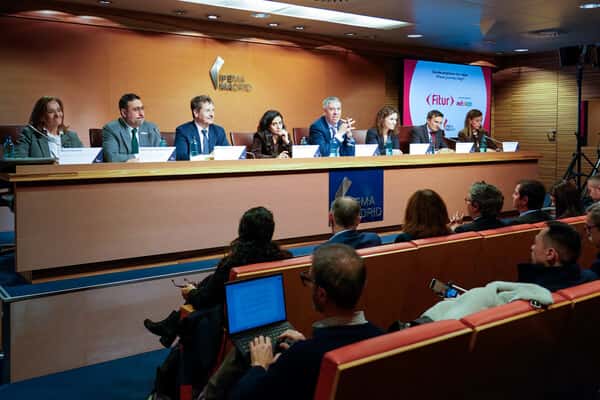
Caption: From left to right: María Valcarce, Director of FITUR; Miguel Aguiñiga Rodríguez, Mexico’s Secretariat of Tourism; Mariano de Paco, Community of Madrid; Sheika Alnuwais, Secretary‑General of UN Tourism; José Vicente de los Mozos, Chairman ofIFEMA MADRID; Rosario Sánchez ,Ministry of Industry and Tourism; Marco Sansavini, Chair of the FITUR OC and President of Iberia; and Almudena Maíllo, Madrid City Council
The flagship innovation is the new Knowledge Hub in Hall 12, a purpose-built nerve centre for the business of travel. Eight auditoriums, ten conference programmes, more than 200 sessions and upwards of 250 senior speakers will turn the hall into something closer to a think tank than an exhibition.
Here, FITUR Experience will explore experiential tourism, the sector’s fastest-growing and most disruptive child, while the inaugural International Summit on Communication and Tourism will dissect how destinations now sell stories in an era of algorithms, influencers and reputational fragility.
Meanwhile, the Travel Technology Area, now twice its previous size, will host more than 190 innovation companies, offering a glimpse into a future where bookings are frictionless, data is sovereign and artificial intelligence quietly runs the back office.
In short, FITUR has decided that the business of tourism is no longer just about where we go but how we think.
Madrid’s economic dividend
Big fairs bring big cheques. Last year, FITUR injected €487 million into the Madrid economy, a figure that would gladden any treasurer’s heart. This year’s forecasts suggest more than 150,000 professionals will pass through the turnstiles, alongside close to 100,000 public visitors over the weekend.
Hotels, restaurants, taxis and theatres will all enjoy the familiar FITUR bounce. For Madrid, the fair is not merely an event; it is an annual stimulus package with lanyards.
Mexico steps into the spotlight
Every fair needs a leading actor, and in 2026, the role belongs to Mexico, named Partner Country for the edition.
The timing is deliberate. Mexico’s tourism sector grew by 13.9 per cent between January and September 2025, according to SECTUR, and the nation is now determined to secure its place as the world’s fifth most visited destination.
At FITUR, Mexico will mount a prominent presence, part diplomacy, part destination marketing, part strategic statement. Expect colour, culture and a quiet confidence that Latin America’s tourism heavyweight has very much arrived.
Sustainability, access and the open weekend
Beyond the banners and business cards, FITUR 2026 is keen to demonstrate civic virtue. A new fast-track professional entrance will ease congestion at the South East access, while Metro Line 8 will run enhanced services in a gentle nudge toward public transport.
Across 11 specialised sections, the fair will tackle sustainability, accessibility, and cross-sector collaboration themes that are no longer fashionable add-ons but operational necessities.
And when the professionals pack away their laptops, the public will take over. The weekend programme promises workshops, experiences and hands-on encounters designed to remind travellers why the industry exists in the first place: to inspire, delight and occasionally seduce us into booking something reckless.
A fair that mirrors its industry
FITUR 2026 arrives as both a mirror and a milestone. It reflects an industry restored to health, newly ambitious and unashamedly global. It also marks a pivot from volume to value, from booths to brains, from destinations to data.
For Madrid, it is five days at the centre of the tourism universe. For the industry, it is a reassurance that the long recovery is over and the next growth cycle has already begun.
As trade fairs go, FITUR has become less of a marketplace and more of a parliament. And in an industry that thrives on movement, ideas may now be travelling faster than tourists.
More information and the full programme are available at: https://www.ifema.es/en/fitur, Programme schedule:
https://www.ifema.es/en/fitur/activities-schedule.
by Prae Lee – (c) 2026.
Read Time: 4 minutes.
About the Writer.
 You can tell a lot about a person by how they handle a busy Bangkok morning. Prae Lee doesn’t rush; she glides through it. There’s a calm certainty about her, the sort that comes from knowing where you come from and where you’re going.
Educated at Chulalongkorn University, she took her business degree with the quiet pride of someone who believes in doing things correctly. Her travels for further study in Singapore and Australia didn’t change her; they polished what was already there: curiosity, discipline, and grace.
She returned to her family business in Bangkok, breathing a little modern life into it. She handled social media with the intuition of someone who listens and sells with the gentle persistence that the Thais do so well.
Prae doesn’t make a fuss, but everything she touches shines brighter.
Now part of the Global Travel Media family, Prae brings authenticity and quiet confidence to her writing, drawing from a life steeped in culture, travel, and connection.










